Random number generators
a generator and random number technology, applied in the field of random number generators, can solve the problems of limiting constraints, re-keying after a crash is non-productive overhead for a system, and restricting the choice of parameters, so as to achieve the effect of quick re-keying
- Summary
- Abstract
- Description
- Claims
- Application Information
AI Technical Summary
Benefits of technology
Problems solved by technology
Method used
Image

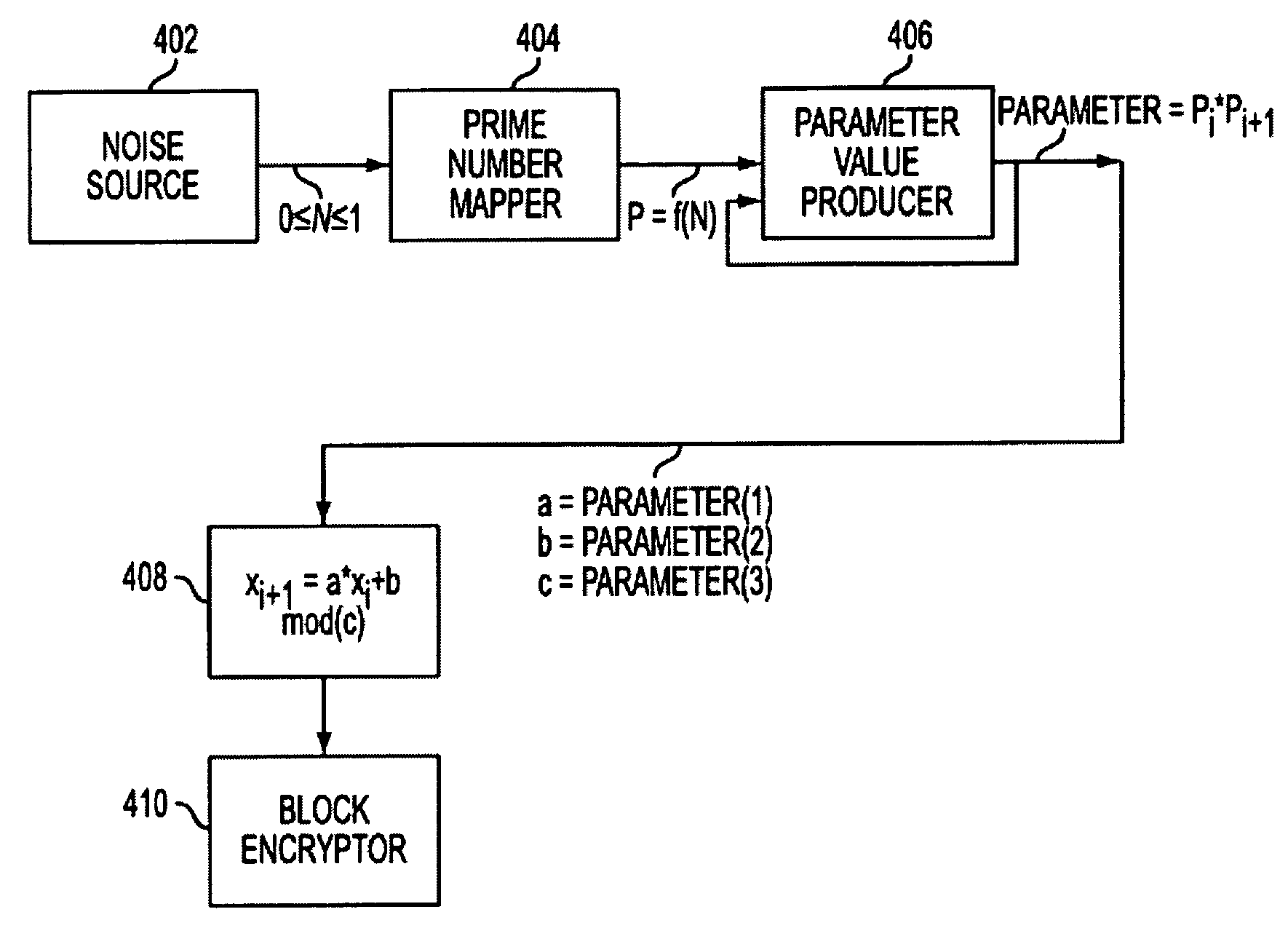

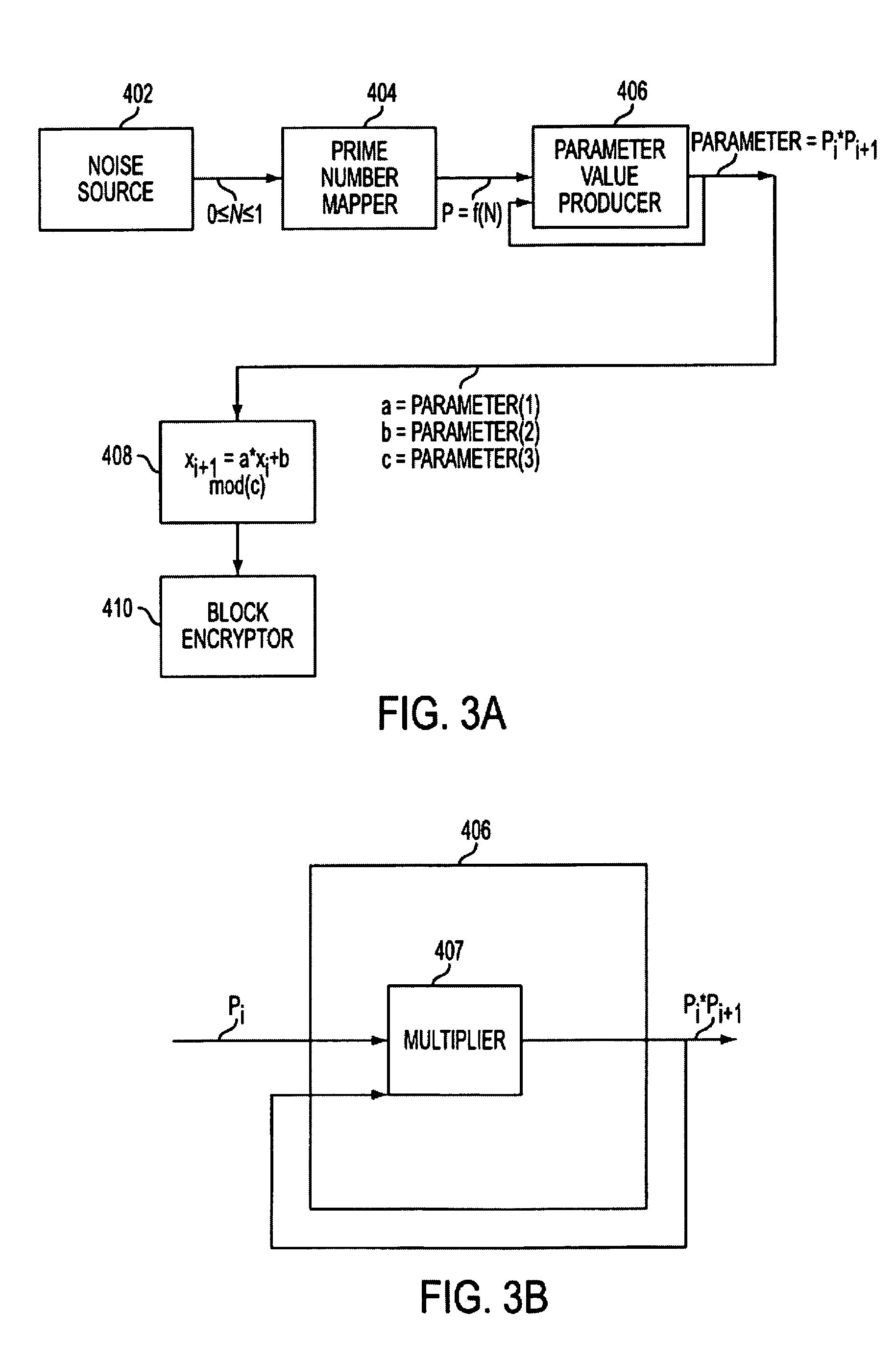
Examples
second embodiment
[0037]FIG. 3C shows a system according to the invention with a parameter value producer 412 which produces a parameter value by raising a prime number Pi from the prime number mapper to a power, for example the Kth power, to produce PiK and multiplying the resultant value by another number Pi+1 generated by the prime number mapper.
[0038]FIG. 3D provides a more detailed view of one embodiment of the parameter value producer 412. Multiplier 414 receives input from the prime number mapper and may receive input from power generator 415. The power generator receives a prime number Pi from the prime number mapper and a random number N based on the noise source 402, such that 0≦N≦1. The power generator then generates an exponent K, based on N, to be used with Pi to produce PiK. PiK is then fed into multiplier 414, which receives another prime number Pi+1, from the prime number mapper and produces PiK*Pi+1. This embodiment of the parameter value producer may also produce parameter values ba...
third embodiment
[0039]FIG. 3E shows a system according to the invention with a parameter value producer 420 which produces the parameter value by raising a prime number Pi from the prime number mapper to a power, for example the Kth power, PiK and multiplying the resultant value by another number Pi+1 raised to the Lth power.
[0040]FIG. 3F provides a more detailed view of one embodiment of the parameter value producer 420. The power generator receives a prime number Pi from the prime number mapper and a random number N based on the noise source 402, such that 0≦N≦1. The power generator then generates an exponent K, based on N, to be used with Pi to produce PiK. A next prime number Pi+1 arrives from the prime number mapper and is fed into the power generator. A second random number, based on the noise source, in a range from 0 to 1 arrives as input to the power generator, which generates an exponent L, based on the newly arrived random number and produces (Pi+1)L. Multiplier 421 multiplies PiK*(Pi+1)...
PUM
 Login to View More
 Abstract
Description
Claims
Application Information
 Login to View More
 - R&D
- Intellectual Property
- Life Sciences
- Materials
- Tech Scout
- Unparalleled Data Quality
- Higher Quality Content
- 60% Fewer Hallucinations
Browse by: Latest US Patents, China's latest patents, Technical Efficacy Thesaurus, Application Domain, Technology Topic, Popular Technical Reports.
© 2025 PatSnap. All rights reserved.Legal|Privacy policy|Modern Slavery Act Transparency Statement|Sitemap|About US| Contact US: help@patsnap.com