
Highly dense nano-carbon foam with controlled porosity synthesized from hollow carbon nanoparticles
a nano-carbon foam and controlled porosity technology, which is applied in the field of high-density nano-carbon foam with controlled porosity synthesized from hollow carbon nanoparticles, can solve the problems of affecting the performance of nano-carbon foam, time-consuming and costly, and chemical process methods that are not suitable for commercial-scale production of nano-carbon foams, so as to reduce or eliminate conductive additives and binders, reduce the amount of total energy storage, and the effect of reducing
- Summary
- Abstract
- Description
- Claims
- Application Information
AI Technical Summary
Benefits of technology
Problems solved by technology
Method used
Image

Examples
Embodiment Construction
[0017]A description of example embodiments of the invention follows.
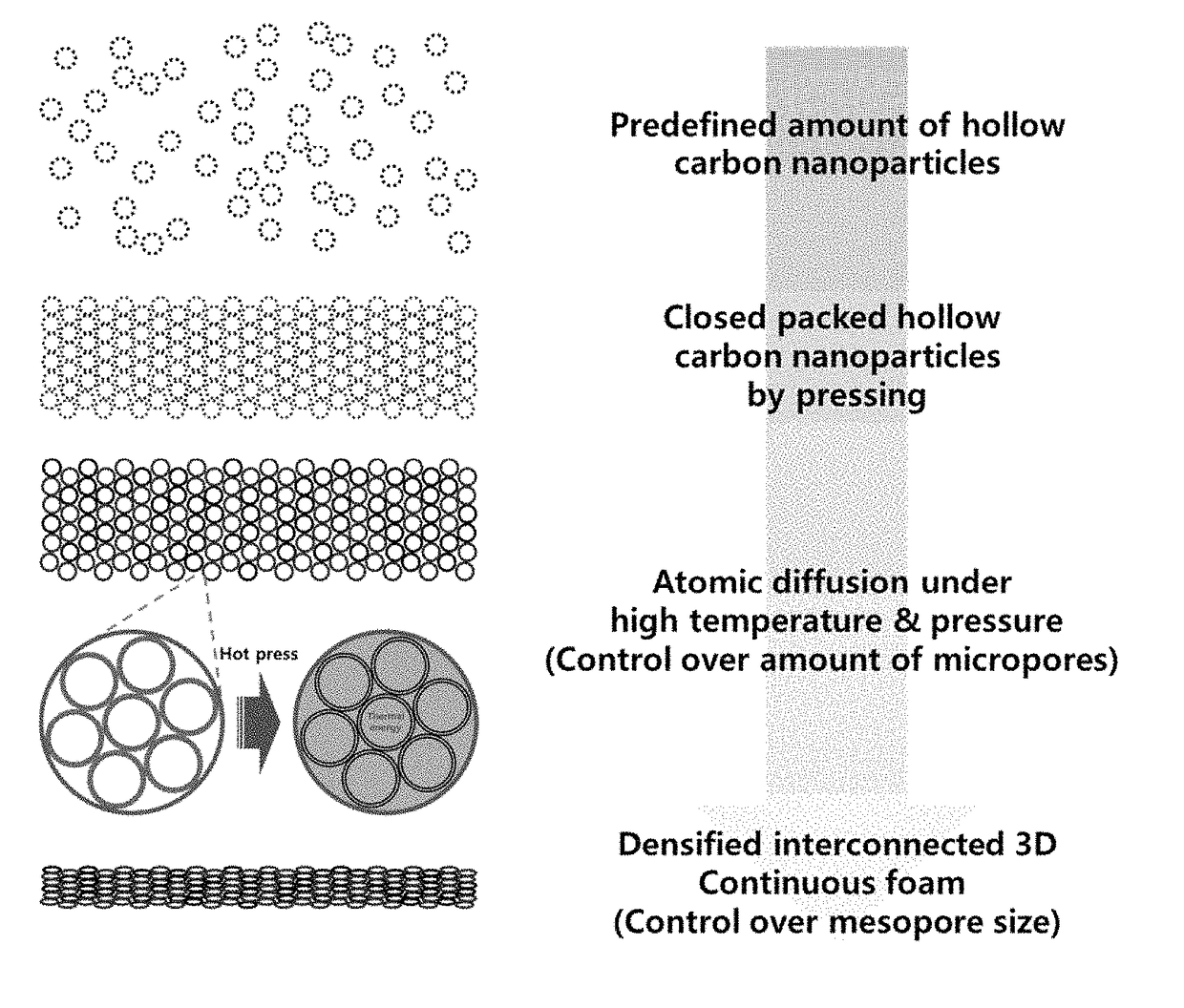
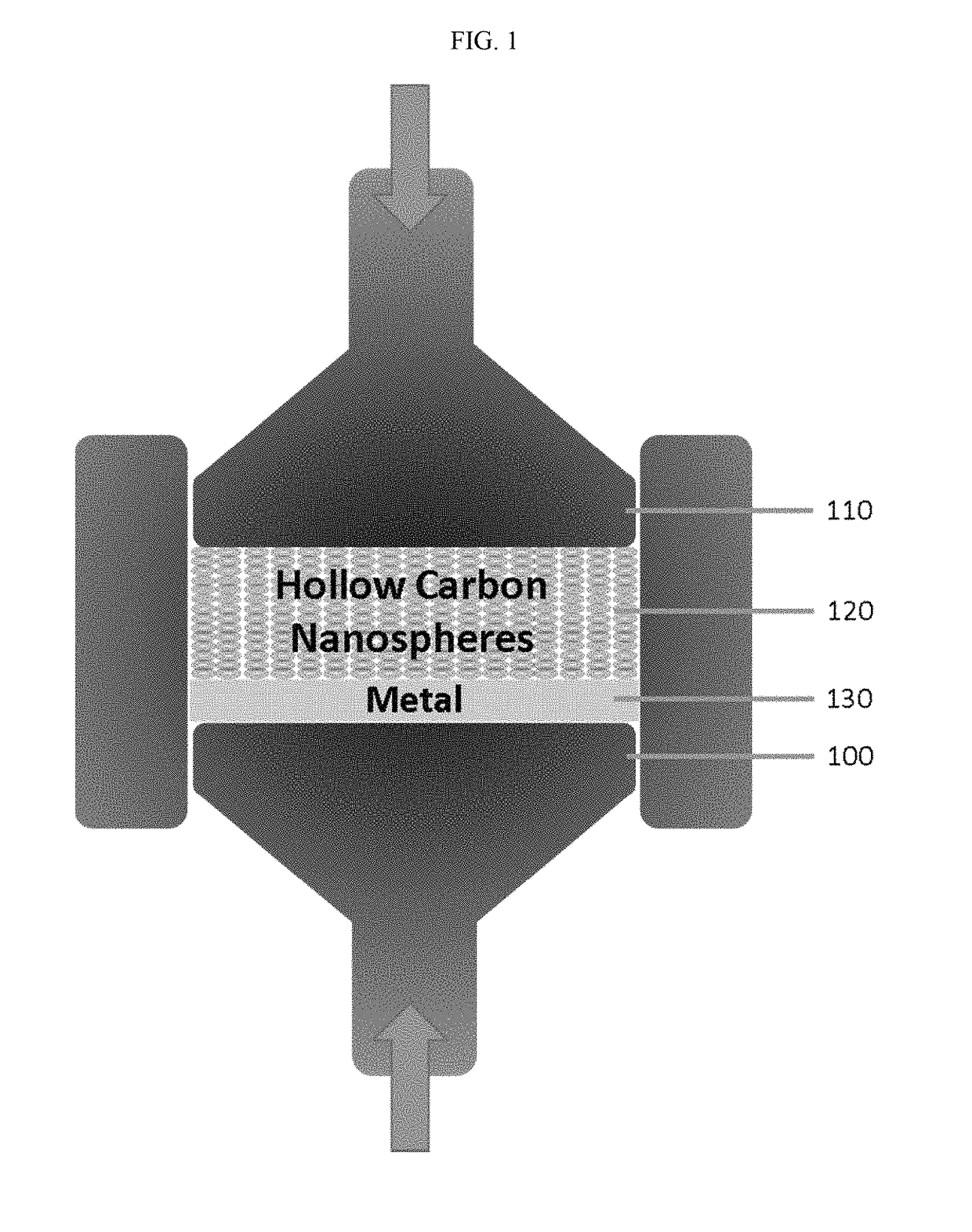
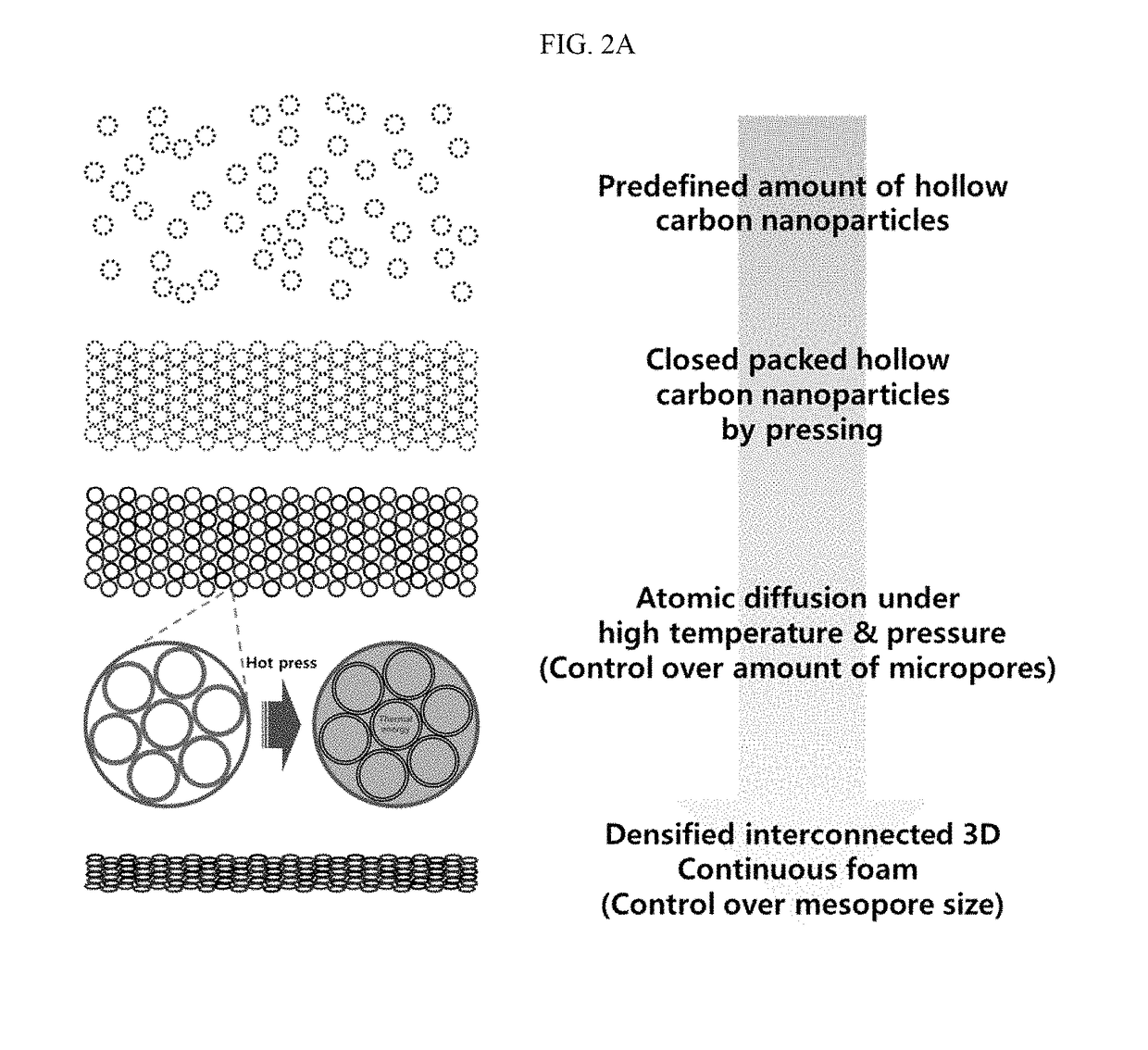
[0018]Hot pressing refers to the application of an elevated pressure and temperature. As used herein, hollow carbon nanoparticles can be hot pressed in order to cause it to adopt an ordered structure. FIG. 1 is an illustration of an apparatus for hot pressing. The apparatus has a lower surface 100 and an upper surface 110. Either the lower surface 100 or the upper surface 110 is adapted to exert mechanical pressure toward the other. Affixed to the lower surface 100 is an optional metal structure 130, which can reduce undesirable contamination or reaction. In some instances, the lower surface 100 and optional metal structure 130 can be the same. As illustrated, hollow carbon nanoparticles 120 are disposed between the upper surface 110 and metal substrate 130, or between the upper surface 110 and the lower surface 100.
[0019]Typically, the pressure is applied along a single axis, which is perpendicular to the surface o...
PUM
| Property | Measurement | Unit |
|---|---|---|
| pressure | aaaaa | aaaaa |
| pressure | aaaaa | aaaaa |
| temperature | aaaaa | aaaaa |
Abstract
Description
Claims
Application Information
 Login to View More