
Benzothiazole derivative with optical spectrum signal amplification performance and preparation and application thereof
A benzothiazole and signal amplification technology, which is applied in luminescent materials, organic chemistry, chemical instruments and methods, etc., can solve problems such as small absorption coefficient, and achieve the effect of large molar absorption coefficient and high fluorescence quantum yield.
Patent Information
- Authority / Receiving Office
- CN · China
- Patent Type
- Applications(China)
- Current Assignee / Owner
- Publication Date
- 2017-05-31
- Estimated Expiration
- Not applicable · inactive patent
Smart Images
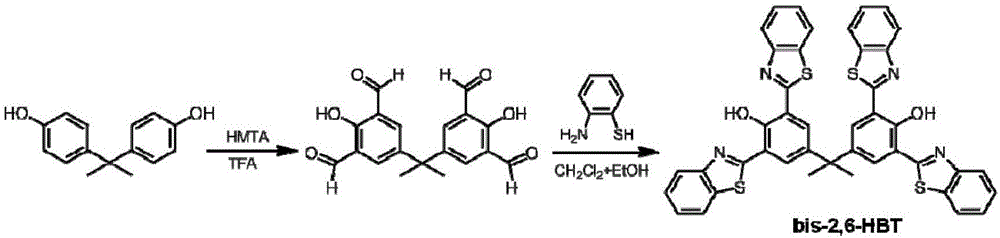
Figure 1 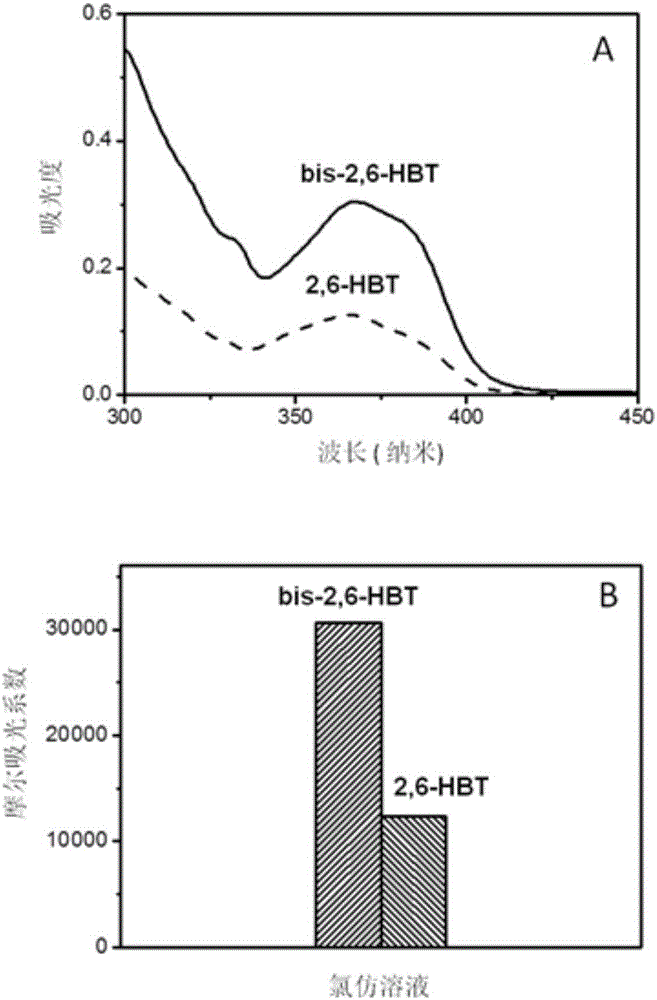
Figure 2 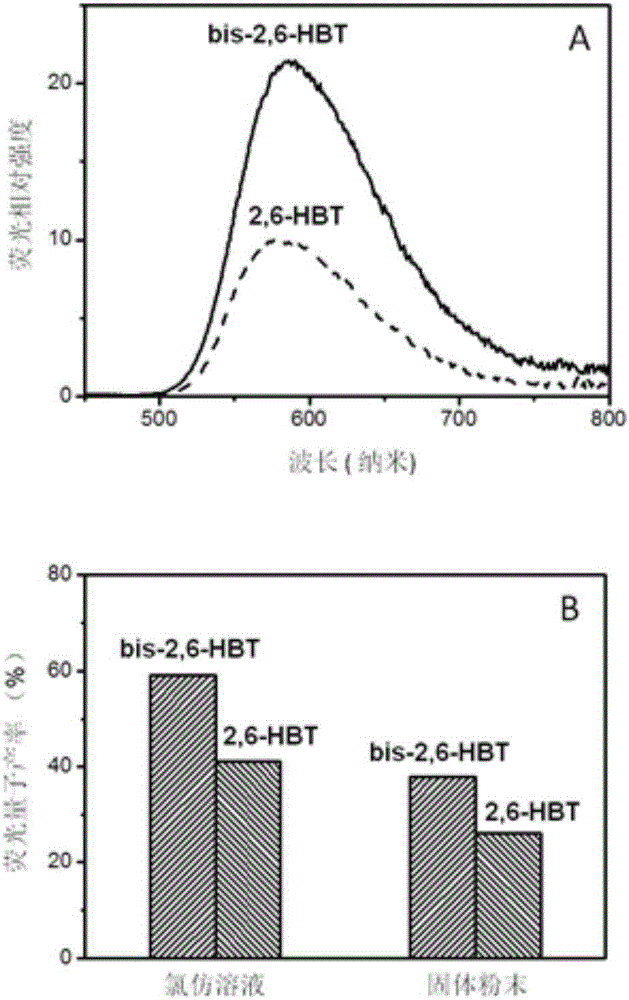
Figure 3
Abstract
Description
technical field
[0001] The invention belongs to the field of spectral signal amplification material and its preparation and application, in particular to a benzothiazole derivative with spectral signal amplification performance and its preparation and application. Background technique
[0002] In recent years, functional organic dyes have attracted much attention due to their important application prospects in light-harvesting antenna molecules, photosensitive devices, and luminescent materials. In the process of artificially simulating photosynthesis to convert solar energy, it is first necessary to harvest light by organic dye antenna molecules that can absorb and gather light energy. In new organic electronic devices represented by organic light-emitting diodes (OLEDs), organic fluorescent dyes that emit light with high efficiency is the key material. Therefore, designing and synthesizing organic dye molecules with high efficiency of light absorption and light emission i...
Examples
Embodiment 1
[0024] Synthesis of benzothiazole derivatives. The synthetic route of bis-2,6-HBT is as follows figure 1 shown.
[0025] (1) Under nitrogen protection, after bisphenol A (4.5g) and hexamethylenetetramine (18g) were refluxed for 72h in 30ml trifluoroacetic acid and under the condition of 105-115°C, 90ml of hydrochloric acid solution was added ( 2M), continue to react for 1h, and cool to room temperature. The solid crude product was obtained by filtration and further purified by column chromatography with dichloromethane as the eluent. The solvent was removed by rotary evaporation to obtain 4.0 g of solid product with a yield of 59%.
[0026] 1 H NMR (400MHz, DMSO), δ (ppm): 11.52 (s, 2H), 10.22 (s, 4H), 7.94 (s, 4H), 1.72 (s, 6H); 13 C NMR (100MHz, DMSO), δ (ppm): 30.37, 41.99, 123.67, 135.50, 141.51, 159.34, 160.99, 192.90.
[0027] (2) Under nitrogen protection, the product obtained in step (1) bisphenol A tetraaldehyde (0.3g) and 2-aminothiophenol (0.6g) were dissolve...
Embodiment 2
[0030] Measurement and comparison of spectral signal parameters.
[0031] The benzothiazole derivative bis-2,6-HTB obtained in Example 1 and the comparative compound 2,6-HBT were respectively dissolved in chloroform to prepare a 10 μM / l solution. Pipette the above-mentioned chloroform solution of 3ml and be placed in quartz cuvette, test absorption spectrum on PerkinElmerLambda 35 spectrometer, calculate molar absorptivity according to absorbance ( figure 2 ). Pipette 3ml of the above-mentioned chloroform solution and place it in a fluorescence cuvette, and test the fluorescence spectrum on an Edinburgh FS5 spectrometer ( image 3 A). The fluorescence quantum yields of chloroform solution and solid powder samples are obtained by direct measurement of the absolute value using the integrating sphere accessory configured by Edinburgh FS5, and the results are compared as image 3 Shown in B. It can be seen from the test results that the spectrum of the benzothiazole derivativ...