
A method for harmless co-processing of heavy metal sludge and organic silicon waste
A heavy metal sludge and co-processing technology, which is applied in sludge treatment, chemical instruments and methods, fixed/solidified sludge treatment, etc., can solve the problems of difficulty in recycling organic silicon waste and high cost of high-temperature solidification of heavy metal sludge. To achieve the effect of reducing operating costs
Patent Information
- Authority / Receiving Office
- CN · China
- Patent Type
- Patents(China)
- Current Assignee / Owner
- Publication Date
- 2021-09-03
Smart Images
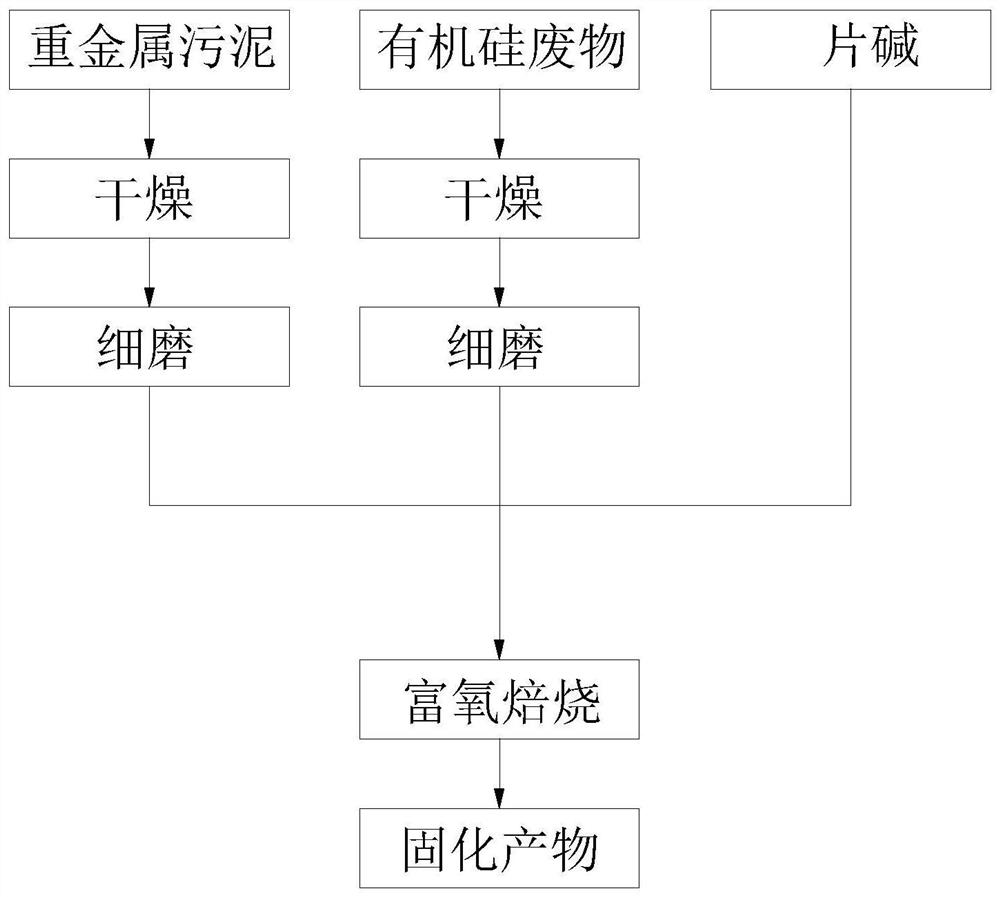
Figure 1
Abstract
Description
technical field
[0001] The invention relates to the field of harmless co-processing of heavy metal waste and organic waste, in particular to a method for harmless co-processing of heavy metal sludge and organic silicon waste. Background technique
[0002] With the development of industry, a large amount of wastewater containing heavy metals is continuously produced, and a large amount of heavy metal sludge is produced after wastewater treatment. Heavy metal sludge is hazardous waste because it contains heavy metal ions such as Zn, Cu, Ni, and Cr. If it is not treated, it will easily cause serious pollution to the environment. At present, the process of harmless disposal of heavy metal sludge mainly includes chemical stabilization, cement kiln co-processing and high temperature solidification. The destination of heavy metal sludge after chemical stabilization is usually hazardous waste landfill, but the volume of hazardous waste landfill is limited and cannot be continuously...
Examples
Embodiment 1
[0027] In this embodiment, zinc-containing sludge is treated as the treatment object, and waste disposal is performed by high-temperature solidification with organic silicon waste. like figure 1 As shown, the specific method is as follows:
[0028] Select zinc-containing sludge and pyrolysis residue for drying, so that the moisture content of zinc-containing sludge and pyrolysis residue is reduced from 70% and 50% to below 10% respectively; caustic soda does not need to be dried because its moisture content is lower than 5%. The zinc-containing sludge with a particle size of less than 0.55mm after grinding, the pyrolysis residue and caustic soda are uniformly mixed at a dry basis mass percentage of 45:40:15 to obtain a mixture.
[0029] One part of the mixed material is cured at a temperature of 1350° C., the curing time is 3.5 hours respectively, and the high temperature curing atmosphere is oxygen-enriched, and the oxygen concentration is 25%. After high temperature solidi...
Embodiment 2
[0035] In this example, copper-containing sludge is used as the treatment object, and waste disposal is carried out by solidifying with organic silicon waste at high temperature. The specific method is as follows:
[0036] Select copper-containing sludge and pyrolysis residue for drying, so that the moisture content of copper-containing sludge and pyrolysis residue is reduced from 75% and 50% to below 10% respectively; caustic soda does not need to be dried because its moisture content is lower than 5%. The copper-containing sludge with a particle size of less than 0.55 mm after grinding, the cracking residue and caustic soda are mixed uniformly at a dry basis mass percentage of 50:40:10. The mixed materials were respectively melted at a temperature of 1400° C., the melting time was 3 hours, and the oxygen concentration was 25%. After high-temperature solidification, it is rapidly cooled by water quenching to form silicon-based glass material B.
[0037] The vitreous body con...
Embodiment 3
[0039] In this example, nickel-containing sludge is used as the treatment object, and waste disposal is carried out by solidifying with organic silicon waste at high temperature. The specific method is as follows:
[0040] Select nickel-containing sludge and pyrolysis residue for drying, so that the moisture content of copper-containing sludge and pyrolysis residue is reduced from 76% and 50% to below 10% respectively; caustic soda does not need to be dried because its moisture content is lower than 5%. The copper-containing sludge with a particle size of less than 0.55mm after grinding, the pyrolysis residue and caustic soda are mixed uniformly at a mass percentage of 52:40:8 on a dry basis. The mixed materials were respectively melted at a temperature of 1450° C., the melting time was 3 hours, and the oxygen concentration was 25%. After high-temperature solidification, water quenching and rapid cooling form silicon-based glass material C.
[0041] The vitreous body content ...