
Antidepressant heteroaryl derivatives of heterocycle-fused benzodioxans
a technology of heterocyclic benzodioxans and antidepressants, which is applied in the direction of heterocyclic compound active ingredients, biocide, drug compositions, etc., can solve the problems of robbing people of energy or motivation, feelings of sadness or emptiness, lack of interest or pleasure, etc., and achieve the effect of reducing the latency period and increasing the serotonin level
Patent Information
- Authority / Receiving Office
- US · United States
- Patent Type
- Applications(United States)
- Current Assignee / Owner
- Publication Date
- 2009-02-12
- Estimated Expiration
- Not applicable · inactive patent
Smart Images
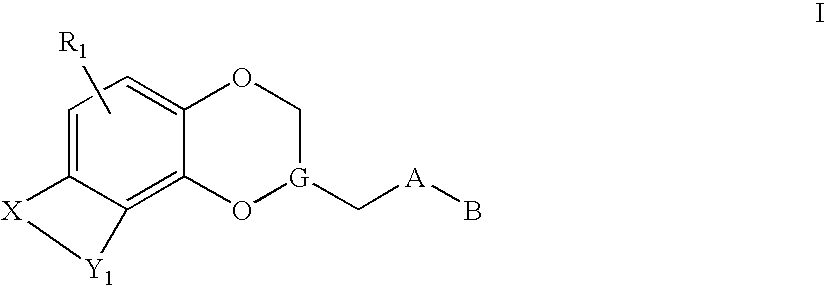
Figure 1 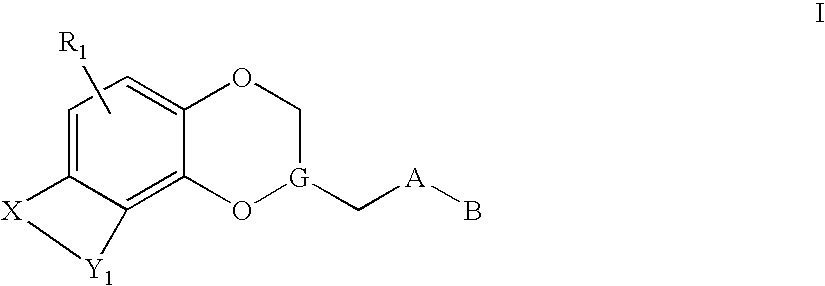
Figure 2 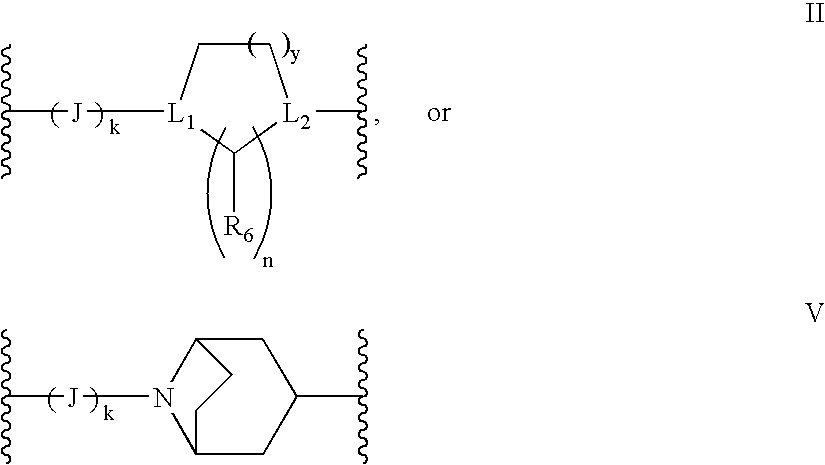
Figure 3
Abstract
Description
[0001] This application claims benefit of priority to U.S. provisional patent application No. 60 / 940,765, filed on May 30, 2007, which is hereby incorporated by reference in its entirety.FIELD OF THE INVENTION
[0002] This invention relates to antidepressant heteroaryl derivatives of heterocycle-fused benzodioxans, to processes for preparing them, methods of using them and to pharmaceutical compositions containing them.BACKGROUND
[0003] Major depressive disorder affects more than 5% of the population, with a lifetime prevalence of 15-20%. Depression is the most frequently diagnosed psychiatric disorder and, according to the World Health Organization, is the fourth greatest public health problem. If left untreated, the effects of depression can be devastating, robbing people of the energy or motivation to perform everyday activities and, in some cases, leading to suicide. Symptoms of the disorder include feelings of sadness or emptiness, lack of interest or pleasure in nearly all activit...
Examples
example 1
6-[(1-{[(2S)-8-methyl-2,3-dihydro[1,4]dioxino[2,3-f]quinolin-2-yl]methyl}piperidin-4-yl)oxy]-2H-1,4-benzoxazin-3(4H)-one dihydrochloride salt
Step A. tert-Butyl 4-{[(4-methylphenyl)sulfonyl]oxy}piperidine-1-carboxylate
[0416]
[0417]To an ice cold solution of 1-tert-butyloxycarbonyl-4-hydroxypiperidine (3 g, 14.9 mmol) in anhydrous pyridine (8 mL) was added dropwise over 10 minutes a solution of 4-methylphenylsulfonyl chloride (3.36 g, 17.6 mmol) in anhydrous pyridine (6 mL). The yellow solution was allowed to come to room temperature and stirred overnight. An additional amount (0.3 g) of the sulfonyl chloride and a catalytic amount of 4-(dimethylamino)pyridine were added and stirring continued for 5 hours at room temperature. The mixture was cooled in an ice-water bath, quenched with ice-water (60 mL) and extracted with ethyl acetate. The extracts were washed with 1N potassium hydrogen sulfate, water, 5% sodium bicarbonate and water, and dried over anhydrous magnesium sulfate. The colo...
example 2
6-[(1-{[(2S)-8-Methyl-2,3-dihydro[1,4]dioxino[2,3-f]quinolin-2-yl]methyl}piperidin-4-yl)methyl]-2H-1,4-benzoxazin-3(4H)-one dihydrochloride
Step A. (4-Methoxy-3-nitrobenzyl)(triphenyl)phosphonium bromide
[0435]
[0436]To a solution of 4-(bromomethyl)-1-methoxy-2-nitrobenzene (5.80 g, 23.77 mmol) in toluene (180 mL) was added triphenylphosphine (6.23 g, 23.77 mmol) at room temperature. The reaction mixture was refluxed for 5 hours and cooled to room temperature. The resulting solid was collected by filtrationa nd dried in vacuo to afford the title compound (8.6 g, 71%), mp: 255-257° C.
Step B. Benzyl 4-(4-methoxy-3-nitrobenzylidene)piperidine-1-carboxylate
[0437]
[0438]To a solution of (4-methoxy-3-nitrobenzyl)(triphenyl)phosphonium bromide of Step 1(3.75 g, 7.4 mmol) in tetrahydrofuran (35 ml) was added n-butyl lithium (2.96 ml, 2.5 M) at −78° C. To the resulting orange colored suspension was added benzyl 4-oxopiperidine-1-carboxylate. The mixture was stirred at reflux for 2 hours, cooled ...
example 3
6-[(1-{[(2S)-8-methyl-2,3-dihydro[1,4]dioxino[2,3-f]quinolin-2-yl]methyl}piperidin-4-yl)oxy]-2H-1,4-benzoxazin-3(4H)-one dihydrochloride salt
Step A. 6-Hydroxy-2H-1,4-benzoxazin-3(4H)-one
[0455]
[0456]To 2H-1,4-benzoxazin-3(4H)-one (4.5 g, 0.03 mole) in trifluoroacetic acid (90 mL), under nitrogen at room temperature, was added at all once a solution of [bis(trifluoroacetoxy)iodo]benzene (PIFA) (1.2 eq, 0.036 mole, 15.5 g) in trifluoroacetic acid (80 mL). The reaction mixture was quickly brought to reflux and stirred under reflux for 20 min. The reaction mixture, while still very warm, was poured over ice-H2O (600 mL) and the precipitate that formed was filtered, dissolved in EtOAc-MeOH and concentrated to generate slightly impure product. The filtrated was extracted with EtOAc (2×). The organic extracts were pooled, treated with brine, dried over anhydrous MgSO4, filtered and concentrated to generate crude desired product 1. Precipitation from EtOAc-EtOH generated a batch of pure desi...