
Electrode plate for fuel cell and fuel cell thereof
A fuel cell and plate technology, applied in the direction of fuel cells, fuel cell additives, solid electrolyte fuel cells, etc., can solve the problems of difficult water discharge, pressure reduction, affecting the performance and life of fuel cells, etc., to achieve pressure enhancement, Improve reliability, improve distribution effect
- Summary
- Abstract
- Description
- Claims
- Application Information
AI Technical Summary
Problems solved by technology
Method used
Image

Examples
Embodiment 1
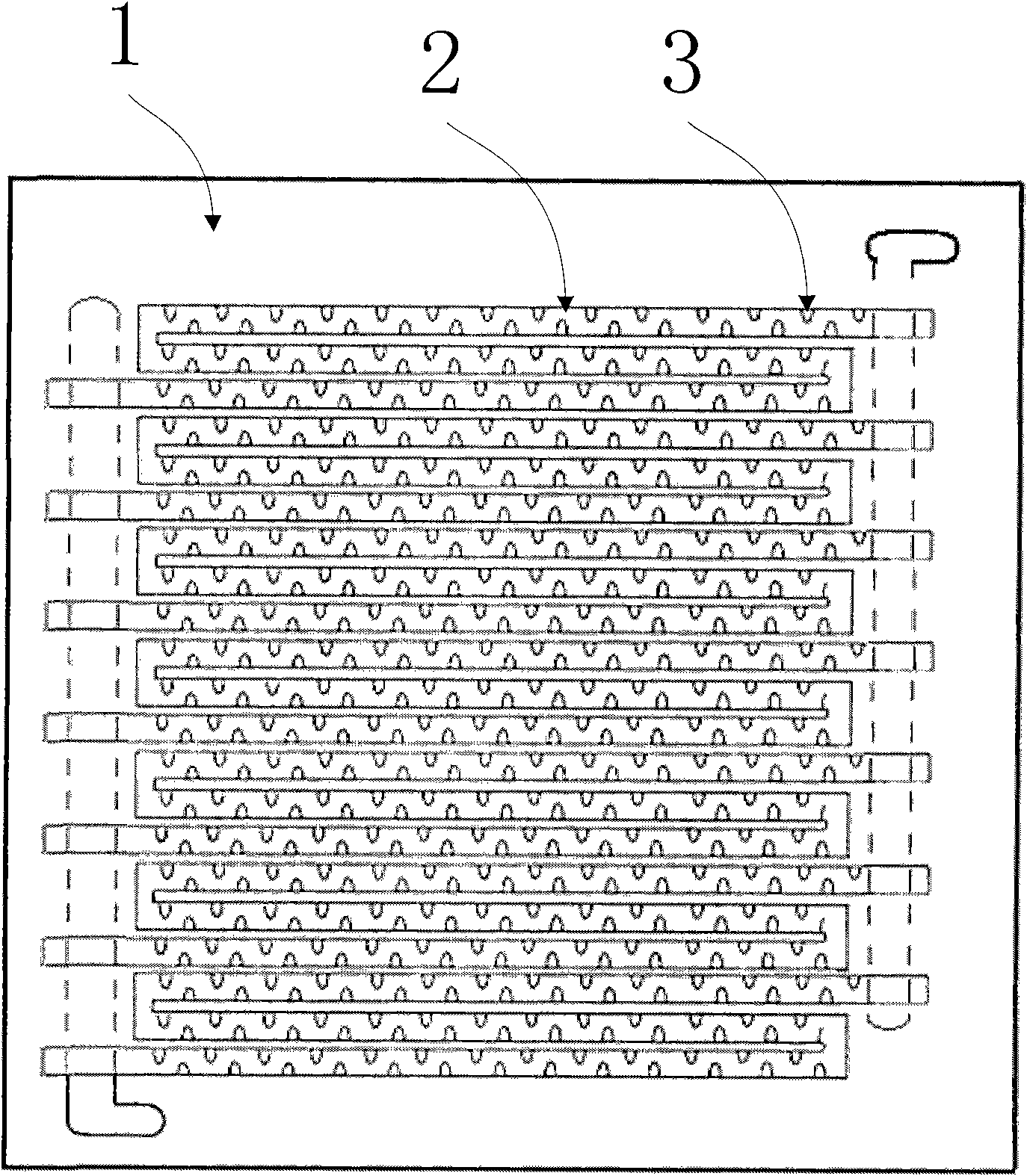
[0024] Such as figure 1 As shown, a pole plate for a fuel cell includes:
[0025] a substrate 1 having at least one main active surface;
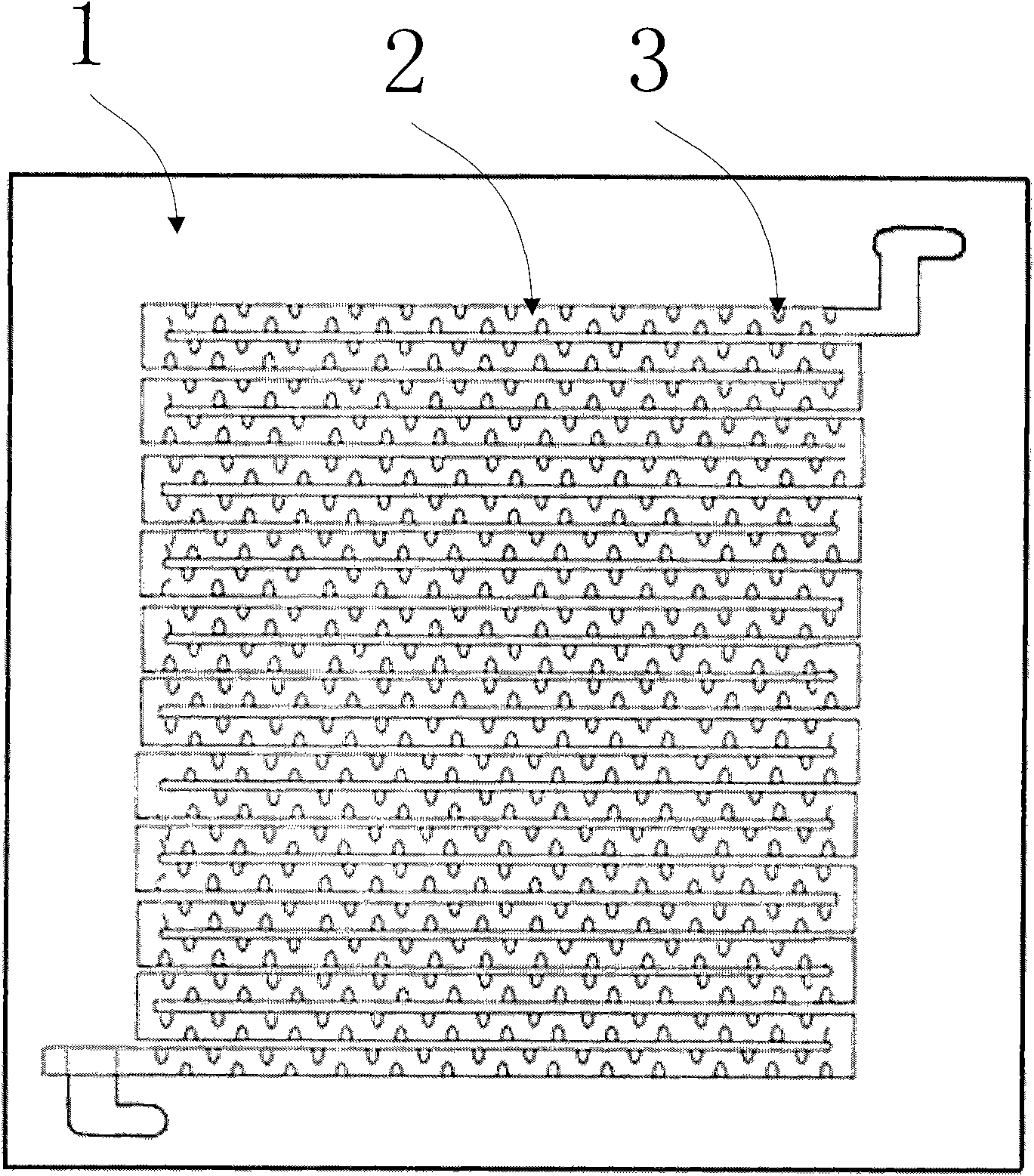
[0026] The substrate 1 is provided with at least one flow channel 2, figure 1 There are multiple flow channels 2 on the middle base plate, image 3 There is only one flow channel 2 on the middle base plate;
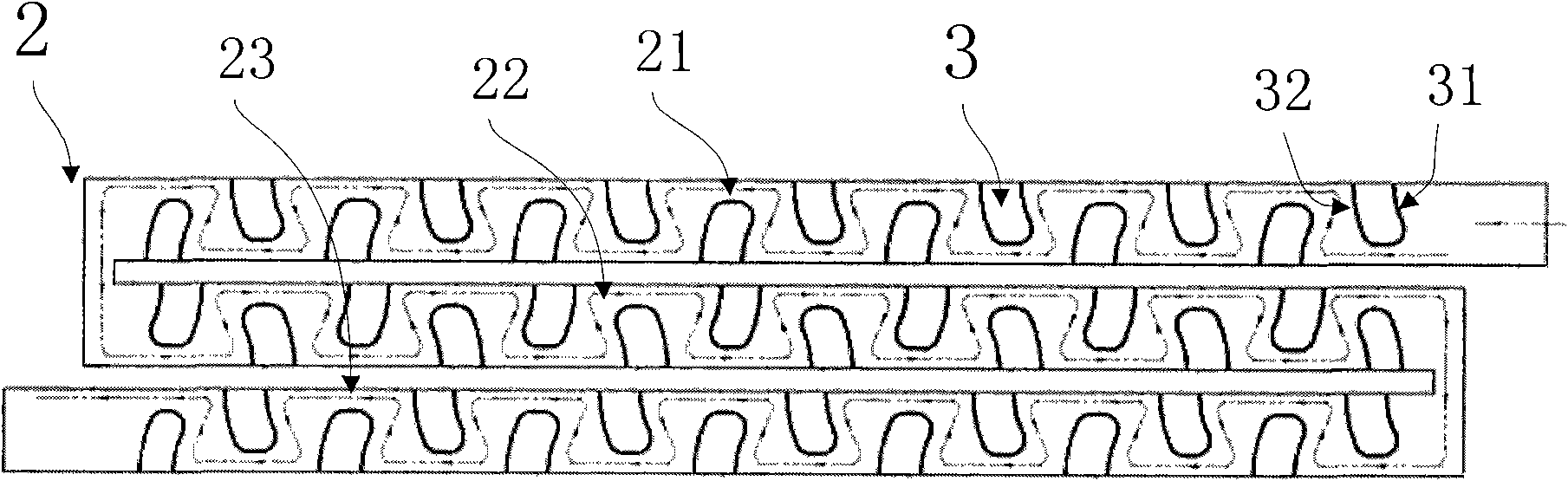
[0027] On the two side walls of at least one flow channel 2 , a plurality of flow guide protrusions 3 are extended in staggered intervals, and there is a gap between each flow guide protrusion 3 and the other side wall 2 .
[0028] Wherein, each of the guide bumps 3 can be designed in various shapes, and the disturbance of the reaction can be realized through the guide bumps 3, so as to increase the local pressure of the flow channel and make it easier for the reaction flow to penetrate the membrane electrode assembly. The air-permeable layer realizes the great improvement of the electrochemical efficiency of the fuel cell. Moreov...
Embodiment 2
[0038] A fuel cell, including a pole plate and a gas-permeable layer:
[0039] Using the polar plate described in Embodiment 1;
[0040] The active surface of the substrate of the pole plate is pressed on the air-permeable layer to form a boundary element;
[0041] The top surface of the diversion bump 3 of the polar plate is pressed on the boundary element;
[0042] The plurality of flow channels of the polar plate are formed between the flow guide bumps 3 of the polar plate and the space between the substrate 1 of the polar plate and the boundary elements.
[0043] Such as Figure 4 As shown, the reaction flow in the flow channel 2 often hits the front curved surface 31 of the flow guide protrusion 3 on the substrate 1, so that the reaction flow is forced to find all other possible forward flow paths, due to the local fluid pressure and With the change of velocity, the reaction flow is also pressed on the air-permeable layer 4 to find a path to move forward. Therefore, t...
PUM
 Login to View More
 Abstract
Description
Claims
Application Information
 Login to View More