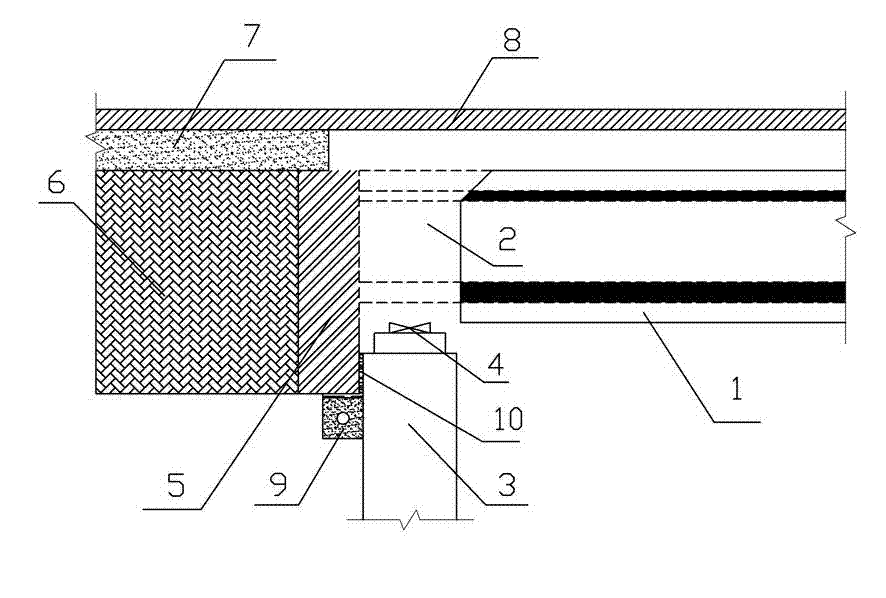
Method for arranging semi-integral hidden expansion joint for abutment and bridge girder

A semi-integral, expansion joint technology, used in bridge construction, bridges, bridge parts, etc., can solve the problems of easy damage to bridge structures, endanger bridge safety, bridge service life, and inconvenient bridge management, and achieve enhanced resistance to various The ability of disaster events, good social and economic benefits, the effect of even distribution of live loads

CN102061667BInactive Publication Date: 2012-10-17河南省新开元路桥工程咨询有限公司
1 Cites 0 Cited by

Patent Information

Authority / Receiving Office
CN · China
Patent Type
Patents(China)
Current Assignee / Owner
Publication Date
2012-10-17
Estimated Expiration
Not applicable · inactive patent

Smart Images

  • Figure 1
    Figure 1
Patent Text Reader

Abstract

The invention discloses a method for arranging a semi-integral hidden expansion joint for an abutment and a bridge girder, which comprises the steps of: first arranging a semi-integral abutment below the end of the bridge girder, arranging a sliding base on the abutment, and placing the end of a girder body on the sliding base, wherein the sliding base is independent from the abutment; arranging a crossbeam on the base in the girder body and pouring the crossbeam and the end of the girder body integrally and fastening the girder with the back wall; filling dam soil outside the back wall, arranging a butt strap on the dam soil and paving an asphalt waterproof layer on the butt strap and the bridge floor integrally; filling a foam material in the crack among the back wall, the dam soil and the semi-integral abutment; and finally arranging an effective drainage system in a position contacted with the dam soil, behind the semi-integral abutment. In the technical scheme, retraction devicesat both ends of the bridge girder are omitted and a soil filled structure is adopted to solve the problem caused by extension of the bridge girder, thereby greatly improving the driving smoothness, reducing the impact of vehicles and prolonging the service life of the bridge girder effectively.
Need to check novelty before this filing date? Find Prior Art

Description

technical field

[0001] The invention relates to a method for setting a bridge expansion device, in particular to a method for setting a hidden expansion joint of a semi-integral abutment bridge. Background technique

[0002] With the rapid development of urban construction, the development of various transportation facilities is advancing by leaps and bounds. Expressways, urban viaducts, and various bridges have been built one after another. Due to the continuous increase of traffic volume, vehicle speed, vehicle load and some problems left in the bridge construction, the damage of bridge expansion joints is very common. The damage of the bridge expansion joint joints will cause the vehicle to bump continuously when driving, the noise is disturbing, the phenomenon of jumping will be aggravated, and it will also endanger the safety of the bridge and the service life of the bridge, thereby increasing the maintenance cost of the bridge.

[0003] In addition, since the expansi...

Examples

Embodiment 2

[0039] Embodiment two: basically the same as embodiment one, the difference is:

[0040] A method for setting hidden expansion joints of semi-integral abutment bridges according to the present invention differs from Embodiment 1 in that:

[0041] Step d: the thickness of the board 7 is 28cm; the thickness of the asphalt waterproof layer 8 is 8cm; the contact surface between the end of the board and the road surface is provided with a joint with a width of 3cm filled with asphalt;

[0042] Step e: fill the gap between the back wall 5, the dam soil 6 and the rigid semi-integral abutment 3 with ethylene-vinyl acetate copolymer EVA foam material 10 .

Embodiment 3

[0043] Embodiment three: basically the same as embodiment one, the difference is:

[0044] A method for setting hidden expansion joints of semi-integral abutment bridges according to the present invention differs from Embodiment 1 in that:

[0045] Step d: the thickness of the board 7 is 32cm; the thickness of the asphalt waterproof layer 8 is 12cm; the contact surface between the end of the board and the road surface is provided with a joint with a width of 2cm filled with asphalt;

[0046] Step e: fill the gap between the back wall 5, the dam soil 6 and the rigid semi-integral abutment 3 with ethylene-vinyl acetate copolymer EVA foam material 10 .