Solar photovoltaic grid-connected inversion control system based on field programmable gate array (FPGA)

A solar photovoltaic and inverter control technology, applied in the field of solar photovoltaic power generation, can solve the problems of large amount of calculation and difficult control chip implementation, and achieve the effects of accurate power prediction, real-time communication, and improved operating speed

CN102142693AInactive Publication Date: 2011-08-03XI AN JIAOTONG UNIV
4 Cites 31 Cited by

Patent Information

Authority / Receiving Office
CN · China
Patent Type
Applications(China)
Current Assignee / Owner
Publication Date
2011-08-03
Estimated Expiration
Not applicable · inactive patent

Smart Images

  • Figure 1
    Figure 1
  • Figure 2
    Figure 2
  • Figure 3
    Figure 3
Patent Text Reader

Abstract

The invention discloses a solar photovoltaic grid-connected inversion control system based on a field programmable gate array (FPGA), which can control a household photovoltaic inversion system to realize grid-connected generation, predict a generation power of the system and realize real-time communication with a grid dispatching centre. The system comprises a signal detection circuit, a control circuit, a communication circuit, a grid-connected circuit and a driving circuit, wherein the signal detection circuit, the communication circuit, the grid-connected circuit and the driving circuit are connected with the control circuit respectively and operate cooperatively under the control of the control circuit. The system predicts the generation power of the household photovoltaic inversion system by using a power prediction algorithm based on a back propagation (BP) neural network and sends a predicted result to the grid dispatching centre in real time. The grid dispatching centre can manage running modes of photovoltaic generation and a conventional power supply reasonably according to the predicted result, reduce an adverse effect on a grid due to incorrect access of a household photovoltaic generation device and improve the schedulability of the photovoltaic generation.
Need to check novelty before this filing date? Find Prior Art

Description

technical field

[0001] The invention belongs to the technical field of solar photovoltaic power generation, and in particular relates to an FPGA-based solar photovoltaic grid-connected inverter control system. Background technique

[0002] With the aggravation of the energy crisis, countries all over the world are actively developing new energy sources. As a clean, pollution-free and renewable new energy source, solar energy has been valued by countries all over the world. Photovoltaic power generation is an important direction for the development and utilization of solar energy. At home and abroad, the government's policy support and consumers' preference for green power have led to the rapid expansion of the photovoltaic energy market. Significant progress has been made, with the UK passing legislation requiring renewable energy to account for a certain percentage of electricity. In recent years, my country has also started to carry out pilot projects and demonstrations,...

Examples

Embodiment Construction

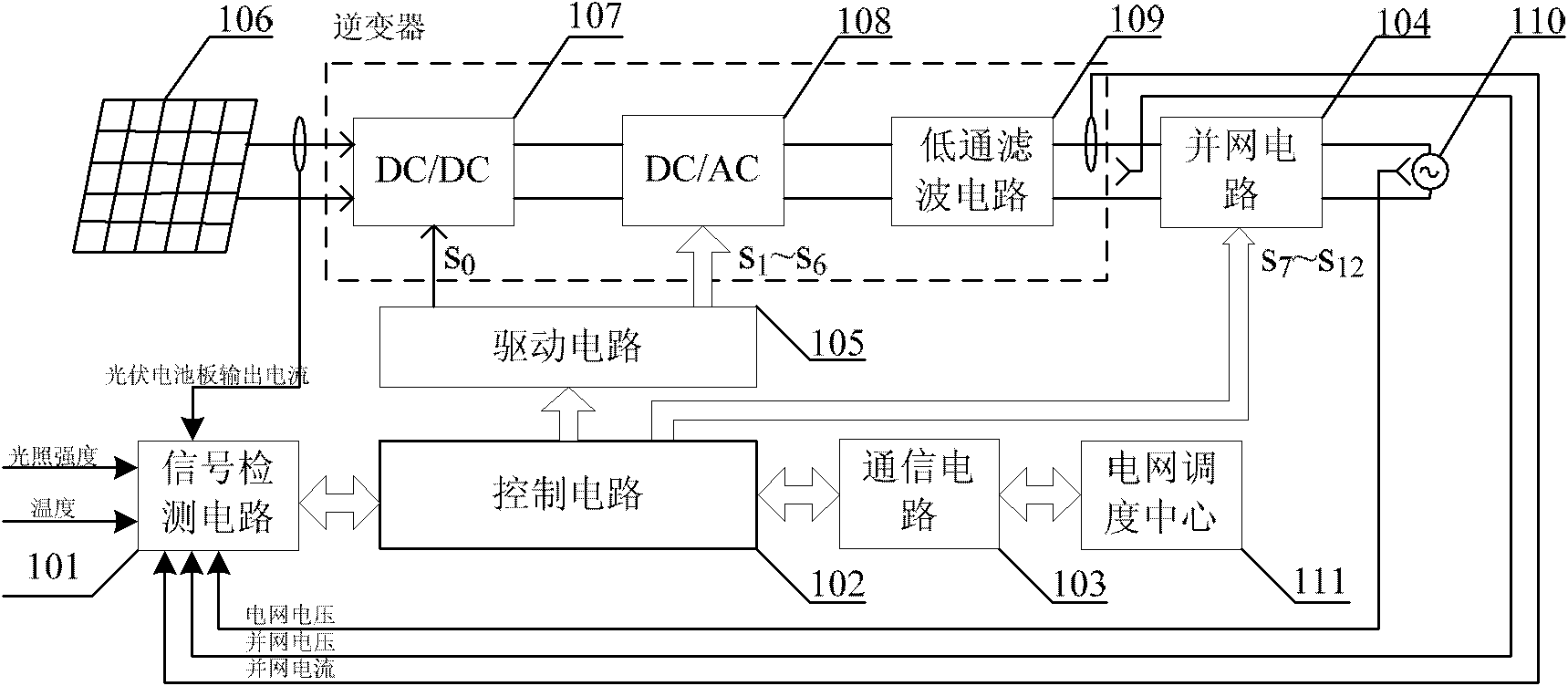
[0029] In order to enable those skilled in the art to better understand the solution of the present invention, the present invention will be further described in detail below in conjunction with the accompanying drawings and embodiments.

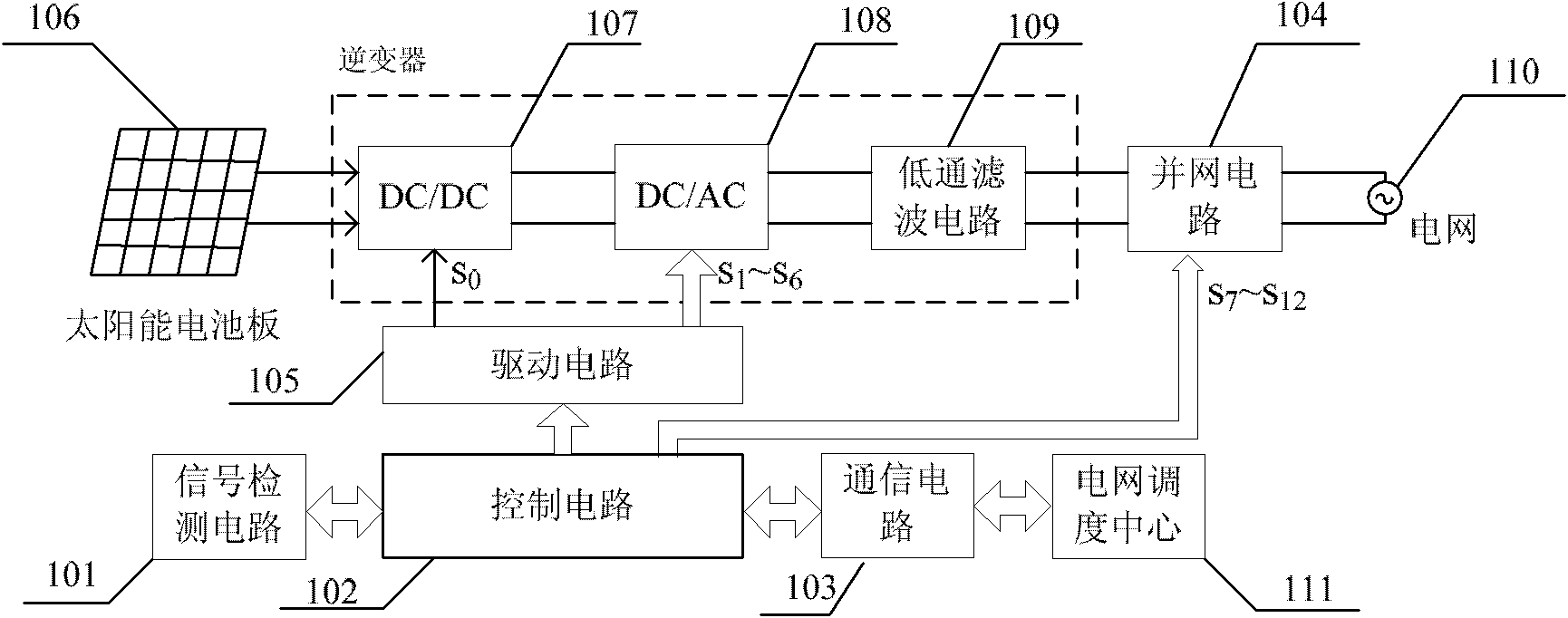
[0030] refer to figure 1 As shown, an FPGA-based solar photovoltaic grid-connected inverter control system includes a signal detection circuit 101, a control circuit 102, a communication circuit 103, a grid-connected circuit 104, and a drive circuit 105. The signal detection circuit 101, the communication circuit 103, and the grid-connected The circuit 104 and the driving circuit 105 are respectively connected to the control circuit 102 and work in coordination under the control of the control circuit.

[0031] refer to figure 2 As shown, under the control of the control circuit 102 , the signal detection circuit 101 collects the light intensity, temperature, photovoltaic panel output current, grid-connected voltage, grid-connected current...