Application of mycoepoxydiene nicotinic acids derivatives in preparation process of pro-inflammatory mediator inhibitors
What is AI technical title?
AI technical title is built by Patsnap AI team. It summarizes the technical point description of the patent document.
A technology of epoxy diene and pro-inflammatory mediator, which can be used in anti-inflammatory agents, drug combinations, non-central analgesics, etc., and can solve problems such as unreported anti-inflammatory physiological activities.
Active Publication Date: 2012-07-18
XIAMEN UNIV
View PDF2 Cites 0 Cited by
Summary
Abstract
Description
Claims
Application Information
AI Technical Summary
This helps you quickly interpret patents by identifying the three key elements:
Problems solved by technology
Method used
Benefits of technology
Problems solved by technology
The anti-tumor activity was detected in vitro by MTT method, and its IC50 for HeLacell line was 4.7 μM (8, Zhang Lianru, Yi Yuting, Chen Junjie, etc., based on the design and target of the anti-tumor active compound MED nicotinic acid derivatives[D] , Xiamen: Journal of Xiamen University, 2010, 31(6) 1184-1189; 9. Shen Yuemao, Zhang Wei, Zhang Lianru, etc. Fungal epoxydiene nicotinic acid derivative 4-NDM and its synthesis method and use, Chinese Patent No. ZL201010150471 .2), but it is not reported that it has anti-inflammatory physiological activity
Method used
the structure of the environmentally friendly knitted fabric provided by the present invention; figure 2 Flow chart of the yarn wrapping machine for environmentally friendly knitted fabrics and storage devices; image 3 Is the parameter map of the yarn covering machine
View more
Image
Smart Image Click on the blue labels to locate them in the text.
Viewing Examples
Smart Image
Click on the blue label to locate the original text in one second.
Reading with bidirectional positioning of images and text.
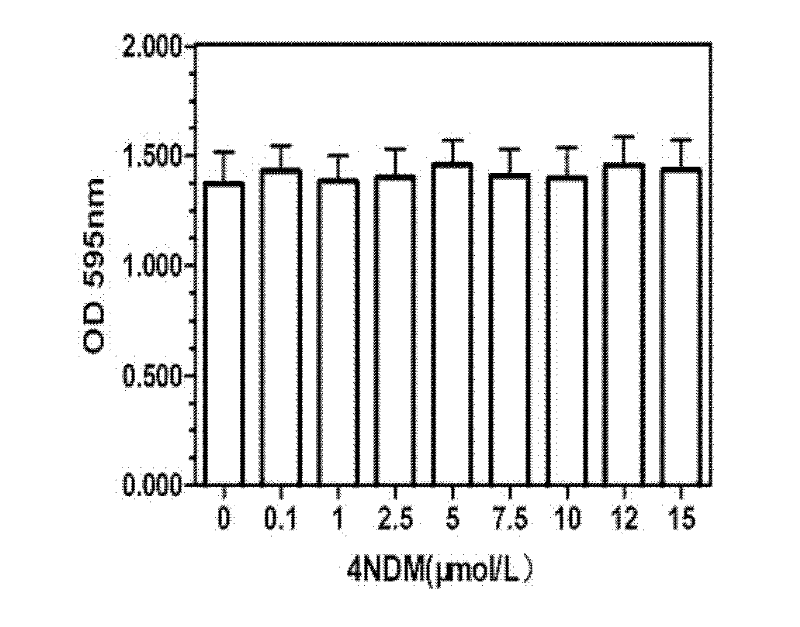
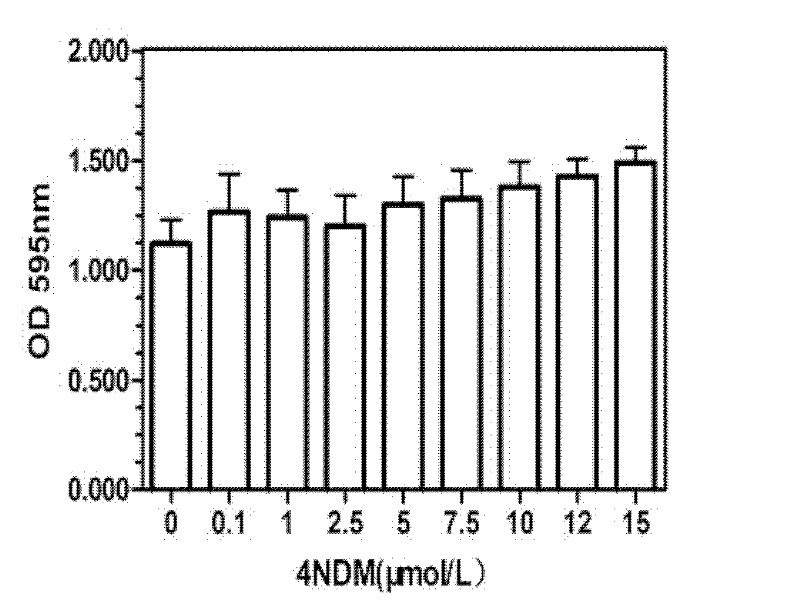
[0024] RAW264.7 cells (4×10 5 cells / well) were inserted into a 96-well culture plate and cultured overnight, and bacterial lipopolysaccharide (lipopolysaccharide, LPS) (100 ng / ml) and different concentrations of 4NDM (0.1, 2.5, 5, 7.5, 10, 12, 15 μmol / L, Use DMSO as a blank control) to act together for 24h or different concentrations of 4NDM (0.1, 2.5, 5, 7.5, 10, 12, 15μmol / L, use DMSO as a blank control) to act alone for 24h, and then add MTT to a final concentration of 0.5mg / L ml for 3 hours, add solution (10% SDS, 0.01mol / L HCL) at 100 μl / well overnight, then measure OD 595 .
[0025] OD 595 Can reflect the growth of cells, so by comparing OD 595 Value to judge whether 4NDM has cytotoxicity.
[0026] MTT method detection result shows (see figure 1 , 2 ): 4NDM probably has no cytotoxicity to R...
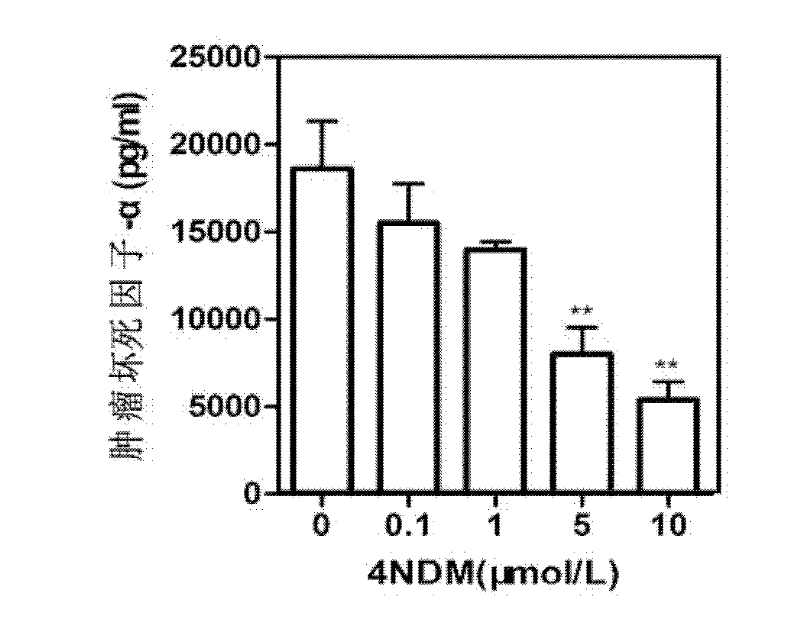
[0028] By detecting the changes in the concentration of pro-inflammatory factors in cells, it can be determined whether 4NDM can inhibit the inflammatory response of RAW264.7 cells. The specific test method is as follows:
[0029] 1) Set the 4NDM concentration gradient. RAW264.7 cells (4×10 5 Cells / mL) were inserted into a 12-well culture plate, and the medium was changed once after 24 h. After 1-2 h, LPS was added to a final concentration of 100 ng / ml to stimulate for 6 h. At the same time, different concentrations of 4NDM (0, 0.1, 1, 5, 10 μmol / L, DMSO was used as a blank control), the effect of 4NDM on the expression of inflammatory factors before LPS stimulation was observed, and the cell culture supernatant was extracted for enzyme-linked immunosorbent assay. Through ELISA detection kit (purchased from eBioscience Company, Mouse TNF-α ...
the structure of the environmentally friendly knitted fabric provided by the present invention; figure 2 Flow chart of the yarn wrapping machine for environmentally friendly knitted fabrics and storage devices; image 3 Is the parameter map of the yarn covering machine
Login to View More
PUM
Login to View More
Abstract
The invention discloses the application of mycoepoxydiene nicotinic acids derivatives in the preparation process of pro-inflammatory mediator inhibitors, and relates to the mycoepoxydiene nicotinic acids derivatives 4-NDM (4-N Dodecyl Mercaptan). The provided application of the mycoepoxydiene nicotinic acids derivatives in the preparation process of the pro-inflammatory mediator inhibitors particularly relates to the application of the mycoepoxydiene nicotinic acids derivatives in the preparation process of drugs that are used for treating inflammatory diseases such as endotoxin shocks which are mediated by inflammatory factors. The molecular formula of the mycoepoxydiene nicotinic acids derivatives is C19H19NO4. Pharmacology experiments prove that the mycoepoxydiene nicotinic acids derivatives can effectively inhibit the expression of the inflammatory factors such as tumor necrosis factor (TNF-Alpha), interleukin 6 (IL-6) and nitric monoxide (NO). The mycoepoxydiene nicotinic acids derivatives can be used for preparing the pro-inflammatory mediator inhibitors, especially, the mycoepoxydiene nicotinic acids derivatives can be used for preparing the drugs for treating inflammatory diseases such as endotoxin shocks which are mediated by inflammatory factors.
the structure of the environmentally friendly knitted fabric provided by the present invention; figure 2 Flow chart of the yarn wrapping machine for environmentally friendly knitted fabrics and storage devices; image 3 Is the parameter map of the yarn covering machine
Login to View More
Application Information
Patent Timeline
Application Date:The date an application was filed.
Publication Date:The date a patent or application was officially published.
First Publication Date:The earliest publication date of a patent with the same application number.
Issue Date:Publication date of the patent grant document.
PCT Entry Date:The Entry date of PCT National Phase.
Estimated Expiry Date:The statutory expiry date of a patent right according to the Patent Law, and it is the longest term of protection that the patent right can achieve without the termination of the patent right due to other reasons(Term extension factor has been taken into account ).
Invalid Date:Actual expiry date is based on effective date or publication date of legal transaction data of invalid patent.


 Login to View More
  Login to View More