
Traditional Chinese medicine composition for preventing and treating swine infectious atrophic rhinitis and preparation method of traditional Chinese medicine composition
An atrophic rhinitis, infectious technology, applied in the field of Chinese veterinary medicine preparations, can solve the problems of antibiotic drug resistance and drug residues, and achieve the effect of avoiding drug resistance
- Summary
- Abstract
- Description
- Claims
- Application Information
AI Technical Summary
Problems solved by technology
Method used
Image

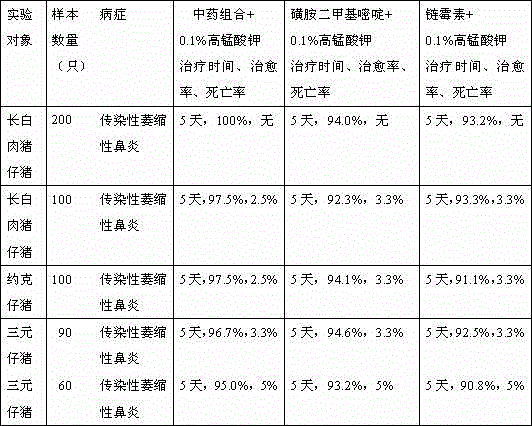
Examples
Embodiment 1
[0030] A traditional Chinese medicine powder for preventing and treating porcine infectious atrophic rhinitis, the parts by weight of each raw material are as follows: 20 parts of ephedra, 10 parts of asarum, 10 parts of angelica, 5 parts of magnolia, 5 parts of cocklebur, 10 parts of anemarrhena, bellflower 10 parts, 10 parts of Scutellaria, 10 parts of Coptidis, and 10 parts of Gardenia. Its preparation method is: (1) selection: pick out impurities, stones and metals, and remove non-medicinal parts; (2) elutriation: use 2 times the amount of water to use the infiltration method to make the water slowly enter the inside to reach the end of the medicine; (3) ) drying: dry at 65°C until completely dried; (4) pulverization: pulverize the dried medicinal materials with a pulverizer; (5) sieving: filter out large particles with an 80-mesh sieve; Bag, 100g per bag , That is the finished product.
Embodiment 2
[0032] A traditional Chinese medicine powder for preventing and treating porcine infectious atrophic rhinitis, the parts by weight of each raw material are as follows: 15 parts of ephedra, 15 parts of asarum, 15 parts of angelica dahurica, 10 parts of magnolia, 10 parts of cocklebur, 5 parts of anemarrhena, platycodon 5 parts, 15 parts of Scutellaria, 5 parts of Coptidis, and 5 parts of Gardenia. Its preparation method is as follows: (1) selection: picking out impurities, stones and metals, and removing non-medicinal parts; (2) elutriation: using 2-3 times the amount of water to use the infiltration method to slowly enter the water to achieve the maximum penetration of the medicine; (3) Drying: dry at 60°C under reduced pressure until completely dried; (4) Grinding: pulverize the dried medicinal materials with a pulverizer; (5) Screening: filter out large particles with a 100-mesh sieve; (6) Packed in bags, 200g per bag , That is the finished product.
Embodiment 3
[0034] A traditional Chinese medicine powder for preventing and treating porcine infectious atrophic rhinitis, the parts by weight of each raw material are as follows: 10 parts of ephedra, 5 parts of asarum, 5 parts of angelica, 8 parts of magnolia, 7 parts of cocklebur, 15 parts of anemarrhena, platycodon 15 parts, 5 parts of Scutellaria, 15 parts of Coptidis, and 15 parts of Gardenia. Its preparation method is as follows: (1) selection: picking out impurities, stones and metals, and removing non-medicinal parts; (2) elutriation: using 2-3 times the amount of water to use the infiltration method to slowly enter the water to achieve the maximum penetration of the medicine; (3) Drying: dry at 65°C under reduced pressure until completely dried; (4) Grinding: pulverize the dried medicinal materials with a pulverizer; (5) Sieving: filter out large particles with an 80-mesh sieve; (6) Packed in bags, 200g per bag , That is the finished product.
PUM
 Login to View More
 Abstract
Description
Claims
Application Information
 Login to View More