Thermoelectric thick film preparation method

A thermoelectric and thick film technology, applied in the manufacture/processing of thermoelectric devices, etc., can solve the problems of reduced mutual contact, reduced flow conductivity, and reduced thermoelectric performance, and achieves the effect of improving thermoelectric performance, not easy to oxidize, and close contact.

CN105024007AActive Publication Date: 2015-11-04SUN YAT SEN UNIV
4 Cites 8 Cited by

Patent Information

Authority / Receiving Office
CN · China
Patent Type
Applications(China)
Current Assignee / Owner
Publication Date
2015-11-04

Smart Images

  • Figure 1
    Figure 1
  • Figure 2
    Figure 2
  • Figure 3
    Figure 3
Patent Text Reader

Abstract

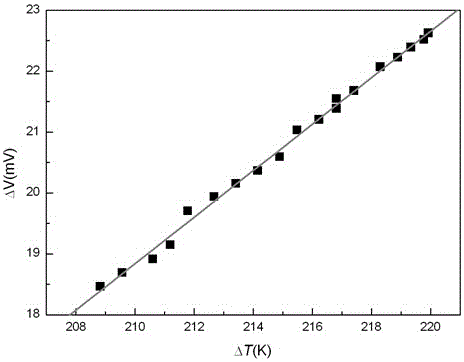
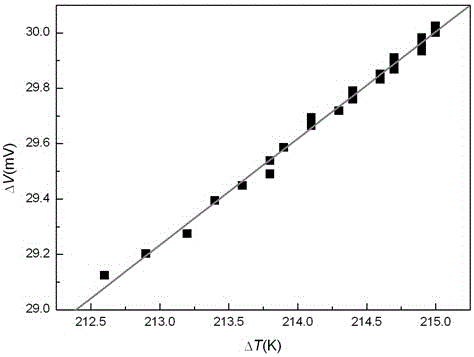
The invention relates to a thermoelectric thick film preparation method. Thermoelectric thick film slurry is composed of thermoelectric material particles, polymers and an organic solvent. Due to the polymer ratio, the thermoelectric thick film slurry printed on a flexible substrate does not fall automatically after being dried, after the thermoelectric thick film slurry is fully dried, one face with viscose of a high temperature-resisting thin film is used for tight covering, and a thermoelectric thick film with excellent performance is acquired through cold isostatic pressing processing. As the polymer ratio is the lowest ratio which can only enable the thermoelectric thick film slurry printed on the flexible substrate not to fall automatically after being dried, attachment and molding of the thermoelectric thick film on the flexible substrate are acquired through the tightly-covered high temperature-resisting thin film and cold isostatic pressing processing, the thermoelectric particles are fully and tightly contacted, conductivity s close to that of a bulk can be acquired, the thermoelectric performance is improved, and due to protection of the high temperature-resisting thin film, the thermoelectric thick film is not likely to oxidize even if working for a long time at a temperature between room temperature and 230 DEG C.
Need to check novelty before this filing date? Find Prior Art

Description

technical field

[0001] The invention relates to the technical field of material preparation, and more specifically, to a method for preparing a thermoelectric thick film. Background technique

[0002] The temperature difference is an important parameter to determine the efficiency of thermoelectric power generation. The length of traditional block thermoelectric arms is limited, and it is not easy to establish a large temperature difference. Therefore, the production of long film-shaped thermoelectric arms is a feasible method to improve the efficiency of thermoelectric power generation. The preparation method of the conductor thick film is flexible in design, small in investment, low in cost, and reliable in performance.

[0003] A good thermoelectric material must have a high thermoelectric coefficient S And the conductivity s, so as to ensure a more obvious thermoelectric effect, and at the same time make the generated Joule heat small.

[0004] The attachment and mold...

Examples

Embodiment 1

[0019] The ratio of the polymer of the present invention is the lowest ratio that only makes the thermoelectric thick film slurry printed on the flexible substrate dry and does not fall off by itself through experiments. The adhesion and molding of the thermoelectric thick film on the flexible substrate are closely covered The high-temperature-resistant film and cold isostatic pressing treatment are obtained to verify that the present invention not only obtains the electrical conductivity s close to the bulk material, thereby improving its thermoelectric performance:

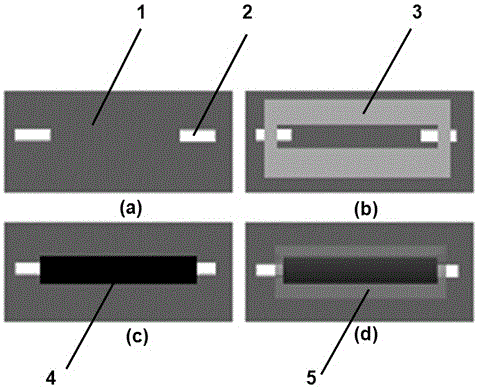
[0020] Such as figure 1 Shown is a schematic diagram of the process flow of the present invention, including a flexible substrate 1 , electrodes 2 , a mask 3 , a thermoelectric thick film 4 , and a high-temperature-resistant film 5 .

[0021] The length, width and thickness of P-type Bi2Te3-based alloy strip samples are 29.3mm, 3.5mm and 2.1mm respectively. At room temperature, using the four-terminal method, th...