Escherichia coli O157:H7 direct type immunofluorescence chromatography test paper
What is AI technical title?
AI technical title is built by Patsnap AI team. It summarizes the technical point description of the patent document.
A kind of technology of O157, Escherichia coli
Inactive Publication Date: 2016-05-25
UNIV OF SHANGHAI FOR SCI & TECH
View PDF3 Cites 0 Cited by
Summary
Abstract
Description
Claims
Application Information
AI Technical Summary
This helps you quickly interpret patents by identifying the three key elements:
Problems solved by technology
Method used
Benefits of technology
Problems solved by technology
[0006] Aiming at the above-mentioned technical problems in the prior art, the invention provides a kind of Escherichia coli O157:H7 direct type immunofluorescence chromatography test paper, described this Escherichia coli O157:H7 direct type immunofluorescence chromatography test paper will solve existing The technical problems of detecting Escherichia coli O157:H7 in food are low sensitivity, long detection time and complicated detection process
Method used
the structure of the environmentally friendly knitted fabric provided by the present invention; figure 2 Flow chart of the yarn wrapping machine for environmentally friendly knitted fabrics and storage devices; image 3 Is the parameter map of the yarn covering machine
View more
Image
Smart Image Click on the blue labels to locate them in the text.
Viewing Examples
Smart Image
Click on the blue label to locate the original text in one second.
Reading with bidirectional positioning of images and text.
Smart Image
Examples
Experimental program
Comparison scheme
Effect test
Embodiment 1
[0036]The preparation process of the test strip of the present invention comprises the steps of: preparation of Escherichia coli O157:H7 monoclonal or polyclonal antibody, preparation of the adsorption fiber layer, preparation of the cellulose film layer, assembly of the test strip and the like.
[0038] Monoclonal antibody preparation: at an inactivating concentration of 10 8 Escherichia coli O157:H7 cfu / mL whole bacteria immunized 6-8 week-old Balb / C mice 3-4 times, with an interval of 3-5 weeks between each immunization. After confirming that the antibody titer met the requirements, super-strong immunization was performed, and then 3 On ~4 days, blood was collected from the infraorbital sinus of the immunized mice, and the positive serum was separated; the mice were killed by dislocation of the neck, and the mice were soaked in 75% alcohol for 5-10 minutes to disinfect the b...
Embodiment 2
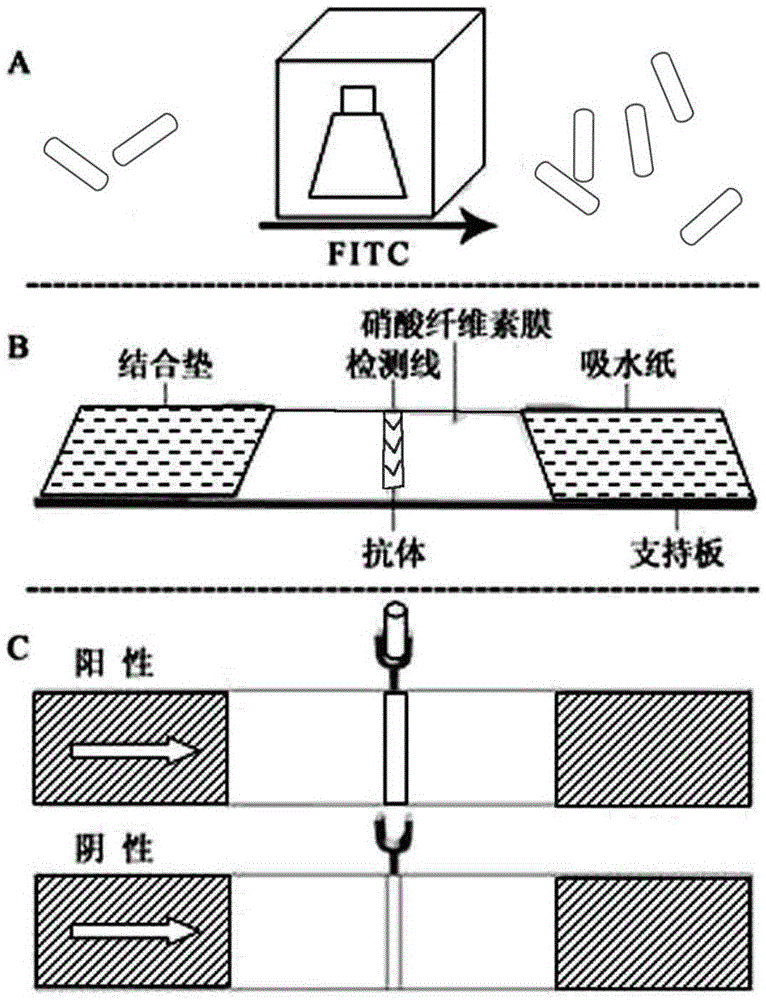
[0051] Example 2: see image 3 , Figure 4 . In the figure, 1 is the support layer, which is made of plastic sheet strips, 2 is the absorbent fiber layer, which is made of glass fiber cotton, the cellulose membrane layer 3 is made of nitrocellulose membrane, and the water-absorbing material layer 4 at the handle end is made of water-absorbing filter paper 1. Paste and fix the absorbent fiber layer 2, the cellulose membrane layer 3, and the water-absorbing material layer 4 on the support layer 1 from left to right, and the fibers at the junctions between the layers interpenetrate with each other. On the cellulose film layer 3, there is a stealth detection imprint 5, which is made of Escherichia coli O157:H7 monoclonal antibody; the imprinted band is formed as "︱".
[0052] 6-1 is the white protective film covering the sample end on the absorbent fiber layer 2, 6-2 is the protective film of other colors (such as yellow) covering the water-absorbing material layer 4, 7 is the s...
Embodiment 3
[0060] Embodiment 3: The structure of the test strip is the same as that of Embodiment 2. Preparation and testing steps of samples to be tested:
[0061] Test bread: aseptically take 25g sample and add it to 225mLEC or NB broth containing FTIC solution, put the above solution into a homogenizer, homogenize continuously for 1-2min on a slap-type homogenizer, and incubate at 37°C several hours.
[0062] Operation method: Insert the test paper into the sample solution, take it out after 10-20 seconds, and lay it flat. After 5-10 minutes, observe whether there is fluorescence on the test line of the test paper to determine whether the sample contains E. coli O157:H7, or read the strip by fluorescence instrument for semi-quantitative analysis.
[0063] Result judgment: (a) positive if there is a yellow-green blot "︱" on the cellulose membrane, it means that the test result is positive, indicating that E. coli O157:H7 is contained in the sample to be tested; There is no yellow-gr...
the structure of the environmentally friendly knitted fabric provided by the present invention; figure 2 Flow chart of the yarn wrapping machine for environmentally friendly knitted fabrics and storage devices; image 3 Is the parameter map of the yarn covering machine
Login to View More
PUM
Login to View More
Abstract
The invention discloses escherichia coli O157:H7 direct type immunofluorescencechromatography test paper. The test paper comprises a supporting layer which is provided with an adsorption layer. A protective layer is arranged on the adsorption layer. The adsorption layer is composed of an adsorptive fiber layer, a cellulosemembrane layer and a water absorption material layer, one end of the adsorptive fiber layer is closely connected with one end of the cellulosemembrane layer, the other end of the cellulosemembrane layer is closely connected with the water absorption material layer, and a detection line is arranged on the cellulose membrane layer and is composed of monoclonal antibodies or polyclonal antibodies composed of escherichia coli O157:H7. The invention further provides a method for preparing the chromatography test paper. The test paper and a detection method are simple, high in specificity, high in sensitivity, visual, accurate and capable of being used for performing qualitative and semi-quantitative detection, the trace contamination of the lowest 1CFU / mL can be detected, the application range is wide, cost is low, and the test paper and the detection method are easy to apply and popularize.
Description
technical field [0001] The invention belongs to the field of bioengineering, and relates to an immunochromatographic test paper, in particular to an Escherichia coli O157:H7 direct immunofluorescencechromatography test paper. Background technique [0002] Escherichia coli O157: H7 type (Escherichia coli O157: H7) is an enterohemorrhagic Escherichia coli, which is one of the main food-borne pathogens. Enteric infectious diseases caused by Escherichia coli O157:H7 have become a global public health concern. Escherichia coli O157:H7 infection can cause serious gastrointestinal complications such as hemorrhagic colitis (HC), appendicitis and colon perforation, and severe thrombotic platelet purpura (TTP) and hemolytic urinary tract syndrome (HUS), etc. Systemic complications, 3-5% of patients died, about 12% of patients had serious sequelae. Moreover, the human infection dose is extremely low, and the ingestion of 10-100 live bacteria can cause the disease. In recent years, ...
Claims
the structure of the environmentally friendly knitted fabric provided by the present invention; figure 2 Flow chart of the yarn wrapping machine for environmentally friendly knitted fabrics and storage devices; image 3 Is the parameter map of the yarn covering machine
Login to View More
Application Information
Patent Timeline
Application Date:The date an application was filed.
Publication Date:The date a patent or application was officially published.
First Publication Date:The earliest publication date of a patent with the same application number.
Issue Date:Publication date of the patent grant document.
PCT Entry Date:The Entry date of PCT National Phase.
Estimated Expiry Date:The statutory expiry date of a patent right according to the Patent Law, and it is the longest term of protection that the patent right can achieve without the termination of the patent right due to other reasons(Term extension factor has been taken into account ).
Invalid Date:Actual expiry date is based on effective date or publication date of legal transaction data of invalid patent.



 Login to View More
  Login to View More