Method for acoustically monitoring blockage of gas extraction pipeline

A gas drainage and sound wave technology is applied in the field of monitoring gas drainage pipeline blockage, which can solve the problems of being unsuitable for underground iron gas drainage pipelines, unable to accurately locate clogging points, and low on-site practicability, and achieve high on-site practicality. Value, improving gas extraction efficiency, and high on-site practicability

CN105927862AActive Publication Date: 2016-09-07CHINA UNIV OF MINING & TECH
8 Cites 5 Cited by

Patent Information

Authority / Receiving Office
CN · China
Current Assignee / Owner
Publication Date
2016-09-07

Smart Images

  • Figure 1
    Figure 1
  • Figure 2
    Figure 2
  • Figure 3
    Figure 3
Patent Text Reader

Abstract

The method discloses a method for acoustically monitoring blockage of a gas extraction pipeline. An acoustic wave sensor is arranged in the bending segment of the gas extraction pipeline to receive acoustic waves of friction between accumulated water and coal slag in the pipeline and the pipeline wall, acoustic wave signal strength is analyzed and processed through a monitoring host, then, the acoustic wave signal strength is compared to precisely find out the blockage area of the extraction pipeline, and the blockage level of the accumulated water and the coal slag in the pipeline is obtained, so that monitoring of the blockage condition of the points nearby the bending segment is achieved; the method for acoustically monitoring blockage of the gas extraction pipeline in a portable and passive manner can detect the blockage degree of the extraction pipeline in real time, the pipeline dredging work can be rapidly guided, and therefore the gas extraction efficiency is improved; and the method is not affected by the pipeline material, the blockage point can be precisely positioned, when the acoustic wave sensor is mounted, the extraction pipeline does not need to be dismounted, normal gas extraction work is not affected, and the extremely high field practical value is achieved.
Need to check novelty before this filing date? Find Prior Art

Description

technical field

[0001] The invention relates to the technical field of monitoring the clogging of gas drainage pipelines, in particular to a method for monitoring the clogging of gas drainage pipelines with sound waves, and is especially suitable for monitoring the clogging of gas drainage pipelines where water and slag easily accumulate in the pipelines. Background technique

[0002] In order to reduce possible gas accidents during coal mining, gas drainage is required when the gas content in the coal seam reaches a certain value. Gas drainage is to set a certain number of boreholes on the coal body, and use a vacuum pump to pump out the gas in the coal seam. Because the coal seam contains a large number of water-conducting fracture zones, during the gas drainage process, the water in the coal seam will enter the drainage pipeline through the borehole, and the water mixed with coal chips will easily accumulate in the upstream and bending sections of the pipeline. As a resu...

Examples

Embodiment Construction

[0025] The present invention will be described in further detail below in conjunction with the accompanying drawings.

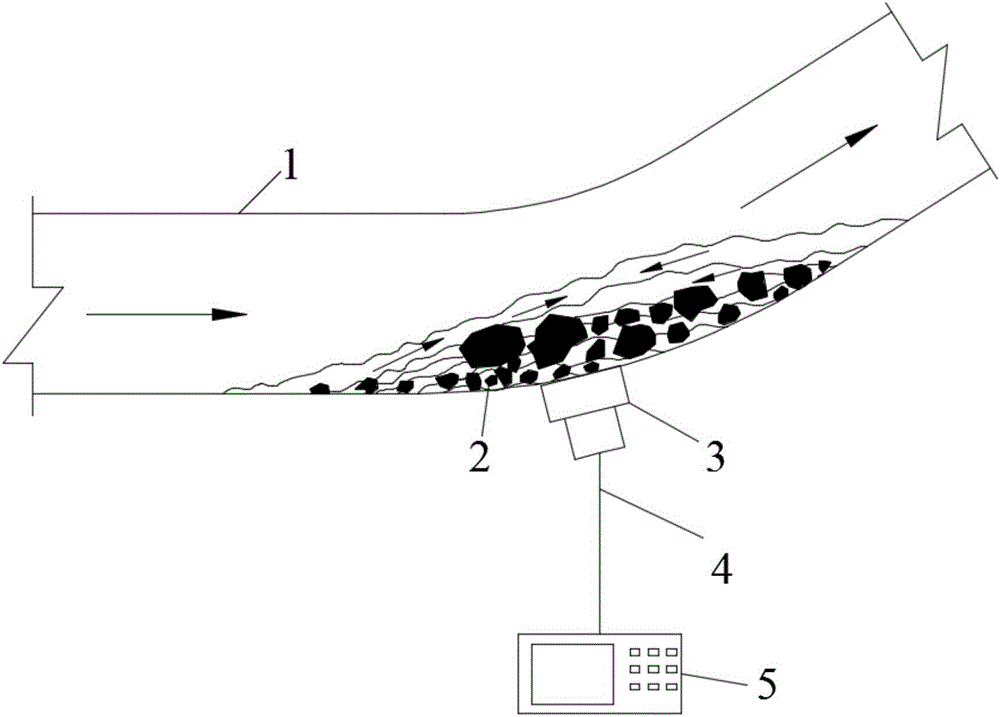
[0026] Such as figure 1 As shown, a method for sonic monitoring of gas drainage pipeline clogging comprises the following steps:

[0027] a. Place the acoustic wave sensor 3 at point A on the wall of the gas drainage pipe 1 to receive the acoustic signals of accumulated water in the pipe and the friction between cinder 2 and the pipe wall, and analyze and process the intensity of the acoustic wave signal by monitoring the host computer 5; the point A is set In the curved section of the gas drainage pipe 1;

[0028] b. Set monitoring point B on the pipe wall at a distance of 3-5m from point A to monitor the acoustic signal strength at point B; the point B is set on the side of point A along the gas flow direction;

[0029] c. If the acoustic signal strength value at point B is greater than that at point A, set monitoring point C in the direction from point A...