
Wind conveyor
A technology of wind conveying and blower, applied in the field of tea processing equipment, can solve the problems of material dripping, long conveying route, poor cooling effect of tea leaves, etc.
- Summary
- Abstract
- Description
- Claims
- Application Information
AI Technical Summary
Problems solved by technology
Method used
Image

Examples
Embodiment Construction
[0015] Embodiments of the present invention will be further described below in conjunction with the accompanying drawings.
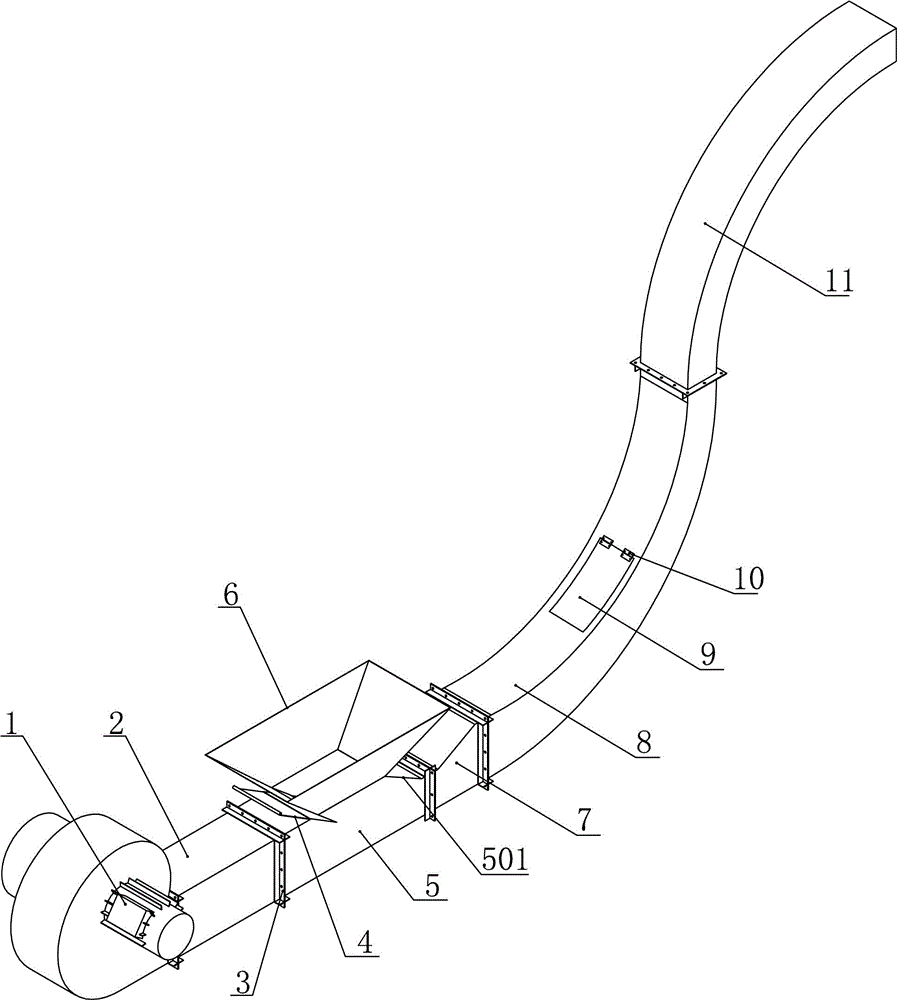
[0016] join figure 1 , a wind conveyor, which includes a blower 1, a primary ventilation pipe 2 connected to the air outlet of the blower 1, a secondary ventilation pipe 5 connected to the primary ventilation pipe 2 through a flange 3, and a material funnel 6 arranged above the secondary ventilation pipe 5 , the air inlet end of the secondary ventilation pipe 5 is provided with a plugboard 4, and the air outlet end is provided with a shrinkage 501. The third-stage ventilation pipe 7 is connected to the shrinkage 501 through a flange, and the fourth-stage ventilation pipe 8 is connected to the third-stage ventilation pipe through a flange. The first-level ventilation pipe 7 is connected, and the fifth-level ventilation pipe 11 is connected to the fourth-level ventilation pipe 8 through a flange.
[0017] Preferably, the air inlet of the three-stage venti...
PUM
 Login to View More
 Abstract
Description
Claims
Application Information
 Login to View More