
Feeder-free and serum-free human induced pluripotent stem cell isolation culture method
A technology of pluripotent stem cells without a feeder layer, applied in the field of isolation and culture of human induced pluripotent stem cells, can solve the problems of difficult large-scale culture of iPScells for clinical application, complex components, unstable quality, etc., to maintain self-renewal and pluripotency The effect of high stability, simple operation, and clear medium composition
- Summary
- Abstract
- Description
- Claims
- Application Information
AI Technical Summary
Problems solved by technology
Method used
Image

Examples
Embodiment Construction
[0033] The present invention will be described in further detail below in conjunction with the accompanying drawings and specific implementation examples.
[0034] A feeder-free, serum-free reprogramming medium comprising:
[0035] DMEM / F12 basal medium (11330-032, Gibco), 47.75mL; N-2Supplement (17502-048, Gibco), 0.5mL; B-27Supplement (17504-044, Gibco), 1mL; MEM Non-essential amino acid solution (11140-050, Gibco), 0.25 mL; Gluamax-I (100X) (35050-061, Gibco), 0.25 mL; Beta-Mercaptoethnol (21985-023, Gibco), 90.9 μL; 100 ng / ml bFGF, 159.1 μL.
[0036] A feeder-free, serum-free human induced pluripotent stem cell medium comprising: TeSR TM -E8 TMKit for hESC / hiPSC Maintenance (Cat. No. 05940, STEMCELL Technologies).
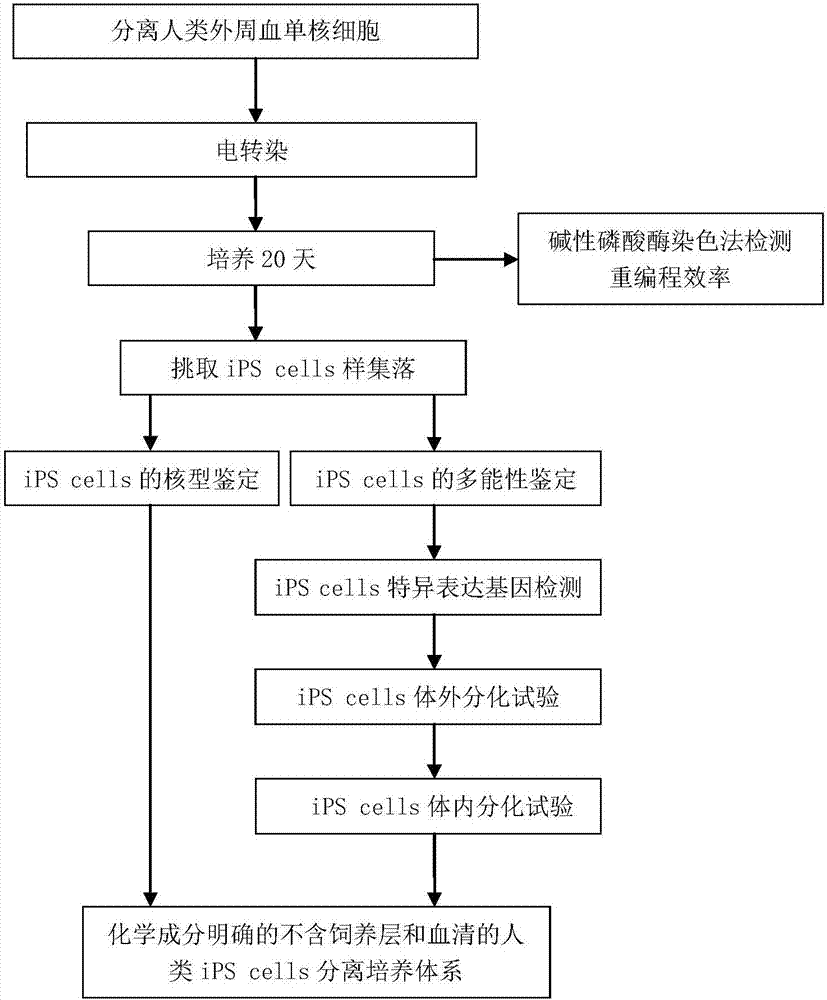
[0037] Such as figure 1 As shown, a method for isolating and culturing human induced pluripotent stem cells without a feeder layer and without serum, comprising the steps of:
[0038] 1. Isolate human peripheral blood mononuclear cells and expand them in v...
PUM
 Login to View More
 Abstract
Description
Claims
Application Information
 Login to View More