Space multi-target detection system and method

A detection method and space target technology, applied in the direction of radio wave measurement systems, instruments, etc., can solve the problem that the antenna array signal synthesis method cannot be directly applied to radar detection, etc.

CN108226888AActive Publication Date: 2018-06-29NAT ASTRONOMICAL OBSERVATORIES CHINESE ACAD OF SCI
14 Cites 12 Cited by

Patent Information

Authority / Receiving Office
CN · China
Patent Type
Applications(China)
Current Assignee / Owner
Publication Date
2018-06-29

Smart Images

  • Figure 1
    Figure 1
  • Figure 2
    Figure 2
  • Figure 3
    Figure 3
Patent Text Reader

Abstract

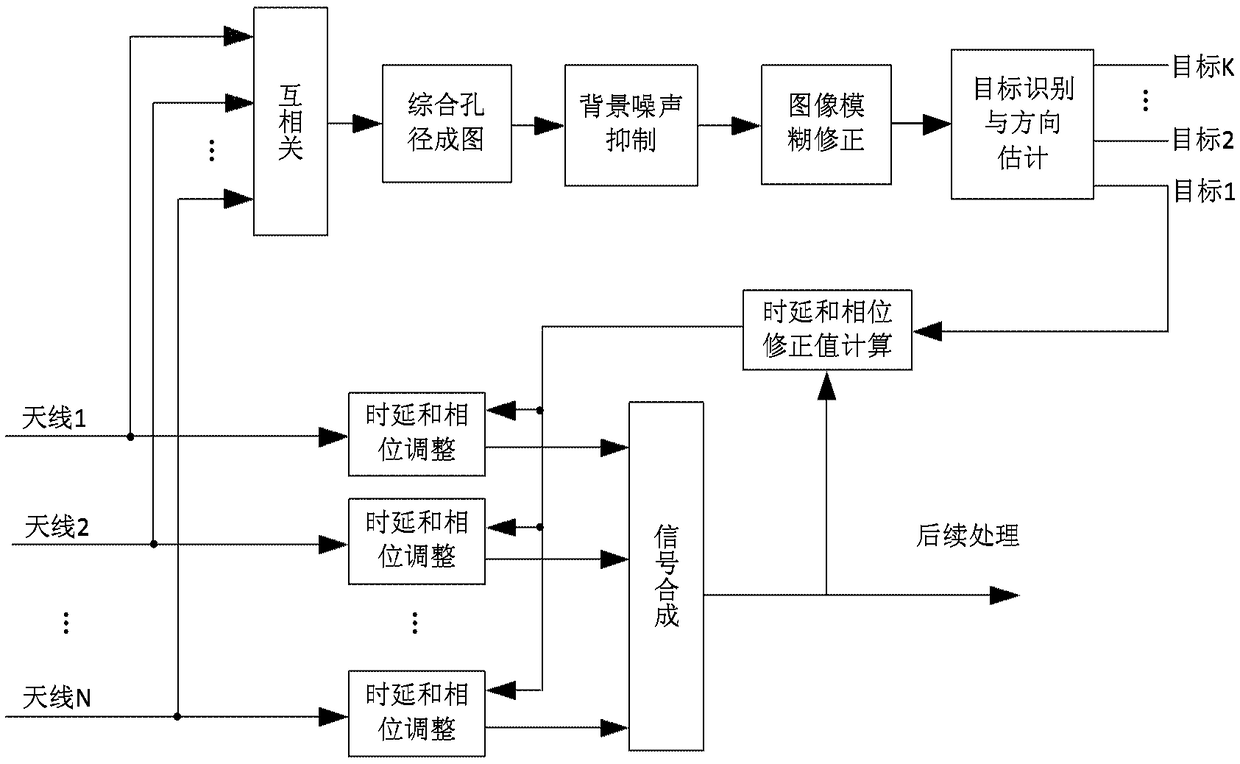
The invention relates to a space multi-target detection system and method. The method comprises the following steps: performing cross-correlation calculation on each of a plurality of receiving antenna signals; obtaining a brightness distribution function according to a cross-correlation calculation result and realizing comprehensive aperture mapping of an observed area; realizing the suppressionof cosmic background noise in the comprehensive aperture mapping by utilizing observed data or prediction calculation; correcting image blur caused by spatial target motion in the comprehensive aperture mapping according to the observed data or an orbital mechanics model; realizing the recognition and the direction estimation of multiple targets in the comprehensive aperture mapping through threshold value judgment; realizing calculation on time delay and phase difference of each of antennas relative to a phase center aiming at selected target direction and performing time delay and phase adjustment; realizing the alignment of each of the antenna signals in the selected target direction according to time delay and phase difference calculation values; performing co-directional addition on signal values of all the receiving antennas and realizing the observation of a signal source in the selected target direction.
Need to check novelty before this filing date? Find Prior Art

Description

technical field

[0001] The present invention relates to the field of space technology, in particular to ground-based detection technology for space objects such as space debris and asteroids, and more particularly to a space multi-object detection system and method. Background technique

[0002] As an active detection device, ground-based radar can detect a large airspace compared with optical detection devices, and has the advantages of working all-weather and all-weather. It is the main method for detecting space debris in low and medium orbits. As of the end of 2014, there were 16,906 Earth orbit objects routinely tracked and cataloged, of which only about 6% were payloads, and the rest were all space debris, with more than 500,000 pieces of space debris larger than 1cm in size. The existence of space debris brings great harm to the normal operation of spacecraft.

[0003] The potential impact threat of small near-Earth objects on the earth has been more and more recogni...

Examples

Embodiment Construction

[0117] In order to make the object, technical solution and advantages of the present invention clearer, the present invention will be further described in detail below in conjunction with specific embodiments and with reference to the accompanying drawings.

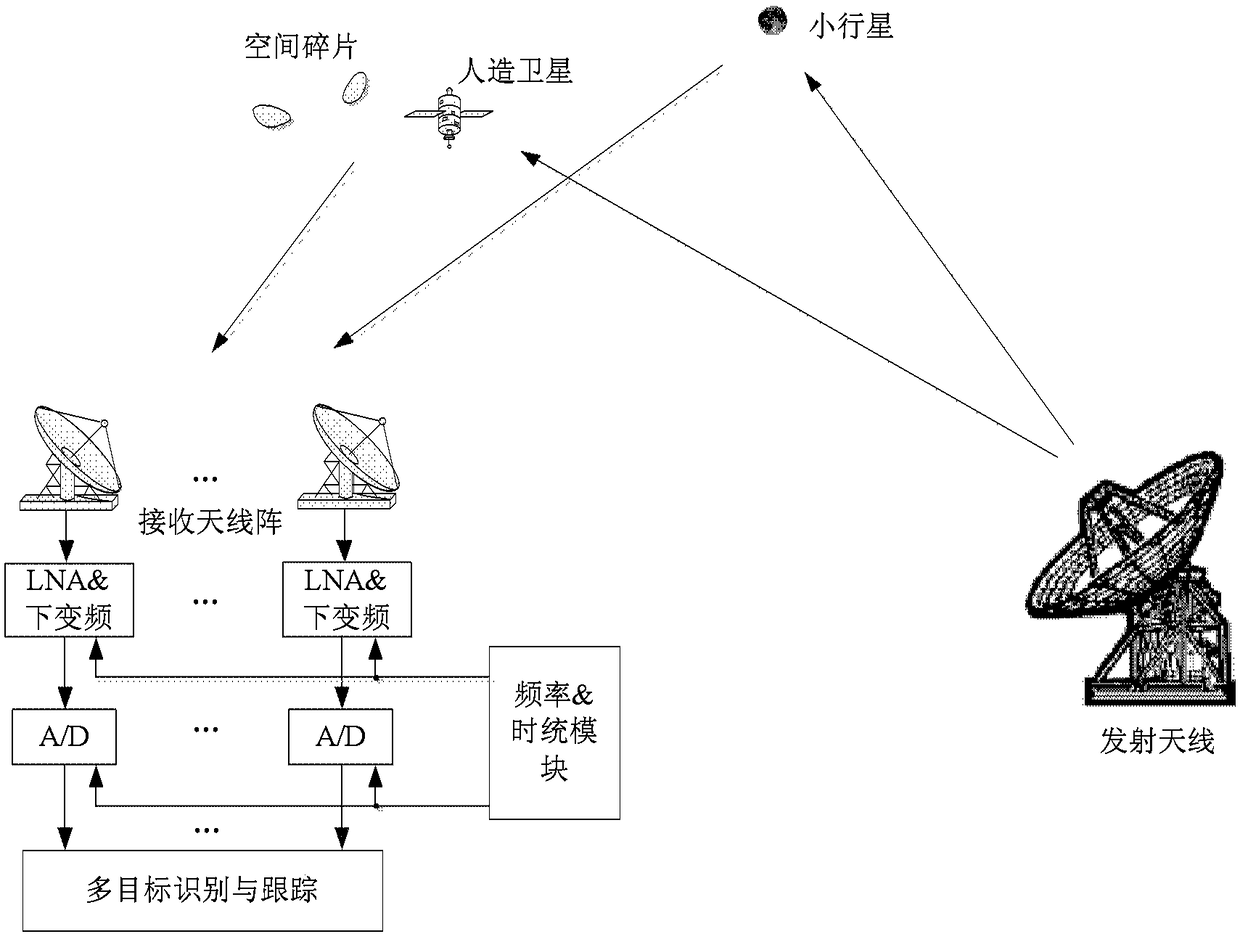
[0118] The acquisition of multiple targets in unknown orbital space is a difficult point in ground-based radar detection. Aiming at the deficiencies of common ground-based radar detection methods, the invention discloses a spatial multi-target detection method based on antenna array synthetic aperture mapping. Multiple targets here refer to space debris, satellites, asteroids or other space targets. Due to the wide beam of the receiving antenna, simultaneous observation of multi-target general survey and precise orbit determination can be realized through data processing.

[0119] The signal receiving antenna of the present invention adopts a large number of small and medium antenna arrays; the transmitting antenna can a...