A bidirectional identity authentication method based on radio frequency identification for a block chain

A two-way identity authentication and radio frequency identification technology, applied in user identity/authority verification, short-distance communication services, security devices, etc., can solve the problem of low security and efficiency of electronic tags, limited storage resources of electronic tags, and high system communication overhead, etc. problems, to overcome limited storage resources, achieve mutual authentication, and achieve a wide range of applications

CN109788465AActive Publication Date: 2019-05-21XIDIAN UNIV
15 Cites 3 Cited by

Patent Information

Authority / Receiving Office
CN · China
Current Assignee / Owner
Publication Date
2019-05-21

Smart Images

  • Figure 1
    Figure 1
  • Figure 2
    Figure 2
  • Figure 3
    Figure 3
Patent Text Reader

Abstract

The invention discloses a bidirectional identity authentication method based on radio frequency identification for a block chain, and mainly solves the problems that a background database in the priorart is small in storage capacity, low in safety and efficiency, limited in electronic tag storage resource and poor in computing power. The method comprises the following implementation steps: (1) anauthentication request message is sent; (2) the blockchain server authenticates the reader; (3) the blockchain server authenticates the electronic tag; (4) the reader authenticates the electronic tag; (5) the electronic tag authenticates the blockchain server; Compared with the prior art, the identity information and data of the electronic tag are inquired through the block chain server, the calculated amount and occupied resources of the electronic tag are reduced, and bidirectional identity authentication between the electronic tag and the reader is achieved.
Need to check novelty before this filing date? Find Prior Art

Description

Technical field

[0001] The present invention belongs to the field of information processing technology, and further relates to a two-way identity authentication method based on radio frequency identification (RFID) on a blockchain in the field of information processing security technology. The invention can be used for the user's identity authentication of the electronic tags stored on the background database server, and adopts lightweight Hash function encryption to perform mutual authentication between the electronic tags and readers in the radio frequency identification RFID system. Background technique

[0002] Radio frequency identification RFID is a key technology for building the Internet of Things. Because radio frequency identification RFID technology can automatically identify high-speed moving objects without contact and can identify multiple electronic tags at the same time, the operation is quick and convenient. Therefore, it is widely used in various fields, such as...

Examples

Embodiment Construction

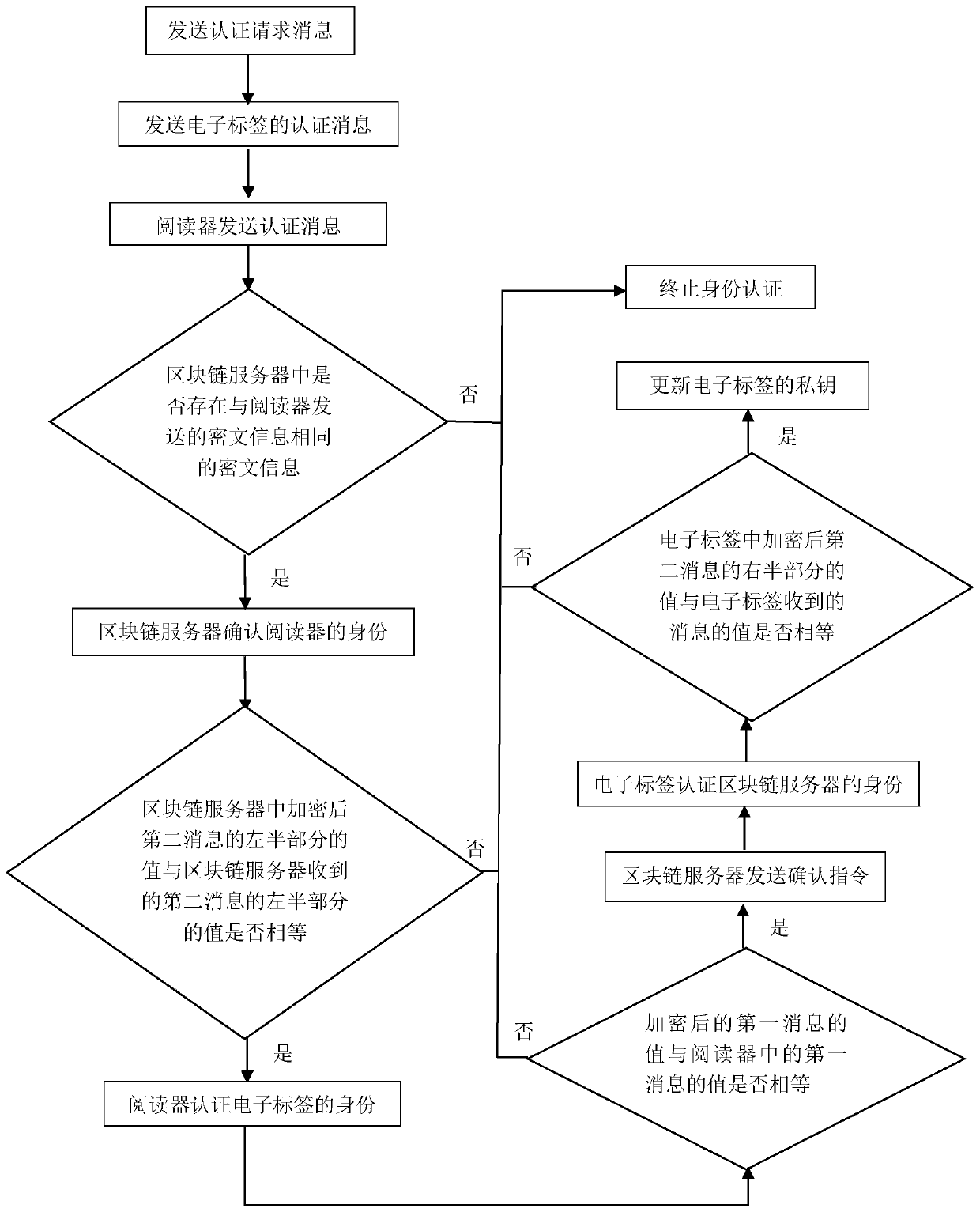
[0049] Attached below figure 1 The present invention will be further described.

[0050] Step 1. Send an authentication request message.

[0051] The reader uses a pseudo-random number generator to generate random numbers for the reader.

[0052] Send the reader's random number and authentication request message to the electronic label.

[0053] Step 2. Send the authentication message of the electronic label.

[0054] Electronic tags use pseudo-random number generators to generate random numbers for tags.

[0055] Concatenate the random number of the electronic tag, the ID number of the electronic tag, and the private key of the electronic tag.

[0056] Use the lightweight Hash function to hash the result of the cascade to get the encrypted first message M 1 .

[0057] Use the lightweight Hash function to hash the private key of the electronic tag to obtain the encrypted hash value.

[0058] The random number of the reader, the random number of the electronic tag, and the encrypted hash va...