Current sensing device and associated method
A current sensing and current technology, applied in electronic switches, only measuring current, circuits, etc., can solve problems such as inability to accurately sense current amplitude and change
- Summary
- Abstract
- Description
- Claims
- Application Information
AI Technical Summary
Problems solved by technology
Method used
Image



Examples
Embodiment Construction
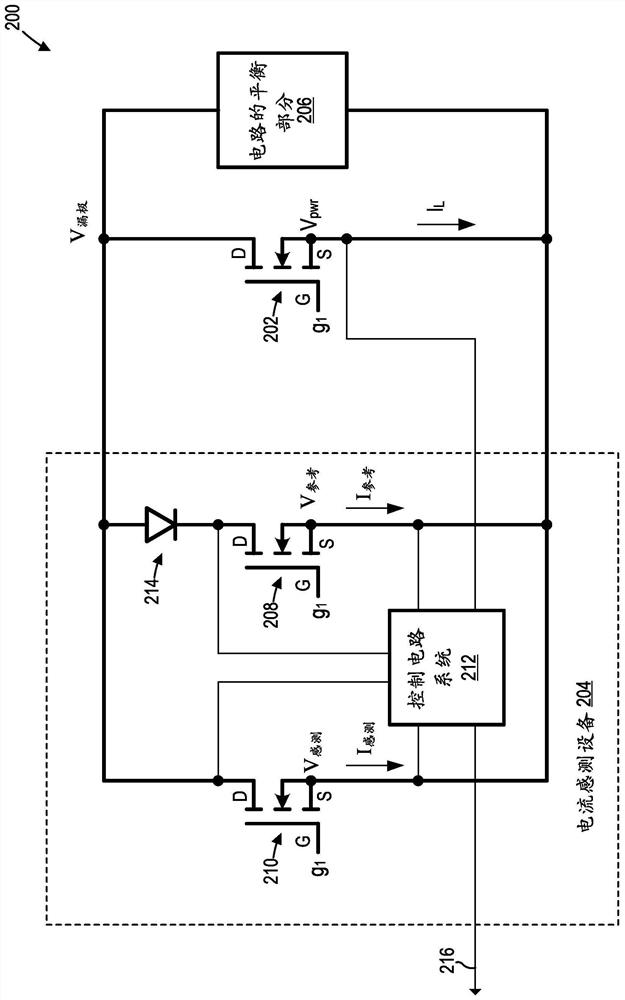
[0045] Applicants have determined that due to the mismatch between the power transistor and the sense transistor, conventional non-dissipative current sensing devices such as figure 1 current sensing devices) may degrade over time. Specifically, power transistors are subject to significant stress during operation, such as due to hot carrier injection (HCI) effects and transient voltage spikes, which may momentarily drive the power transistor to breakdown (BV). This stress causes the electrical characteristics of the power transistor, such as the transistor's on-resistance, to change over time. For example, device-level HCI characterization has shown that transistor triode current, which affects transistor on-resistance, can shift by 10% to 20% over transistor lifetime due to HCI effects. Additionally, simulations show that transistor triode currents may initially shift by about 20% in response to high current switching, followed by a slower shift similar to that caused by the...
PUM
 Login to View More
 Abstract
Description
Claims
Application Information
 Login to View More
 - R&D
- Intellectual Property
- Life Sciences
- Materials
- Tech Scout
- Unparalleled Data Quality
- Higher Quality Content
- 60% Fewer Hallucinations
Browse by: Latest US Patents, China's latest patents, Technical Efficacy Thesaurus, Application Domain, Technology Topic, Popular Technical Reports.
© 2025 PatSnap. All rights reserved.Legal|Privacy policy|Modern Slavery Act Transparency Statement|Sitemap|About US| Contact US: help@patsnap.com