
Application of polymethoxylated flavonoid extract in preparing products resisting oxidation stress
A technique for polymethoxylated flavonoids, oxidative stress, applied in the field of application
- Summary
- Abstract
- Description
- Claims
- Application Information
AI Technical Summary
Problems solved by technology
Method used
Image

Examples
Embodiment 1
[0024] The preparation of embodiment 1 Ou mandarin polymethoxyl flavone component
[0025] The ripe fruit of Ou mandarin orange (collected from Lishui City, Zhejiang Province) is selected with no mechanical damage to the peel and no pests and diseases, and the peel and pulp are separated. After quick-freezing in liquid nitrogen, it is dried in a low-temperature vacuum, and the freeze-dried powder is obtained after grinding. Weigh 10.3g of freeze-dried Ou mandarin fruit peel powder and use 95% ethanol (solid-to-liquid ratio 1:20) to ultrasonically extract three times (25°C), each time for 45min. Evaporate to dryness until the ethanol-free phase is dissolved in deionized water to obtain an aqueous solution of Ou mandarin peel extract.
[0026] Take about 5mL of the aqueous solution of Ou mandarin peel extract and load the sample C18 solid-phase extraction column (12cc / 2g, Waters), after loading, the solid-phase extraction column is first eluted with deionized water for 25 times ...
Embodiment 2
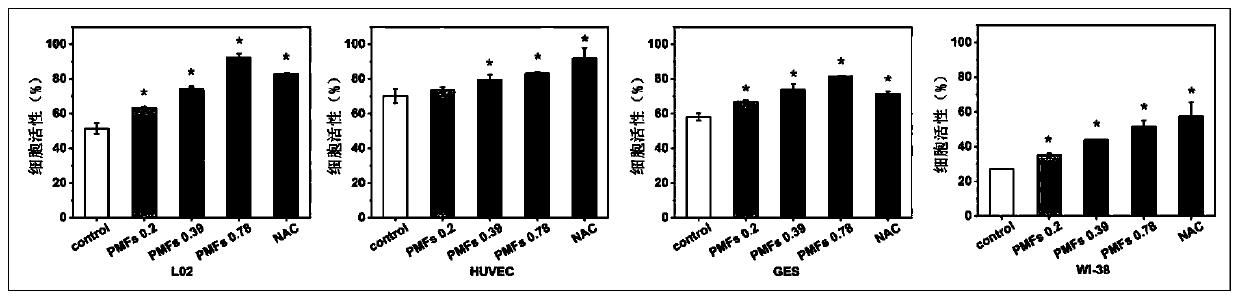
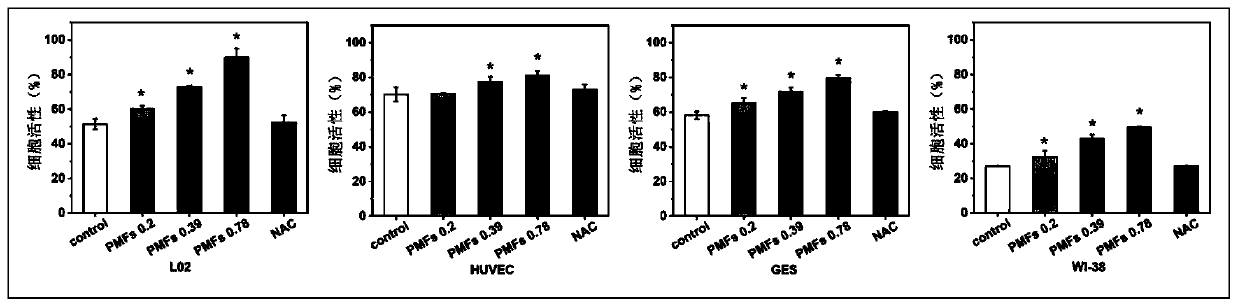
[0027] Example 2 The effect of the polymethoxylated flavonoid components of Ougan on the cell activity of human liver L02 cells, human gastric GES cells, human umbilical vein epithelial HUVEC cells, and human fibroblast WI-38 cells when they are injured by hydrogen peroxide oxidative stress
[0028] Human liver L02 cells, human gastric GES cells, human umbilical vein epithelial HUVEC cells, and human fibroblast WI-38 cells were cultured with RPMI-1640 containing 10% fetal bovine serum at 37°C and 5% CO 2 Incubate in a cell culture incubator, replace with fresh culture medium every other day, and passage once every 2-3 days. During the experiment, L02, GES, HUVEC, and WI-38 cells were seeded in 96-well plates. When the cells grow to 70-80% confluence, the original medium is discarded, and the drugs are added in groups. Establish blank control group (no hydrogen peroxide treatment), DMSO solvent control group, N-acetylcysteine (NAC) control group (final concentration is 2mmol...
Embodiment 3
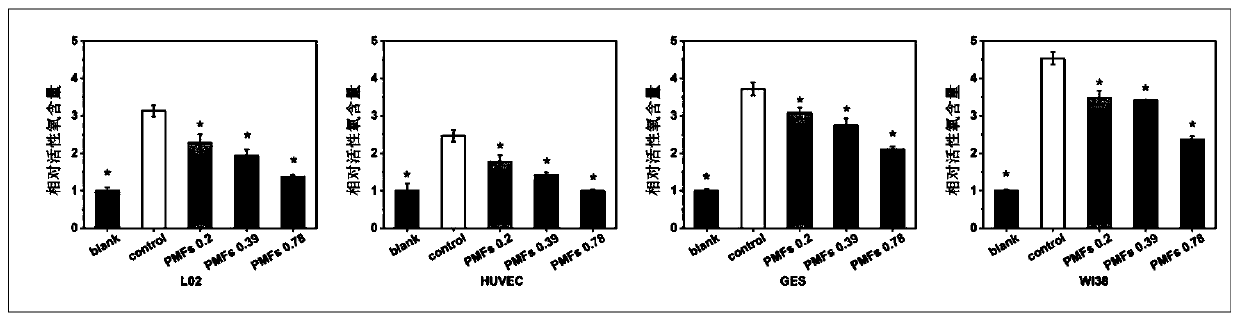
[0030] Example 3 Ou mandarin polymethoxylated flavonoid components on the active oxygen in human liver L02 cells, human gastric GES cells, human umbilical vein epithelial HUVEC cells, and human fibroblast WI-38 cells when they were damaged by hydrogen peroxide oxidative stress The effect of content
[0031] Human liver L02 cells, human gastric GES cells, human umbilical vein epithelial HUVEC cells, and human fibroblast WI-38 cells were cultured with RPMI-1640 containing 10% fetal bovine serum at 37°C and 5% CO 2 Incubate in a cell culture incubator, replace with fresh culture medium every other day, and passage once every 2-3 days. During the experiment, L02, GES, HUVEC, and WI-38 cells were seeded in 96-well plates. When the cells grow to 70-80% confluence, the original medium is discarded, and the drugs are added in groups. A blank control group (without hydrogen peroxide treatment), a DMSO solvent control group, and different concentrations of citrus polymethoxylated flav...
PUM
 Login to View More
 Abstract
Description
Claims
Application Information
 Login to View More