
Process for micro-taking blood and fast quantitatively testing fat blood
A technology for quantitative detection and fat blood, which is applied in measuring devices, blood sampling devices, color/spectral characteristic measurement, etc., can solve problems such as equipment and effective methods that have not been recorded, so as to prevent the occurrence of fat blood collection and prevent blood from being scrapped , the effect of saving blood resources
- Summary
- Abstract
- Description
- Claims
- Application Information
AI Technical Summary
Problems solved by technology
Method used
Image

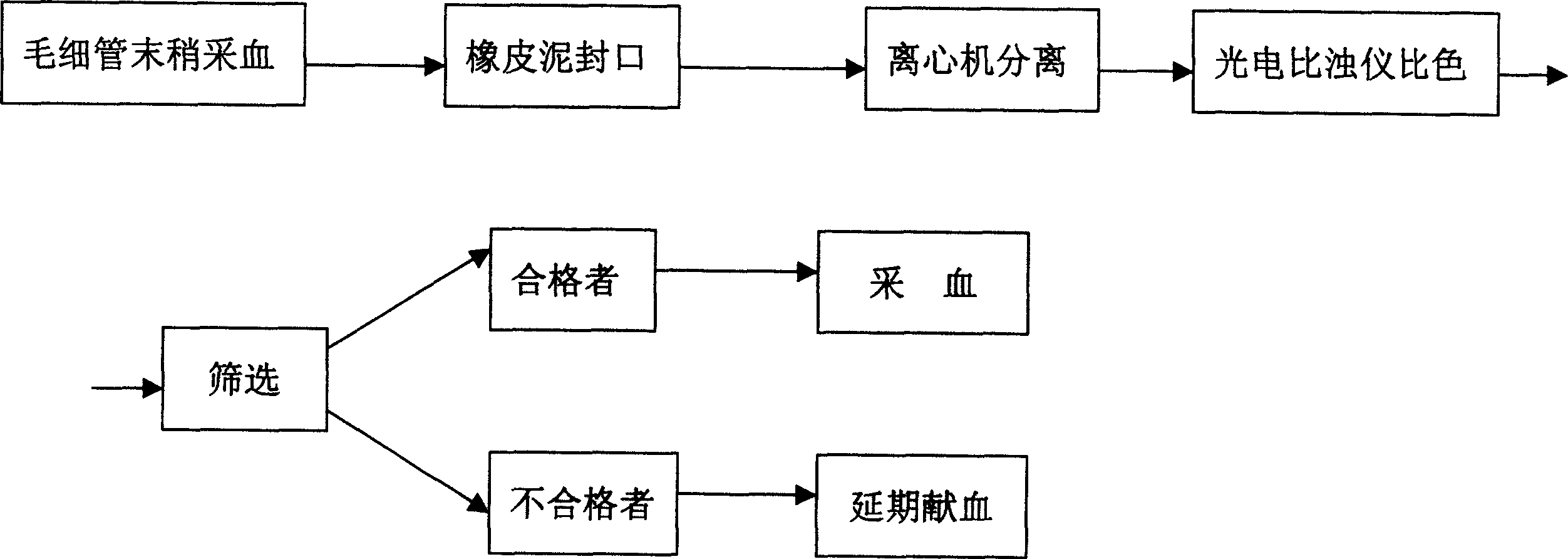
Examples
Embodiment 1
[0018] Use the special capillary blood collection tube of the present invention to collect 60ul of blood at the end of the blood donor on the street, seal the lower opening of the capillary blood collection tube with plasticine, open the special centrifuge cover for rapid quantitative detection of fat blood for micro blood collection, and place the capillary blood collection tube in the centrifuge tube In the micropore of the movable soft rubber column in the cavity, start the centrifuge to separate the plasma; place the capillary blood collection tube after separating the plasma in the sample positioner of the photoelectric turbidimeter, turn on the photoelectric turbidimeter, and detect it by monochromatic light waves. The test results determine whether it is fat blood. If it is lower than the set standard, it means that the trace blood collected is qualified blood, and blood collection can be carried out on the street for on-site blood donation.
Embodiment 2
[0020] Use the special capillary blood collection tube of the present invention to collect 40ul of blood from the end of the blood donor on the street, seal the capillary blood collection port with plasticine, open the special centrifuge cover for the rapid quantitative detection of fat blood in the street micro blood collection, and place the capillary blood collection tube in the centrifuge tube In the micropore of the movable soft rubber column in the cavity, the centrifuge is started to separate the serum; the capillary blood collection tube after separating the plasma is placed in the sample window of the photoelectric turbidimeter, and the photoelectric turbidimeter is turned on for detection by monochromatic light waves. The results determine whether to donate blood or not. If it is higher than the set standard, it means that the trace blood collected is unqualified, and it is blood with excessive fat, which can discourage blood donors from delaying blood donation.
PUM
 Login to View More
 Abstract
Description
Claims
Application Information
 Login to View More