
Use of neural cells derived from human pluripotent stem cells for the treatment of neurodegenerative diseases
a technology of neural cells and pluripotent stem cells, which is applied in the field of neurodegenerative diseases and their treatment, can solve the problems of loose efficacy, unspecialized cells capable of renewing themselves, and the number of people needing a transplant far exceeds the number of organs available for transplantation, so as to achieve the effect of increasing dopamine and increasing dopamine levels
- Summary
- Abstract
- Description
- Claims
- Application Information
AI Technical Summary
Benefits of technology
Problems solved by technology
Method used
Image

Examples
example 1
hPSC-NSCs
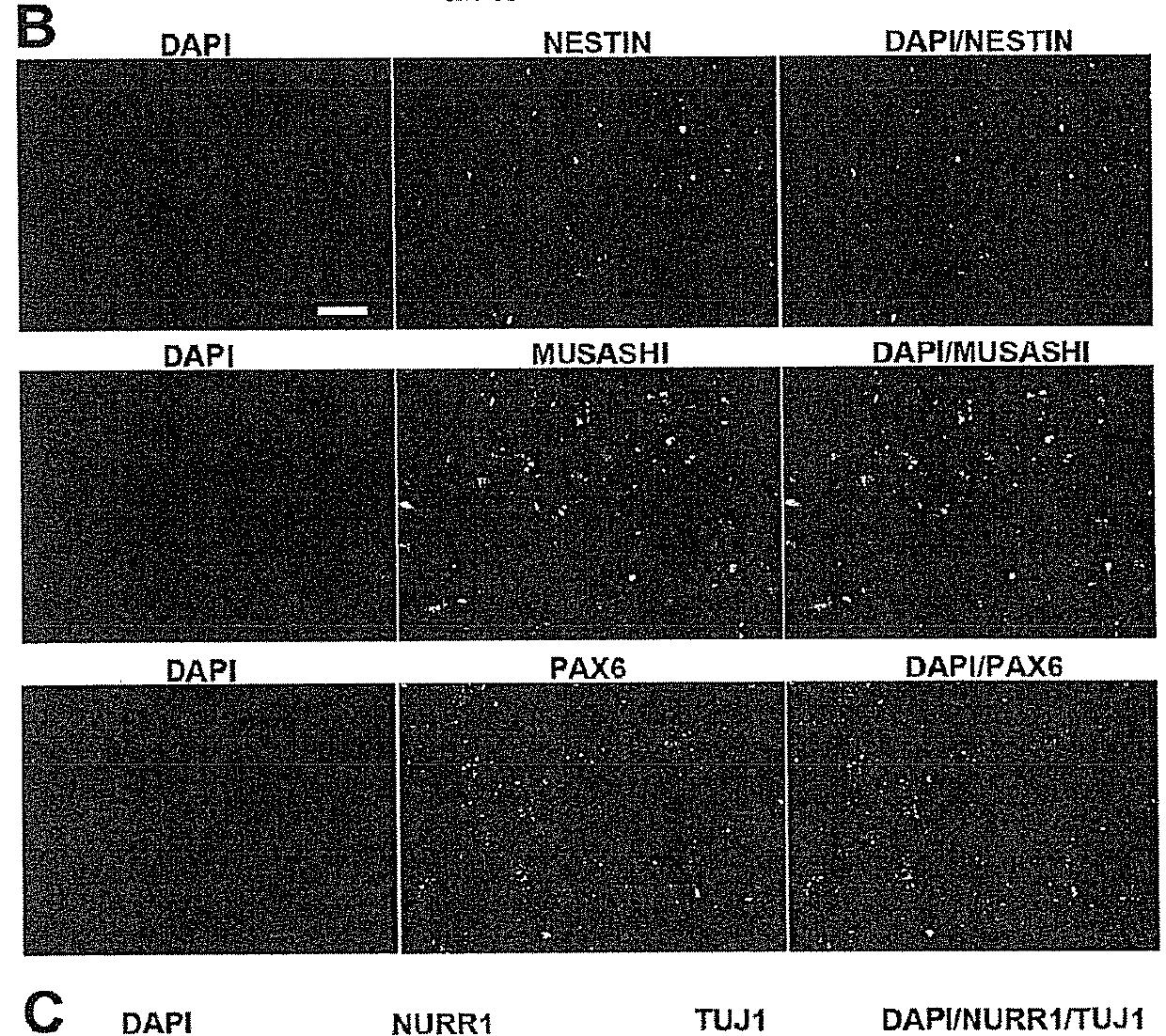
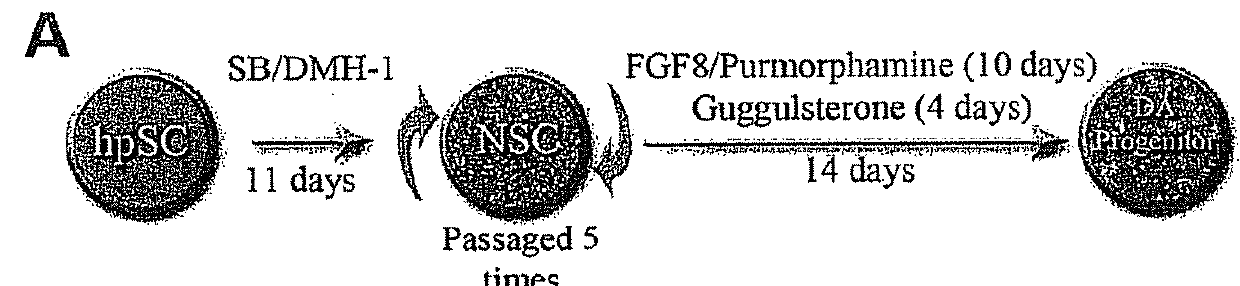
[0076]To derive NSCs, primitive neuroepithelium was induced by switching the hPSCs grown on Matrigel from StemPro to N2B27 medium supplemented with 5 μM SB218078 and 1 μM DMH-1. After 6 days in the presence of these neural inducers, Pax6, an early marker of neural induction, was significantly up-regulated. On day 7, the neutralized hPSCs were switched to NSC medium and then dissociated to derive proliferative NSCs. After 4 passages, the hPSC derived NSC (hPSC-NSC) population was 98% positive for Nestin, 96% for Musashi-1, 95% for PAX6, 0% for OCT4 and gene expression microarray analysis revealed up-regulation of putative NSC markers including FABP7, BRN2, SOX3, ST6GALNAC5, CXCR4, DCX, NES, and MSI.
[0077]Specifically, the hPSC lines [human embryonic stem cell line WA-09 and human parthenogenetic stem cell lines LLC2P and LLC12PH (International Stem Cell Corporation)] were first maintained on a mitomycin-C inactivated mouse embryonic fibroblast (Millipore) feeder layer in emb...
example 2
hPSC Derived Dopaminergic Neurons
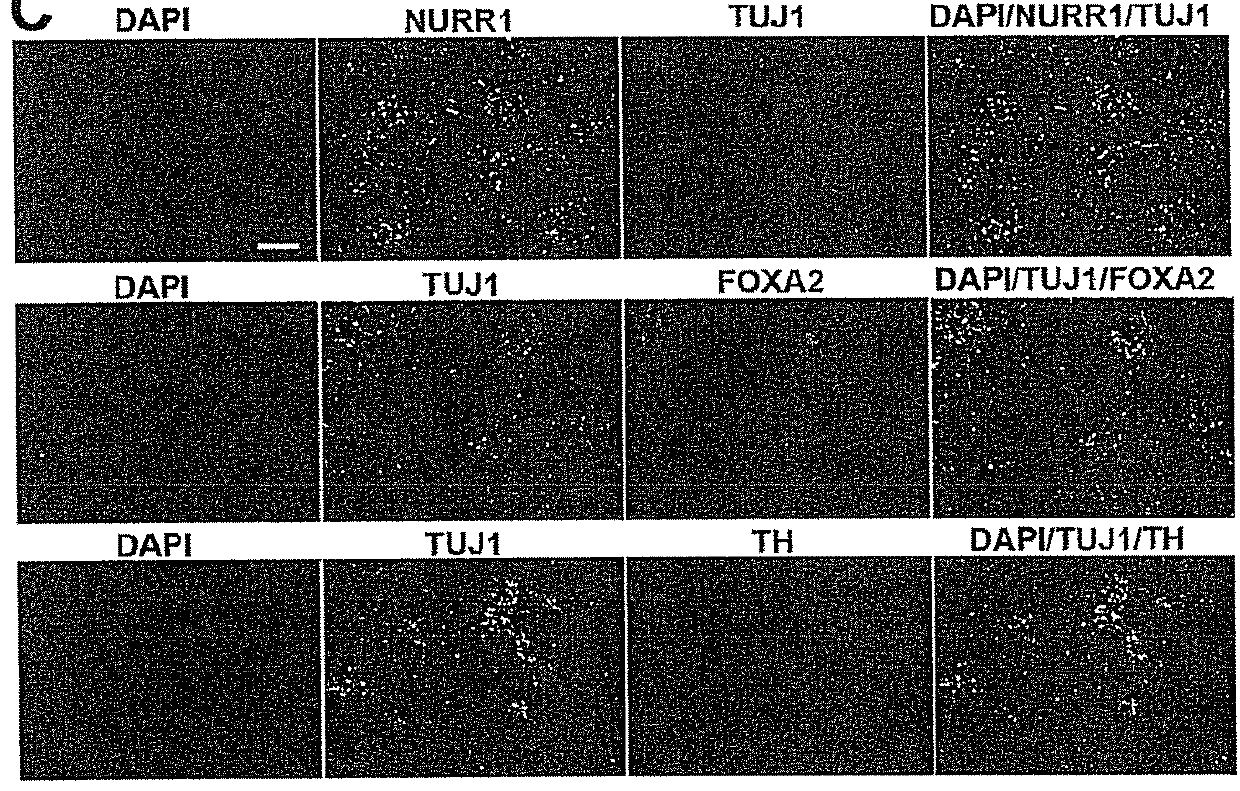
[0078]hPSC-NSC were first primed into DA neuron precursor cells with 100 ng / mL FGF8 and 2 μM Purmorphamine for 7 days. The DA neuron precursor cells were plated at 2000 cells / well of a 96-well plate and treated with guggulsterone (GS) at 2.5 μM for two weeks. After 30 days of differentiation, GS-treated neurons appeared mature with elaborate neurite extensions. At this stage, the derived cells expressed not only the major neuronal marker β-III-tubulin (TUJ1), but also the important DA neuron markers tyrosine hydroxylase (TH), the dopamine transporter (Dat), Foxa2, Nurr-1, and Girk2. Furthermore, FACS analysis revealed that more than 97% of the cells gated were TH positive.
[0079]The method specifically involved treating both hESC-H9-NSCs (Invitrogen) and hPSC-NSCs with Purmorphamine (2 μM) and FGF8 (100 ng / mL) in NB medium [NeuroBasal medium, 1× GlutaMAX, 1× N2 / B27 Supplement (Invitrogen)] for 7 days. After 7 days of Purmorphamine and FGF8 treatment, ...
example 3
Implantation of hPSC-Derived NSCs into 6-OHDA-Induced Parkinson's Disease Rat Model
[0080]Adult female Sprague-Dawley rats with unilateral, medial forebrain bundle 6-OHDA lesions of the nigro-striatal pathway were purchased from Charles River. This Parkinson's disease rat model is based on a 6-OHDA induced lesion on the left brain hemisphere. A rotational challenge test was administered by Charles River 5-7 days post-surgery to verify surgical success with a subcutaneous injection of 0.2 mg / kg of apomorphine hydrochloride. The drug was administered and the rotational count began upon the first rotation. The count continued for 5 minutes and the final count was divided by 5 for the rotations per minute. A successful surgery was determined by a minimum of 5 rotations per minute. All information was logged on the Parkinson Test Sheet: Animal Number, body weight, injection time, start time, end time, total rotations, rotations per minute, and Pass or Fail.
[0081]Three weeks after 6-OHDA l...
PUM
| Property | Measurement | Unit |
|---|---|---|
| time | aaaaa | aaaaa |
| O2 tension | aaaaa | aaaaa |
| tension | aaaaa | aaaaa |
Abstract
Description
Claims
Application Information
 Login to View More