
Minimally-invasive surgery tool with automatic lighting
a technology of automatic lighting and minimally invasive surgery, which is applied in the field of surgical retractor tools, can solve the problems of difficult to obtain sufficient illumination of the target tissue, limited light penetration, and often occurring shadows, and achieves the effects of facilitating sterility, preventing moisture, and maximizing user convenien
- Summary
- Abstract
- Description
- Claims
- Application Information
AI Technical Summary
Benefits of technology
Problems solved by technology
Method used
Image

Examples
Embodiment Construction
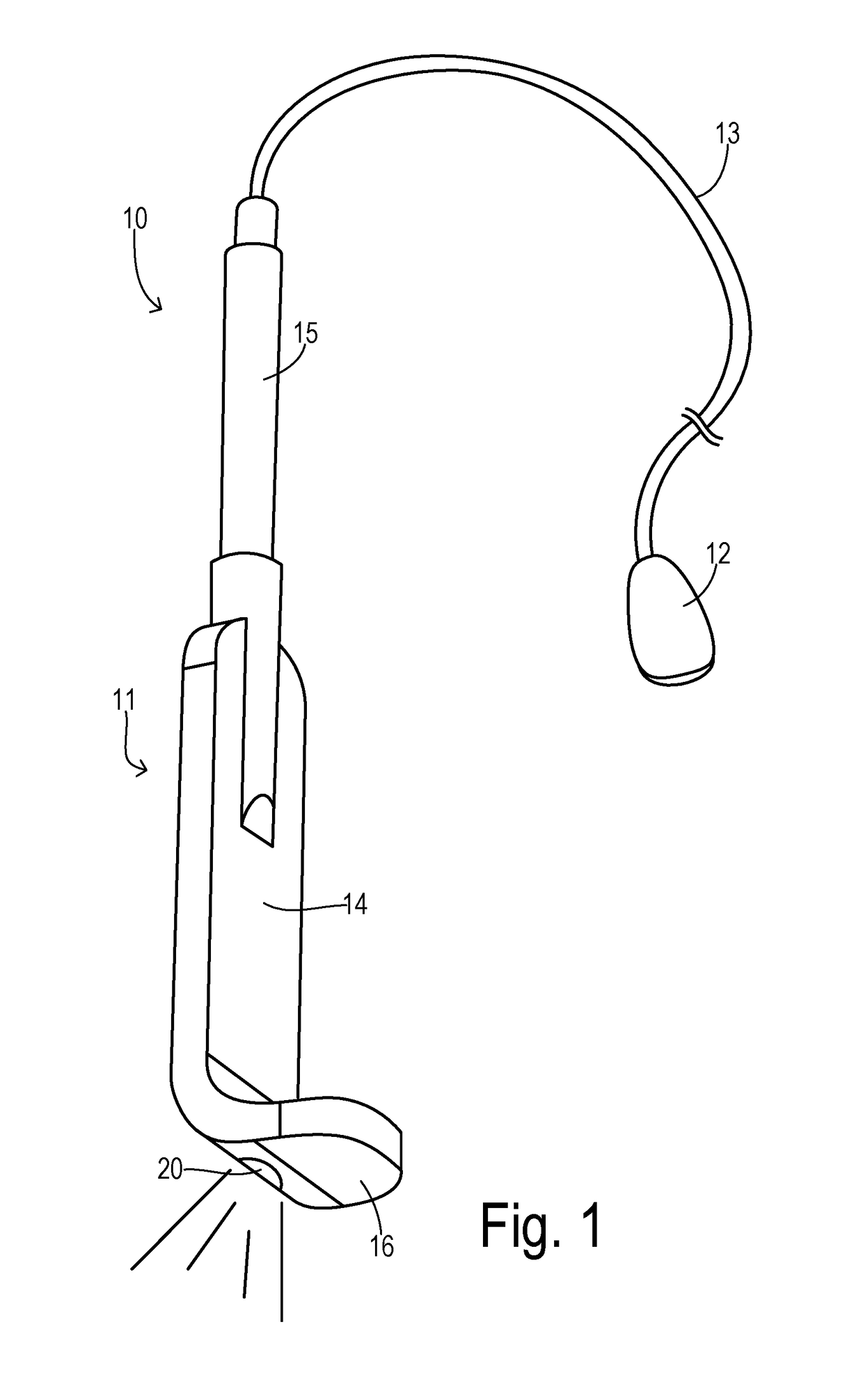
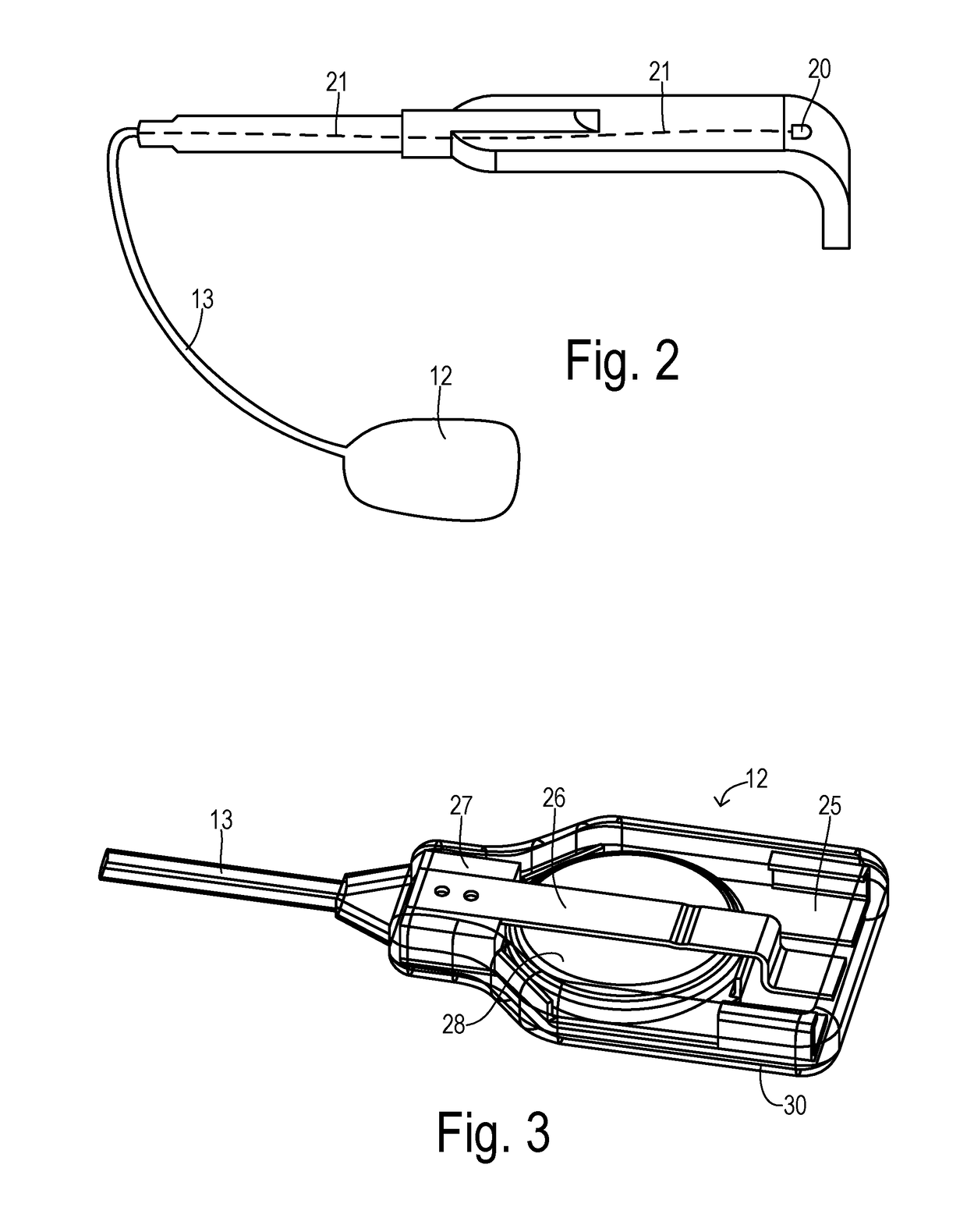
[0020]FIGS. 1 and 2 are perspective views of an illuminated tool system 10 having a retractor or rake body 11 connected to a power unit 12 by a power cord 13. Rake body 11 has a paddle or rake 14 and a handle section 15 at opposite ends. Rake 14 is formed at the distal end with a finger or flap 16 extending transversely from body 11. Rake body 11 is preferably molded of a biocompatible thermoplastic material such as polyvinylchloride, nylon, or the like. At least in the region of rake 14, body 11 is comprised of a light transmissive (i.e., clear) plastic. A light emitting diode (LED) 20 and electrical wiring 21 are imbedded by insert molding rake body 11 around them or by potting. LED 20 preferably emits white light. Other light sources could also be used. Power unit 12 supplies a current to LED 20 that produces a desired level of illumination. Wiring 21 passes through power cord or cable 13 to power unit 12 with the overmolding preferably forming a continuously molded structure for...
PUM
 Login to View More
 Abstract
Description
Claims
Application Information
 Login to View More