
Silver powder for silver clay and silver clay comprising the silver powder
- Summary
- Abstract
- Description
- Claims
- Application Information
AI Technical Summary
Benefits of technology
Problems solved by technology
Method used
Image

Examples
embodiment 1
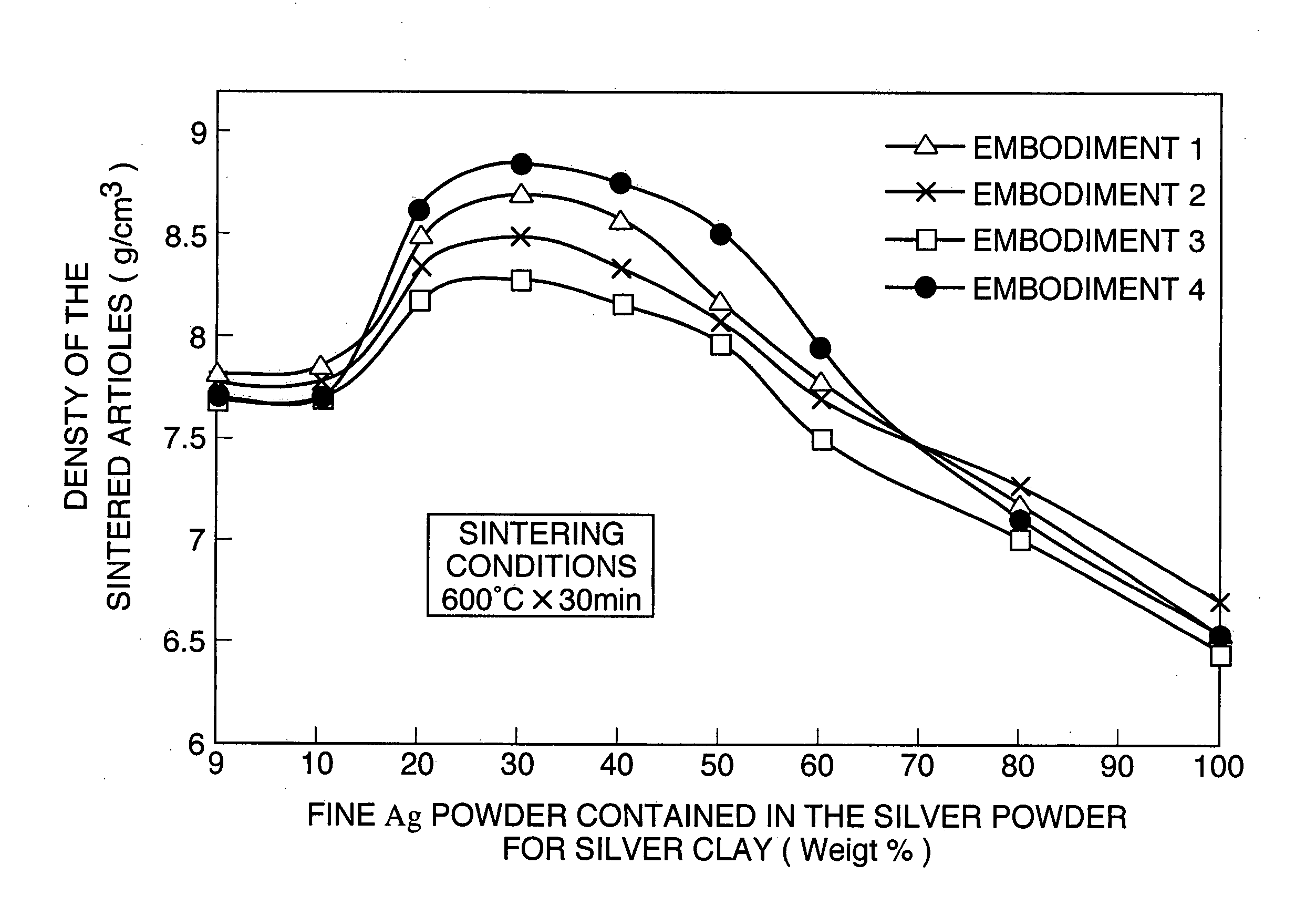
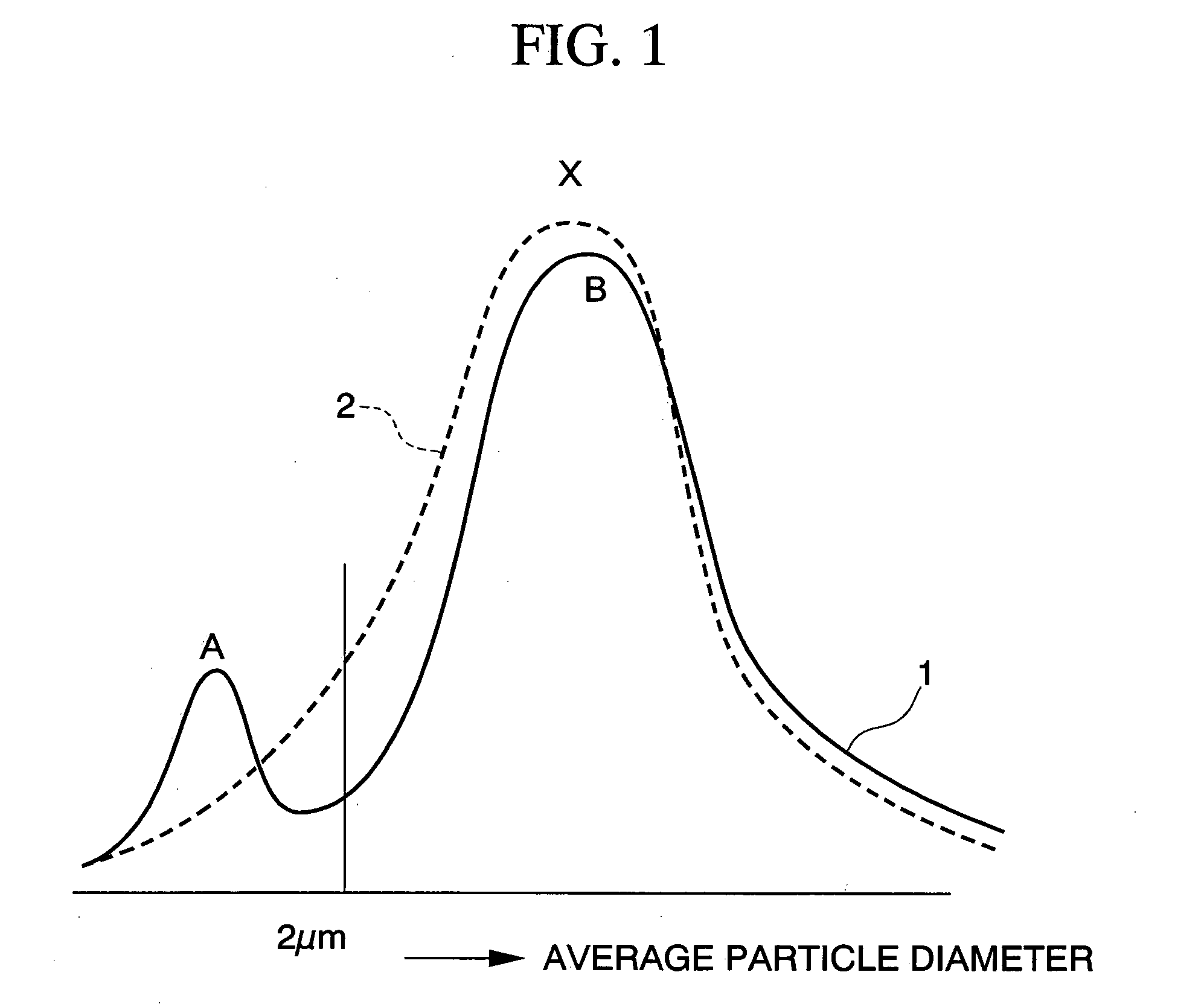
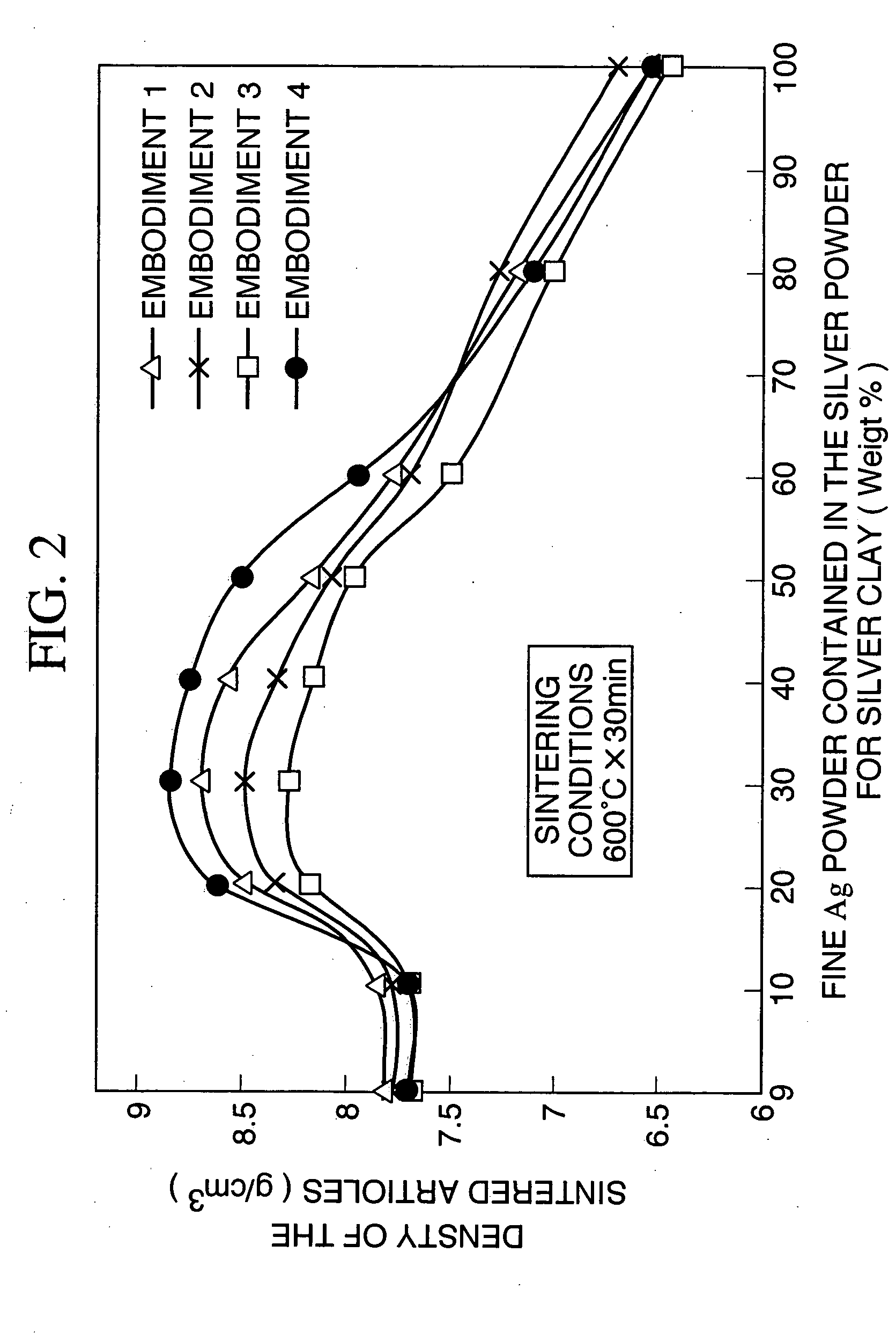
[0028] Nine types of silver powder for silver clay having different particle distributions were produced by a spherical fine Ag powder having an average particle diameter of 1.0 μm produced by a chemical reduction method being mixed into an atomized Ag powder having an average particle diameter of 5.0 μm, at 0 weight %, 10 weight %, 20 weight %, 30 weight %, 40 weight %, 50 weight %, 60 weight %, 80 weight %, and 100 weight %. Furthermore, methyl cellulose, a surface active agent, olive oil as an oil, and water were added to the nine types of silver powder for silver clay having differing particle distributions, and silver clays 1 to 9 were produced that contain the silver powder for silver clay at 85 weight %, methyl cellulose at 4.5 weight %, surface active agent at 1.0 weight %, olive oil at 0.3 weight %, with the remainder being water.
[0029] The silver clays 1 to 9 were molded, and the obtained molded articles were sintered 30 minutes at a low temperature of 600° C. to produce ...
embodiment 2
[0030] Nine types of silver powder for silver clay were having different particle distributions were produced by a spherical fine Ag powder having an average particle diameter of 1.5 μm produced by a chemical reduction method being mixed into an atomized Ag powder having an average particle diameter of 5.0 μm, at 0 weight %, 10 weight %, 20 weight %, 30 weight %, 40 weight %, 50 weight %, 60 weight %, 80 weight %, and 100 weight %. Using these nine types of silver powder for silver clay having different particle distributions, silver clays 10 to 18 were produced by the same method as Embodiment 1.
[0031] These silver clays 10 to 18 were molded, and sample sintered articles were produced by sintering the obtained molded articles under conditions identical to those of Embodiment 1. The tensile strength and the density of the obtained sample sintered articles were measured in a manner identical to that in Embodiment 1, and the results of the measurements are shown in Table 2. Furthermo...
embodiment 3
[0032] Nine types of silver powder for silver clay were having different particle distributions were produced by a spherical fine Ag powder having an average particle diameter of 0.5 μm produced by a chemical reduction method being mixed into an atomized Ag powder having an average particle diameter of 5.0 μm, at 0 weight %, 10 weight %, 20 weight %, 30 weight %, 40 weight %, 50 weight %, 60 weight %, 80 weight %, and 100 weight %. Using these nine types of silver powder for silver clay having different particle distributions, silver clays 19 to 27 were produced by the same method as Embodiment 1.
[0033] These silver clays 19 to 27 were molded, and sample sintered articles were produced by sintering the obtained molded articles under conditions identical to those of Embodiment 1. The tensile strength and the density of the obtained sample sintered article were measured in a manner identical to that in Embodiment 1, and the results of the measurements are shown in Table 3. Furthermor...
PUM
| Property | Measurement | Unit |
|---|---|---|
| Percent by mass | aaaaa | aaaaa |
| Percent by mass | aaaaa | aaaaa |
| Percent by mass | aaaaa | aaaaa |
Abstract
Description
Claims
Application Information
 Login to View More