
Stackable differential mobility analyzer for aerosol measurement
a technology of differential mobility analysis and aerosol measurement, which is applied in the direction of material analysis, instruments, etc., can solve the problems of dma axial alignment and gas leakage, become increasingly difficult to perform accurate measurement/classification for particles less than 10 nm, and can only classify one particle at a time as the conventional dma, so as to achieve higher resolution sizing measurements
- Summary
- Abstract
- Description
- Claims
- Application Information
AI Technical Summary
Benefits of technology
Problems solved by technology
Method used
Image

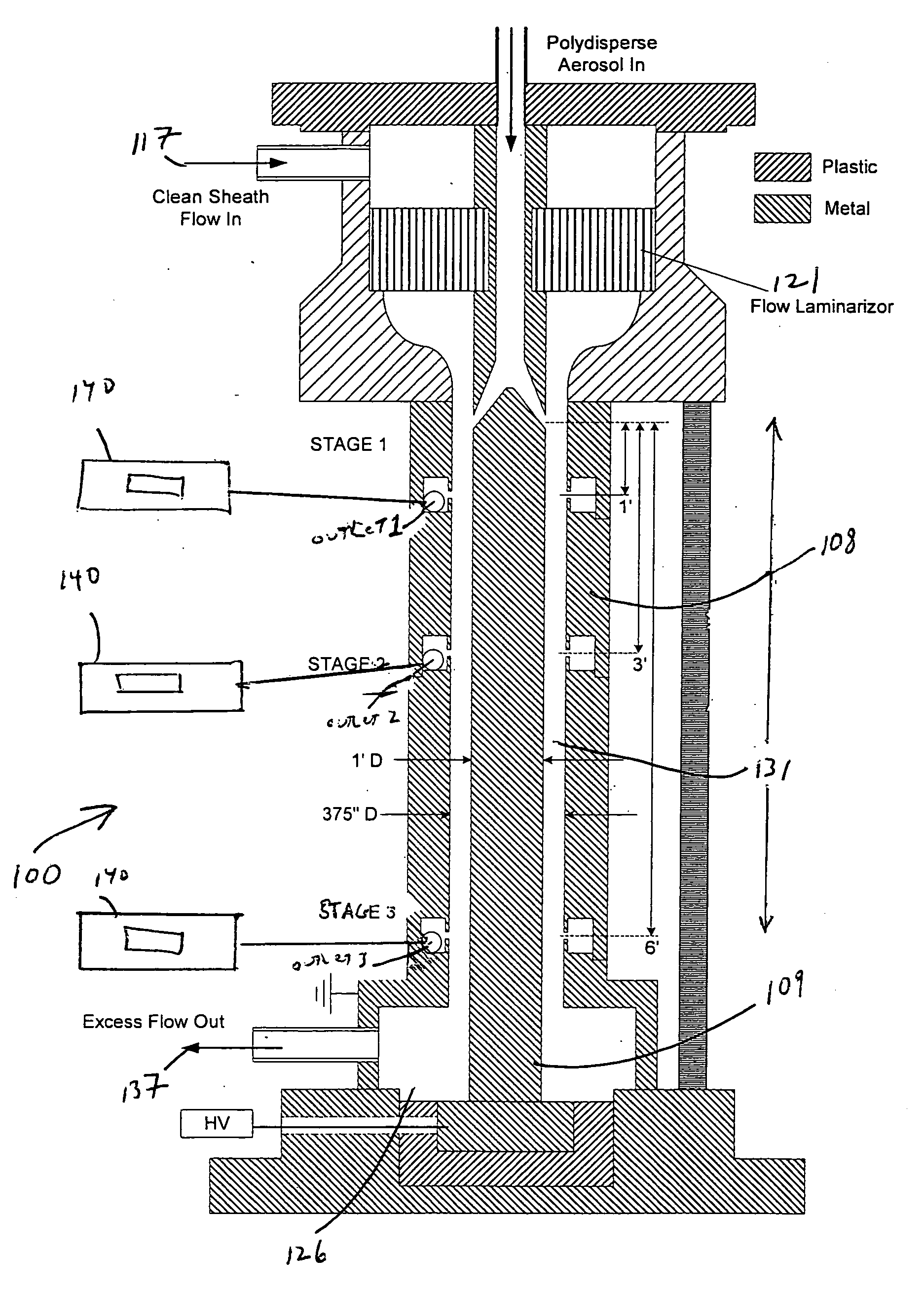
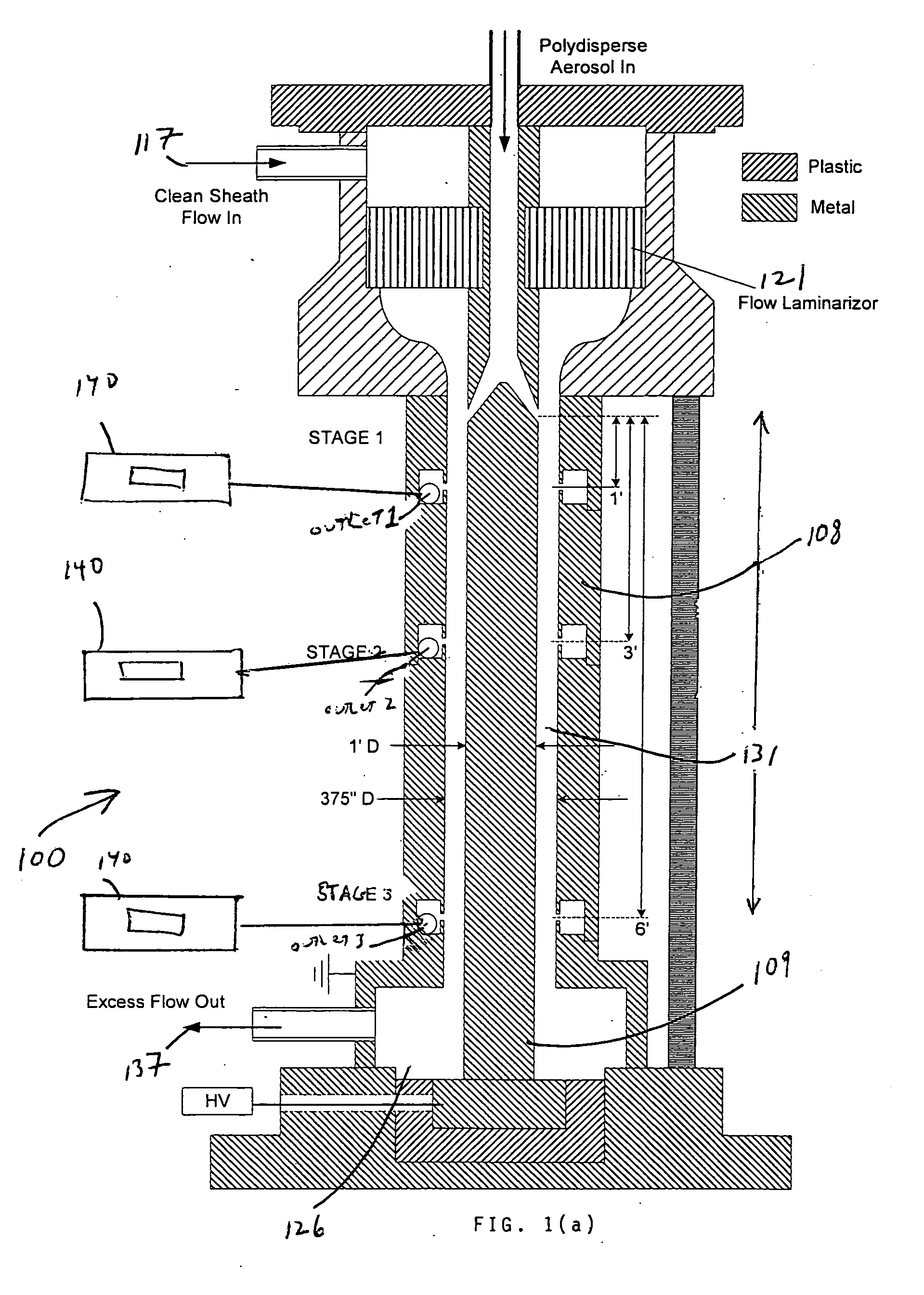
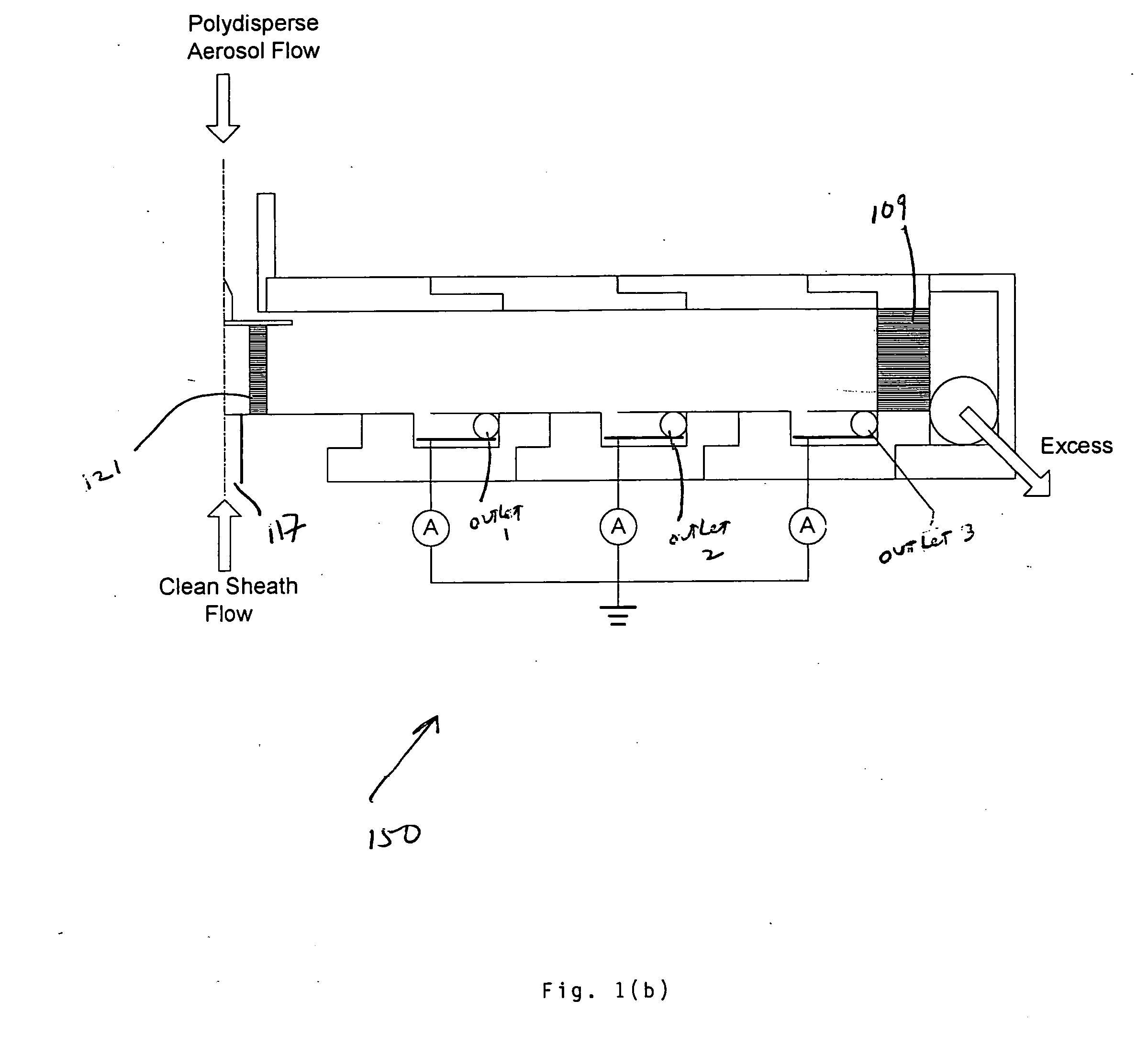
Examples
examples
[0047] The present invention is further illustrated by the following specific Examples, which should not be construed as limiting the scope or content of the invention in any way.
Calibration of Central Electrode Voltage
[0048] Theoretical central voltage (Vt) was calculated by equation (1) based on Knutson and Whitby: Vt=(qc+qm)ln(R2 / R1)4π LZp*(1)
where qc is the sheath flow rate, qm is the excess flow rate, R1 is the outer radius of the center rod (1.27 cm), R2 is the inner radius of the MDMA (1.746 cm), L is the classification length for each stage, and Z*p is the central mobility of first DMA. Since sampling flow is extracted from each stage in MDMAs 100 and 150, the flowrate ratio of polydisperse aerosol and sheath flows are different for each of the three stages. A method is described herein calculate the sheath flow at each stage. The sheath flow at first stage is the clean air introduced into MDMA. The sheath flow subtracting sampling flow at the first stage is equal ...
PUM
 Login to View More
 Abstract
Description
Claims
Application Information
 Login to View More