Method for improving control and detection precision of tidal volume by a calculation introduced with r value

a technology of tidal volume and calculation method, which is applied in the direction of valve operating means/release devices, applications, diagnostic recording/measuring, etc., can solve the problems of inaccurate calculation of tidal volume vt of patients, long circuits affecting signal precision, etc., to improve the control and detection precision of tidal volume, improve the safety of devices during ventilation, and improve the accuracy

US20090165798A1Inactive Publication Date: 2009-07-02BEIJING AEONMED
9 Cites 17 Cited by

Patent Information

Authority / Receiving Office
US · United States
Patent Type
Applications(United States)
Current Assignee / Owner
Publication Date
2009-07-02
Estimated Expiration
Not applicable · inactive patent

Smart Images

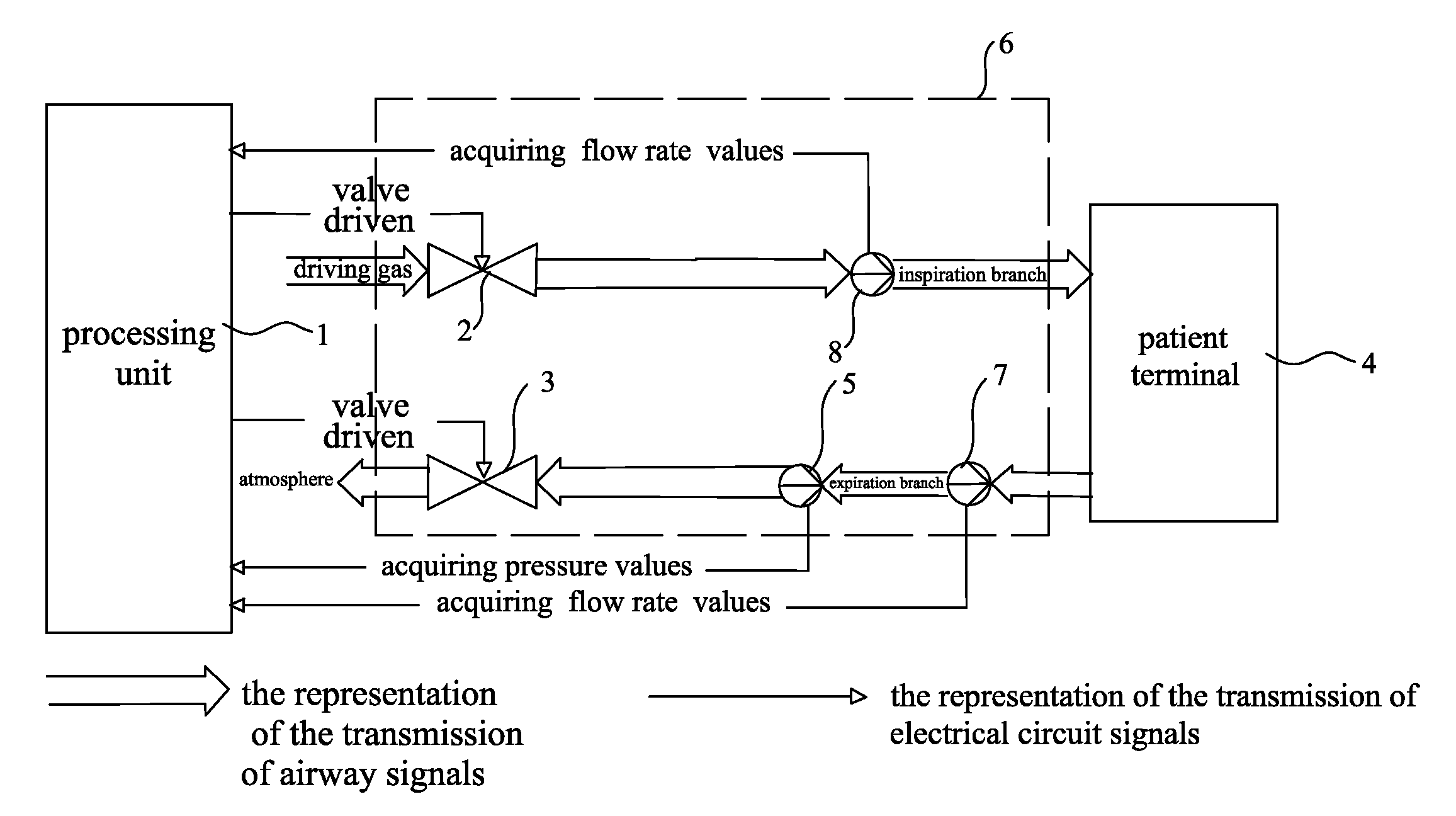
  • Figure 1
    Figure 1
  • Figure 2
    Figure 2
  • Figure 3
    Figure 3
Patent Text Reader

Abstract

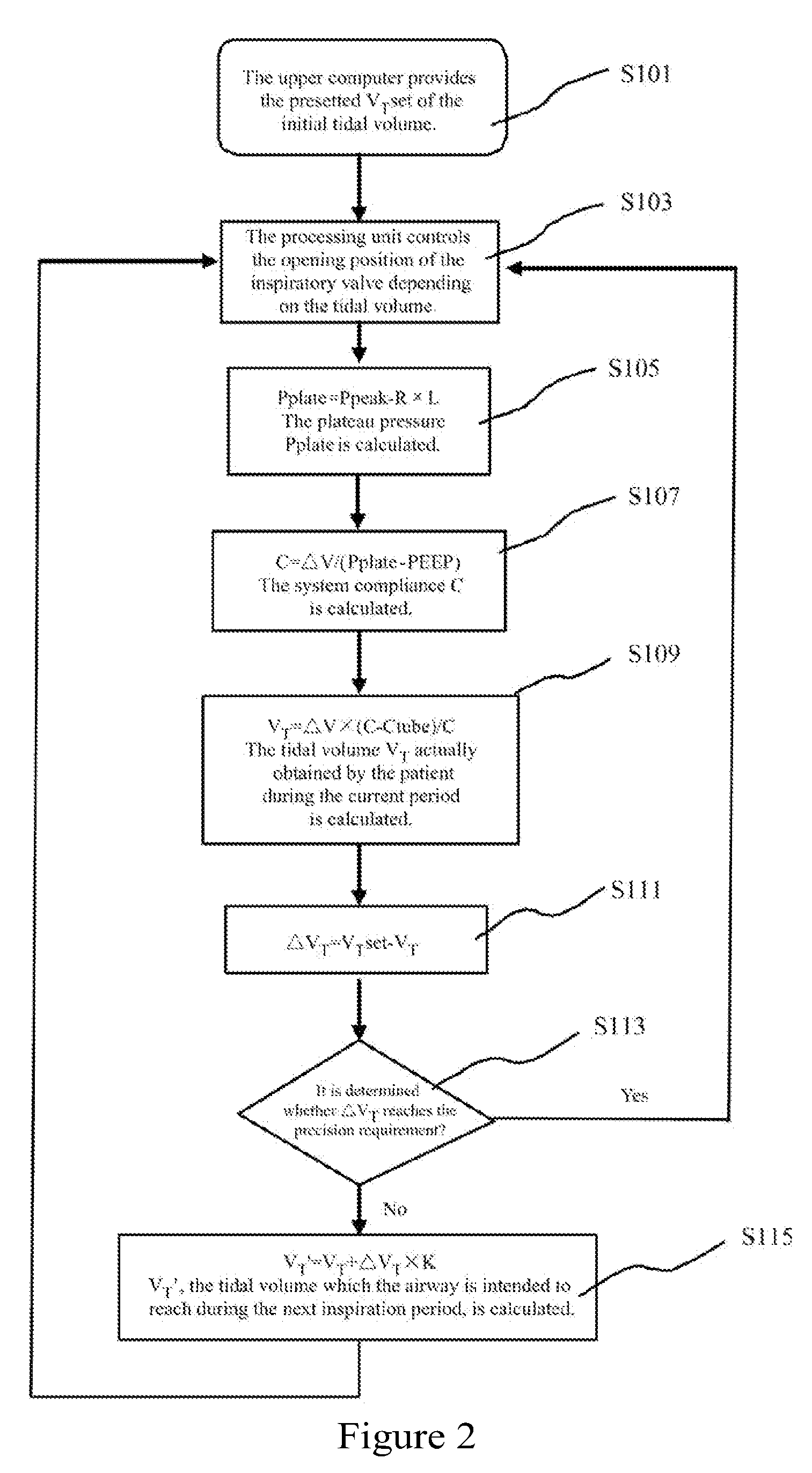
The present invention discloses a method for improving control and detection precision of tidal volume by introducing R value, comprising the steps of: a plateau pressure Pplate is used to calculate a system compliance C with C=ΔV / (Pplate−PEEP); VT, the tidal volume obtained currently at patient terminal, is calculated with VT=ΔV×(C−Ctube) / C, wherein ΔV is the variation of tidal volume, PEEP is the positive end expiratory pressure and Ctube is the compliance C of the line. Depending on the calculated VT, the tidal volume which is actually obtained by the patients during this period, the processing unit calculates the tidal volume VT′, which the airway is intended to reach during the next expiration period, by VT′=VT+ΔVT×K wherein K is a scaling factor for control and adjustment, VT is the tidal volume obtained by the patient during the current period, VTset is the presetted tidal volume, ΔVT=VTset−VT. And the processing unit accordingly controls the opening position of the inspiratory valve during the next inspiration period, so as to achieve the purpose of improving control and detection of precision tidal volume.
Need to check novelty before this filing date? Find Prior Art

Description

TECHNICAL FIELD

[0001] The present invention provides a novel method for improving control and detection precision of tidal volume. Meanwhile, during the calculation of tidal volume, the precision is improved with R value introduced, which can be applied to detection and diagnosis devices used in medical diagnosis, in particular, to the calculation and monitoring of tidal volume within an anesthesia machine or ventilator.BACKGROUND

[0002] At present, for an anesthesia machine or a ventilator, there exists two methods for detecting tidal volume:

[0003] A sensor is placed at the patient terminal for real-time detecting data, which brings about the advantages that the monitored data is accurate, data process is not necessary, and the patient's status can be reflected in real-time. However, this method causes the disadvantage that the circuit from the machine to the patient's mouth is relatively long, resulting in possible interference during an operation by a surgeon. Furthermore, the relati...

Examples

Embodiment Construction

[0027]Hereinafter, the present invention is further set forth in conjunction with the best embodiment shown in the accompanying figures.

[0028]The device used for implementing the method according to the present invention comprises a processing unit 1, a airway system and a data acquiring and receiving unit. The airway system includes a respiratory circuit 6 and a driver line and a respiratory line at patient terminal 4 which are respectively connected to the outside of the respiratory circuit and the air bag. The respiratory line at patient terminal includes inspiration branch and expiration branch. A inspiratory valve 2 and a PEEP valve 3 which is used for discharging the driving gas to the atmosphere are connected in the driver. The sensor data acquiring and receiving unit for acquiring the airway peak pressure and PEEP value includes an airway pressure sensor 5 positioned in the airway, by which the airway peak pressure and PEEP value are acquired and transmitted to the processin...