
Fingerprinting a data object
a data object and fingerprinting technology, applied in the field of fingerprinting data objects, can solve the problems of difficult task and troublesome extraction of watermark data forming fingerprints from data objects
- Summary
- Abstract
- Description
- Claims
- Application Information
AI Technical Summary
Benefits of technology
Problems solved by technology
Method used
Image

Examples
Embodiment Construction
[0028]Variants are alternate forms of a data object such as a file or directory of files. Variants differ in that the files contain different watermarks, are encrypted with different keys, and / or possibly contain different advertisement data such as an advertising video at some points in the file, but they are otherwise identical. File variants have the same name and length, and directory variants have the same directory names, filenames and file lengths. Variants are typically identified by a positive integer, beginning with 0 and incrementing by 1 up to a maximum of e.g. 255, i.e., variant 0, variant 1, . . . , variant 255.
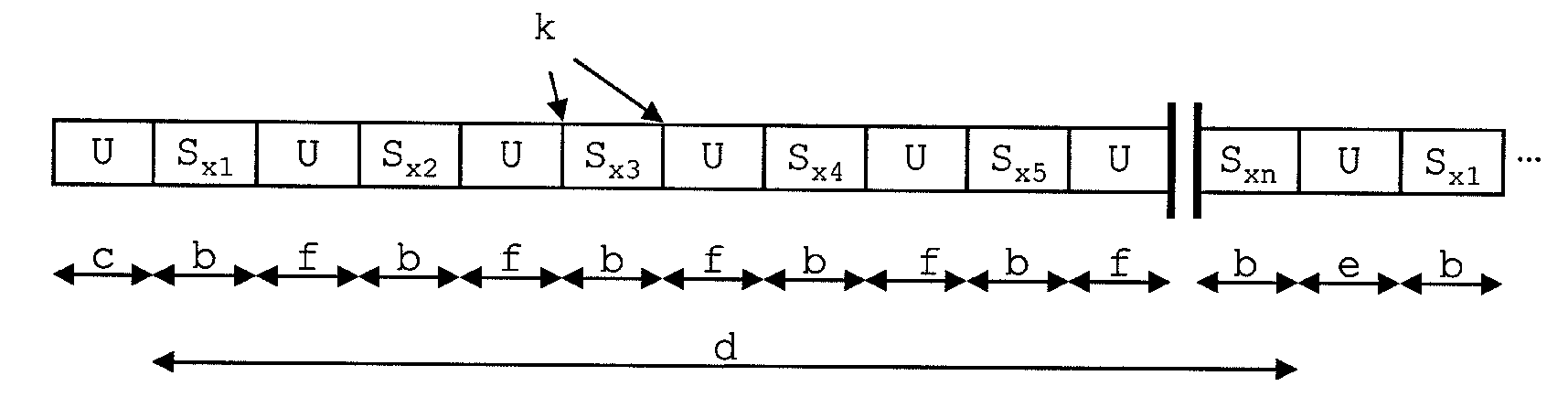
[0029]In FIG. 1 the format of a variant of a data object of an exemplary embodiment of the invention is shown. Herein the following notation is used:
k=Multiplex boundary locations;
U=Un-watermarked sections, or watermarked with a “don't care” value;
Sxy=Section watermarked with preferably unique watermark data in variant x at sequence number y;
c=Size of pre-finger...
PUM
 Login to View More
 Abstract
Description
Claims
Application Information
 Login to View More