Polypropylene impact copolymer based hot melt adhesive

US20150024649A1Active Publication Date: 2015-01-22BOSTIK INC
4 Cites 35 Cited by

Patent Information

Authority / Receiving Office
US · United States
Current Assignee / Owner
Publication Date
2015-01-22

Smart Images

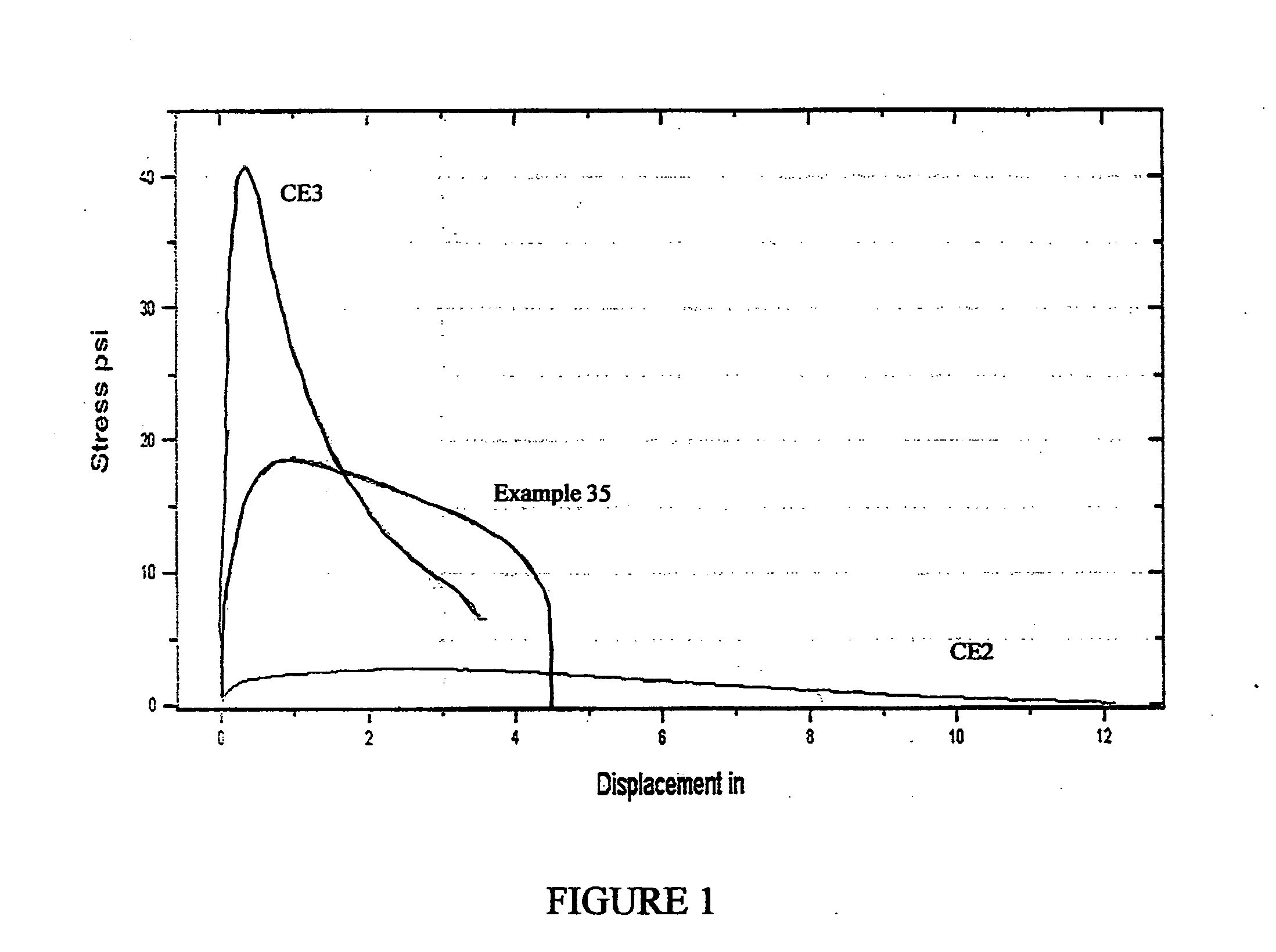
  • Figure 1
    Figure 1
Patent Text Reader

Abstract

A hot melt adhesive using polypropylene impact copolymers that is particularly well suited for elastic attachment and stretch films in diaper structures. The hot melt adhesive composition is a blend of about 2.5% to about 30%, by weight, of a polypropylene impact copolymer; about 2.5% to about 30%, by weight, of an olefin based elastomer; about 10% to about 70%, by weight, of a tackifying resin having a softening point of at least about 80° C. and up to about 140° C.; about 0% to about 60%, by weight, of a plasticizer; and about 0.1% to about 5% of a stabilizer or antioxidant.
Need to check novelty before this filing date? Find Prior Art

Description

BACKGROUND OF THE INVENTION

[0001] The present invention relates to hot melt adhesives, and more particularly to a hot melt adhesive using a polypropylene impact copolymer to provide high bond performance for making elastic components such as laminates containing elastic strands or films for use in disposable diapers.

[0002] The increasing complexity of manufactured goods, in particular disposable goods, leads to major improvements and developments in the hot melt adhesive industry. Hot melt adhesives are being used to bond a wider variety of substrates, within a broader adhesive application process window, and for a large end-use portfolio. For example, considering the diaper manufacturing industry, materials involved may be non-woven materials, polymeric films, and in general elastomeric components. These elastomeric components can be used in products like diapers, in a form of strands, films, nonwovens or any other continuous or discrete form.

[0003] Processability of hot melt adhesive...

Examples

examples 1 to 26

[0077]Procedure:

[0078]All formulations were produced on a 300 g scale, using the following method. A 475 mL steel vessel was charged with mineral oil, antioxidant, tackifying resin, and, where present, wax. A digitally-controlled heating mantel and an internal thermocouple, inside the vessel, were used in tandem to gradually heat the formulation to the target temperature (177 to 190° C.). After the mixture appeared mostly homogenous, the solution was mechanically stirred between 100 to 200 rpm, and the low modulus polyolefin (PO) was gradually added followed by the impact copolymer (ICP). The resultant clear to slightly hazy molten mixture was held at the target temperature an additional 30 to 120 minutes until it appeared to be fully homogenized. After this time, the vessel was removed from the heating mantel and samples were collected for testing. Table 1 outlines example compositions of this invention, while key physical properties are provided in Table 2.

TABLE 1Example 1-26 Form...