
Electro-optic modulator utilizing copper-tungsten electrodes for improved thermal stability
a technology of electrooptic modulators and copper tungsten electrodes, applied in non-linear optics, instruments, optics, etc., can solve the problems of increasing the cost of equipment, requiring extra facilities, and introducing additional complexity to package design, so as to reduce the unwanted stress-related birefringence in the crystal, and minimize the leakage of light
- Summary
- Abstract
- Description
- Claims
- Application Information
AI Technical Summary
Benefits of technology
Problems solved by technology
Method used
Image

Examples
Embodiment Construction
[0018]Reference throughout this specification to an “example” or an “embodiment” means that a particular feature, structure, or characteristic described in connection with the example is included in at least one embodiment of the invention. Thus appearances of the terms “example” or “embodiment” in various places throughout the specification do not necessarily refer to the same embodiment. Furthermore, as used herein, the terms “about”, “substantially” and “essentially” means that the recited characteristic (e.g., “CTE”) need not be achieved exactly, but that deviations or variations, including for example, tolerances, measurement error, measurement accuracy limitations and the like as known to those skilled in the art, may occur in amounts that do not preclude the effect that the recited characteristic was intended to provide.
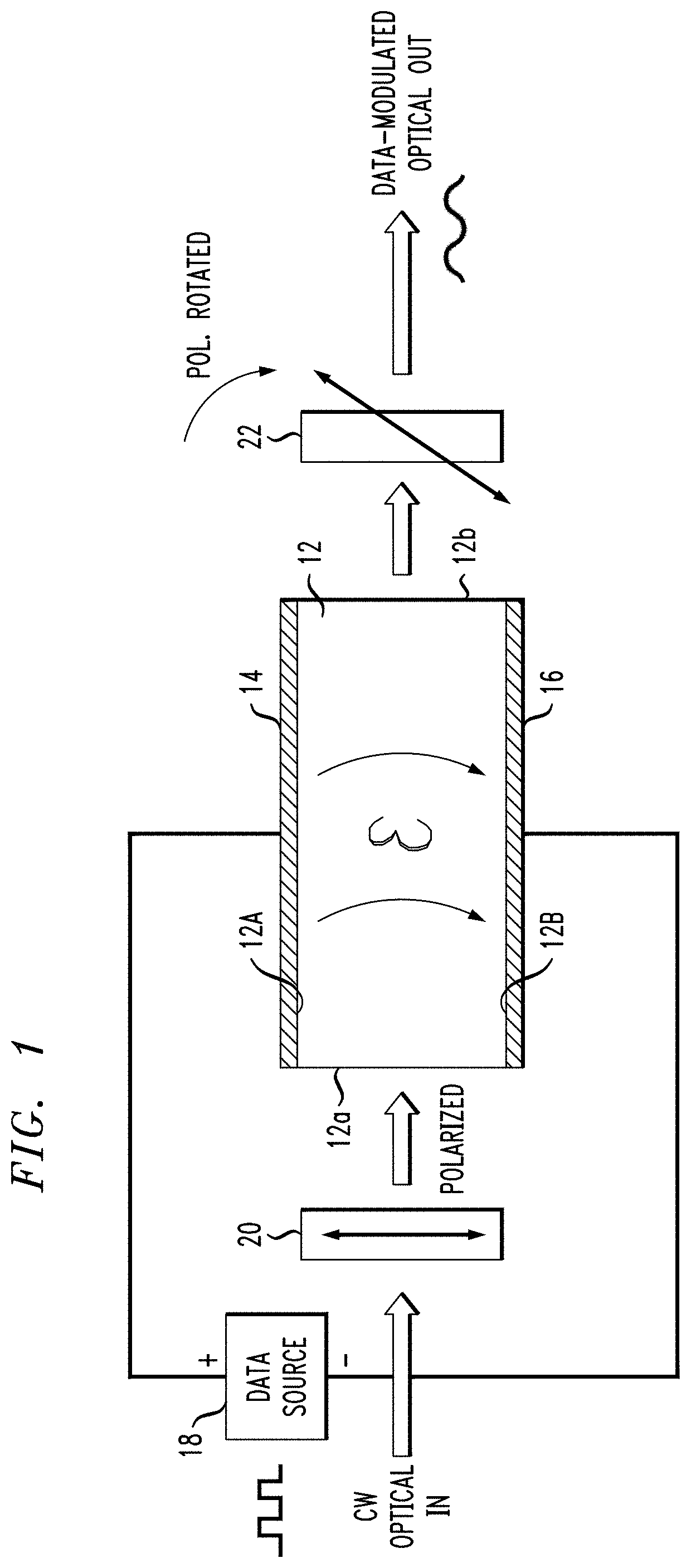
[0019]FIG. 1 illustrates an exemplary electro-optic modulator 10 formed in accordance with the present invention. The operation of electro-optic modulator 10 ...
PUM
 Login to View More
 Abstract
Description
Claims
Application Information
 Login to View More