
Multi protocol label switching for multiple access segments
a multi-protocol label and access segment technology, applied in the field of multi-protocol label switching for multiple access segments, can solve the problems of large and complex routing tables, occupying a lot of space, and a scarce resource of space, so as to reduce the number of labels used, reduce the size of labels, and less space
- Summary
- Abstract
- Description
- Claims
- Application Information
AI Technical Summary
Benefits of technology
Problems solved by technology
Method used
Image

Examples
Embodiment Construction
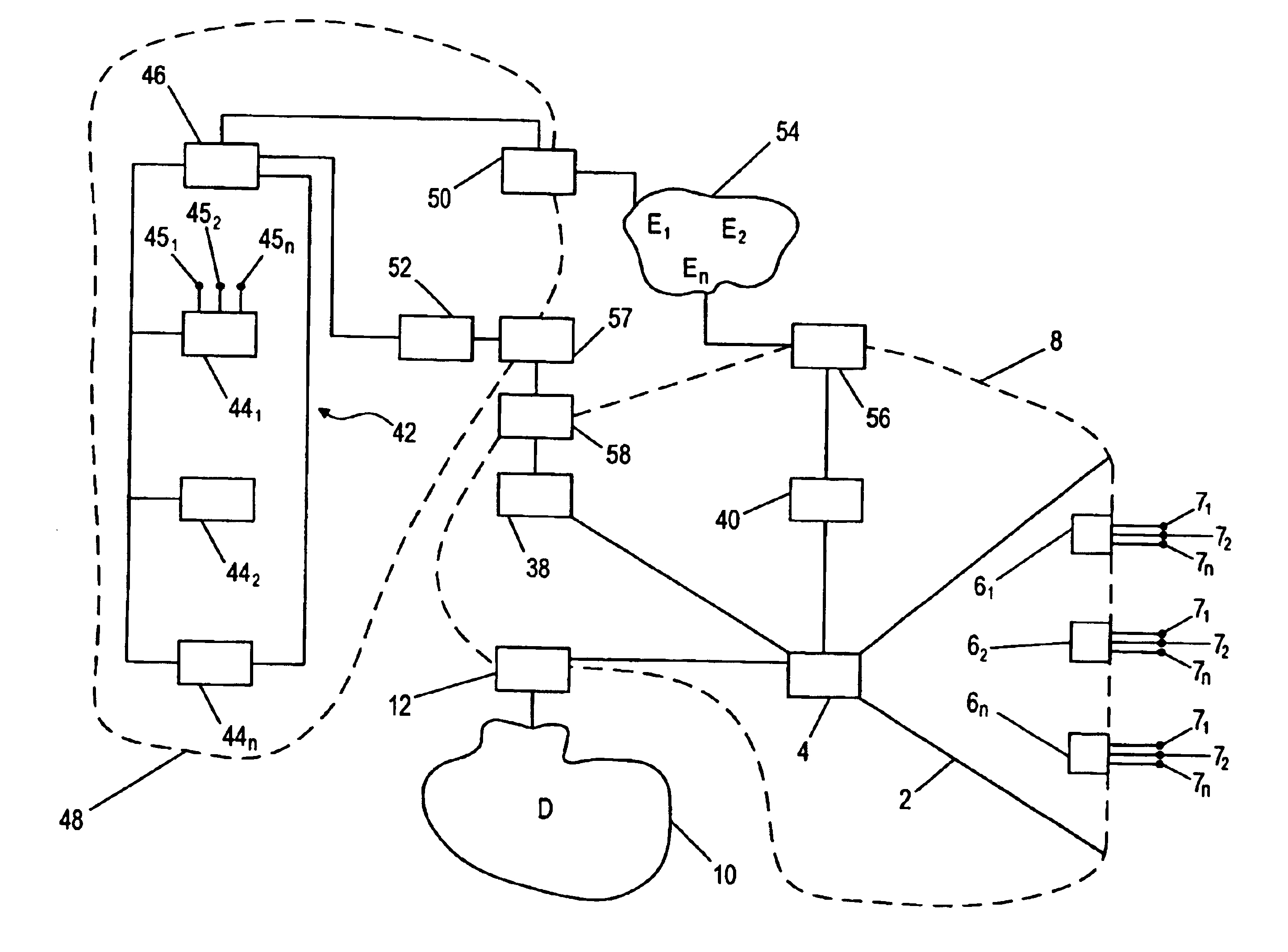
The Internet Protocol (IP) network of FIG. 1 comprises a multiple access (MA) segment (2) served by a switching node (4), such as a radio bass station or a satellite. The structure of the switching node (4) is shown in FIG. 4a and comprises at least one headend (1a) and a switch, more specifically a label switch router comprising a switching function (5) and a switch controller (9). The (MA) segment (2) comprises a broadcast downlink over which the switching node (4) broadcasts simultaneously to all the end systems (6.sub.1, 6.sub.2, . . . 6.sub.n) within the MA segment. The MA segment (2) also comprises an alternative, such as a multi frequency time division multiple access (MFTDMA) uplink over which each end system (6.sub.1, 6.sub.2, . . . 6.sub.n) can communicate with the switching node (4). There may be a high number of end systems within a single MA segment (2). As an alternative to MFTDMA the segment (2) could use time division multiple access (TDMA), frequency division multip...
PUM
 Login to View More
 Abstract
Description
Claims
Application Information
 Login to View More