[0014]The advantages of this refinement are, inter alia, that there is no need for any
moving parts, such as fans or pumps, to circulate the
refrigerant. Furthermore, only a single thermally insulating heat (transport)
pipe, which can be designed to be relatively thin, is required to circulate the
refrigerant. This reduces the complexity, particularly of the rotating seal, which seals the gas area of the refrigerant from the external area of the rotor. A seal, which is thus only comparatively small, is more reliable and requires less servicing since its circumferential speed is lower. In this case, gas losses of the refrigerant from the internal area to the external area have no significant influence on the operation of the
heat pipe, since the amount of liquid in the
system is effected only to a minor extent. In consequence, long lives can be achieved with an adequate reservoir size. Furthermore, the
refrigeration unit can easily be matched to the different requirements of
machine installation. In particular, depending on the configuration, a
heat pipe with a length of many meters can be provided so that, for example, a
refrigeration machine can be installed at an accessible point in order to simplify its servicing, while the actual motor or generator is installed in a location where access is difficult. The
heat transfer and the provision of the refrigeration power are thus particularly simple and economic with the refinement, in particular since only a comparatively simple seal is required.
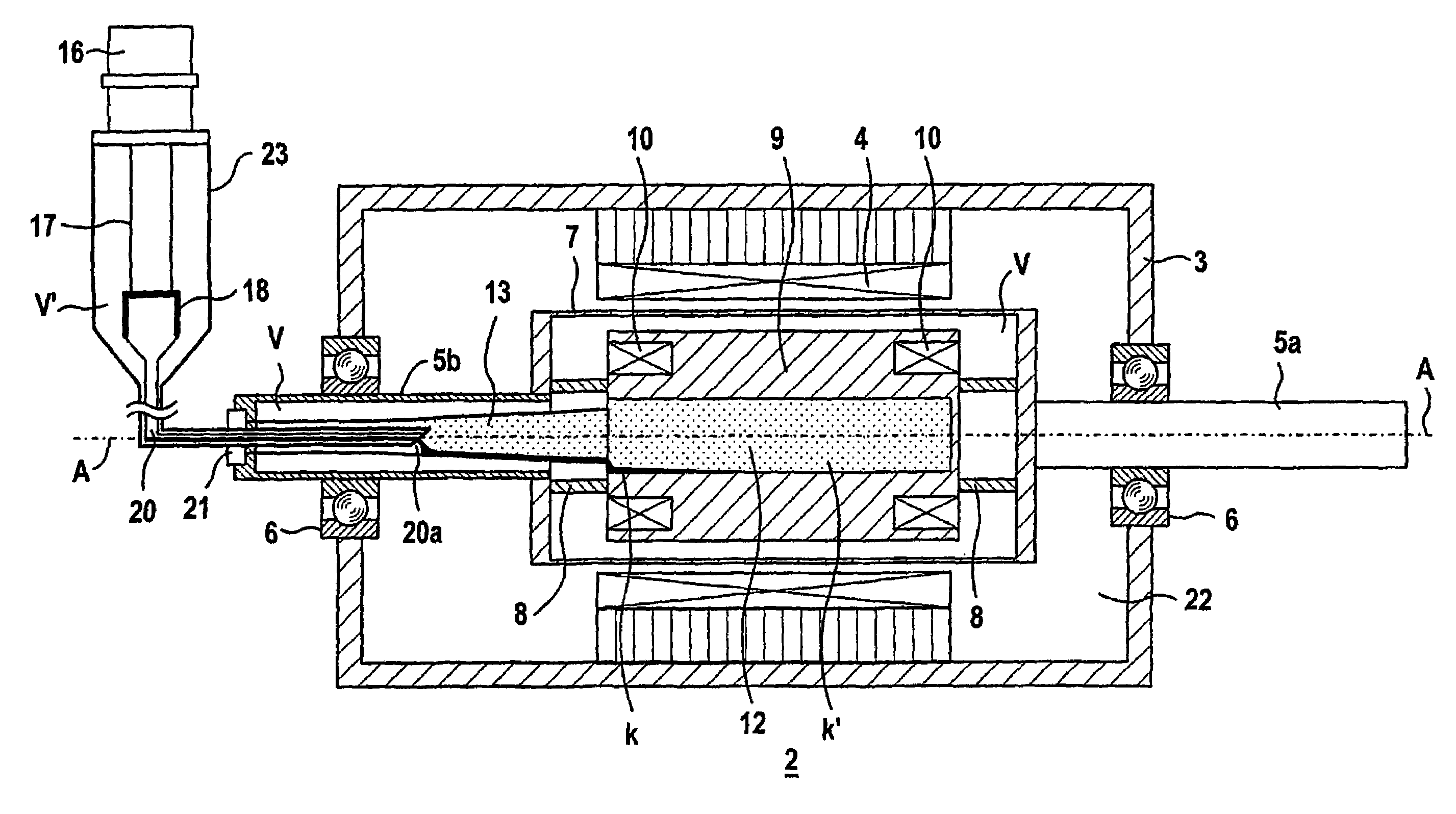
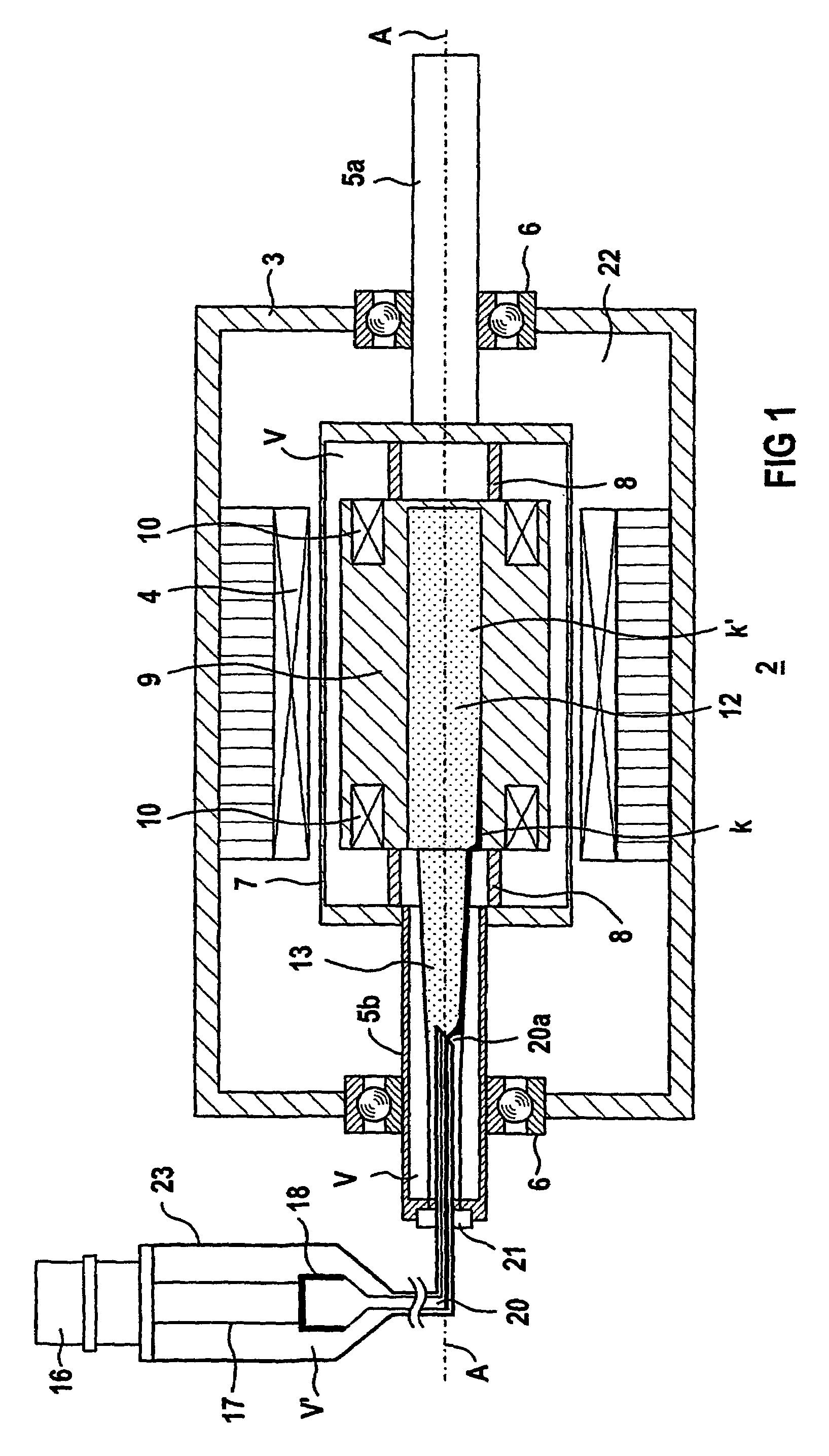
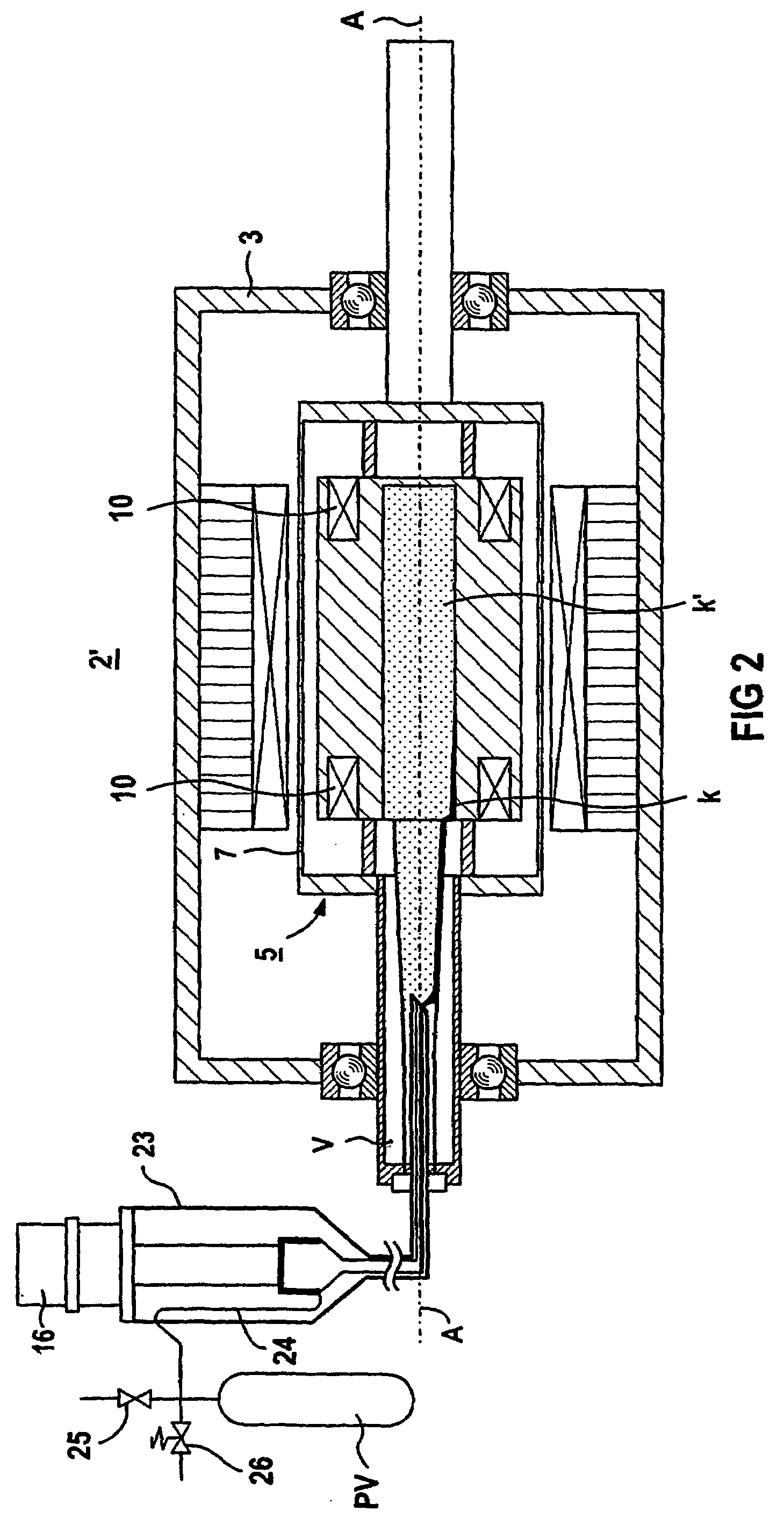
[0015]It is thus possible to seal the refrigerant area in a particularly simple manner, such that the central cavity is closed on one side by the winding
mount, and the lateral cavity is sealed on the side facing the cold head by a sealing device with rotating parts. In this case, at least one seal from the group of ferro fluid seals, labyrinth seals, gap seals may be used as the sealing device.
[0017]The cold head can particularly advantageously be designed to have two or more stages. In particular, parts of an
electricity supply or a
thermal radiation shield can then in particular be kept at a comparatively high
intermediate temperature by its first stage. An appropriately designed cold head thus allows stationary parts of the superconducting device in each case to be kept at a temperature level which is advantageous for effective cooling, in a simple manner.
[0019]It is also advantageous for the
heat pipe to be formed as a dripping edge at its end which projects into the lateral cavity. This makes it easier for the condensate to enter the lateral cavity. The refinement can also be implemented in such a way that the process of the droplets dripping off is assisted by rotation, by the gas movement in the rotating internal area resulting from the wind formed by the gaseous part of the refrigerant.
[0020]Furthermore, it may be regarded as being advantageous for the lateral cavity to widen in the direction of the central cavity. This is because it may also be possible to make use of the force of gravity or
centrifugal force to assist the transport of the refrigerant, with the transport
route of the refrigerant thus being inclined such that it points outward with respect to the rotation axis.


 Login to View More
  Login to View More