
Apparatus and method for attaching a graft ligament to a bone
a technology of graft ligaments and apparatuses, applied in the field of surgical equipment and methods, can solve the problems of insufficient bone quality in the tibia, interference screws that cannot be perfectly interference screws that cannot be used in all clinical situations,
- Summary
- Abstract
- Description
- Claims
- Application Information
AI Technical Summary
Benefits of technology
Problems solved by technology
Method used
Image

Examples
Embodiment Construction
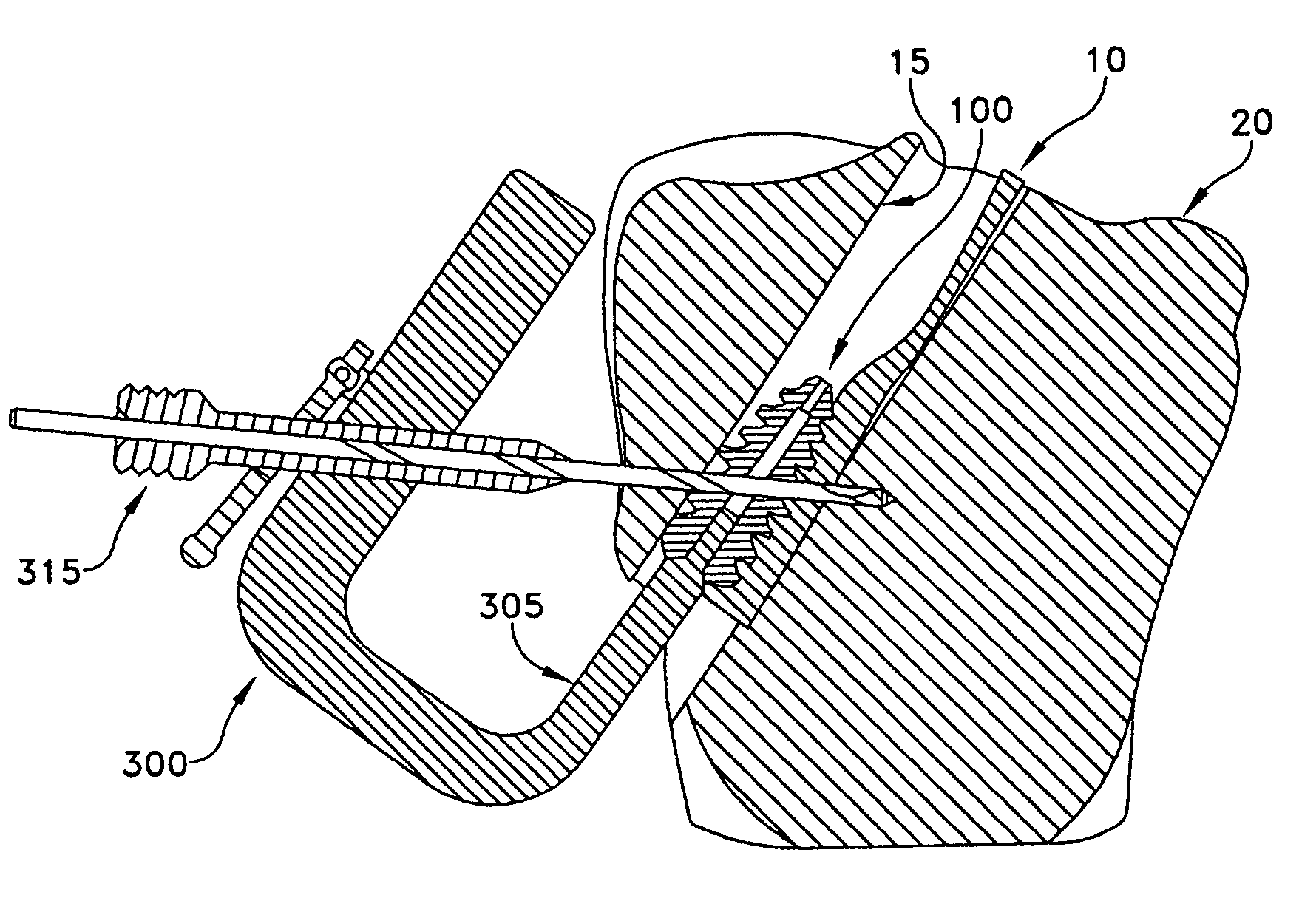
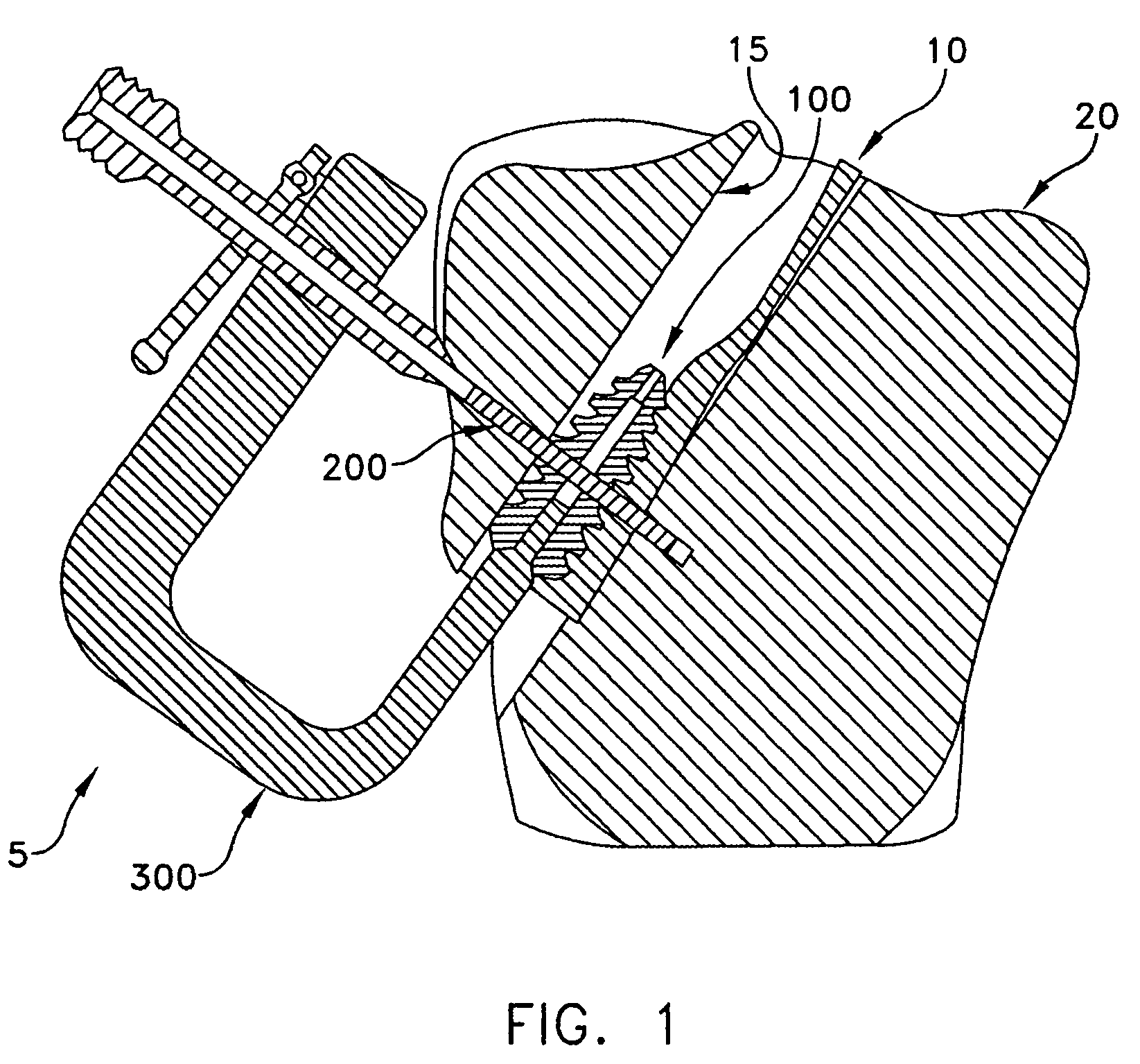
[0036]Referring first to FIG. 1, there is shown a novel fixation system 5 for securing a graft ligament 10 within a bone tunnel 15 of a tibia 20 of a human knee joint.
[0037]Novel fixation system 5 generally comprises an interference screw 100, a transverse pin 200 and a transverse guide assembly 300.
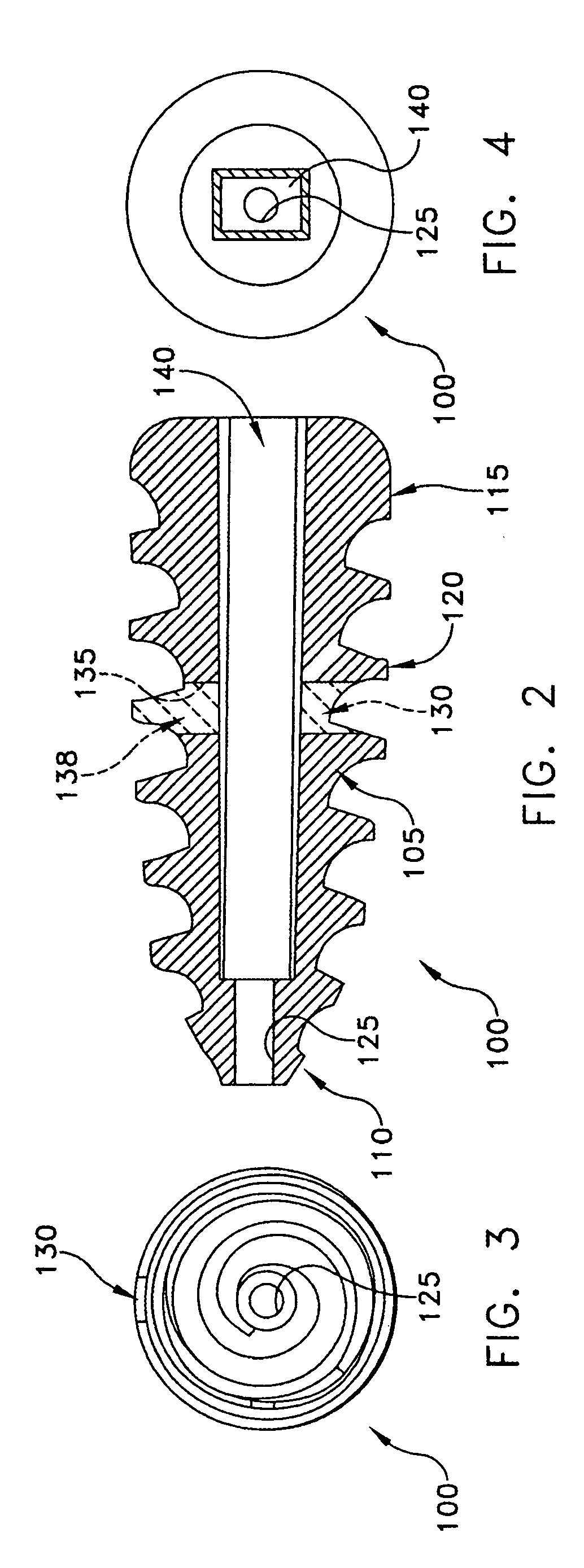
[0038]Interference screw 100 is shown in greater detail in FIGS. 2–4. Interference screw 100 generally comprises a body 105 having a distal end 110 and a proximal end 115. Screw threads 120 extend longitudinally along body 105. Preferably screw threads 120 extend along the entire length of the screw, from distal end 110 to proximal end 115; however, if desired, screw threads 120 may extend along only a portion of the length of the body. Interference screw 100 is preferably cannulated, with a central lumen 125 extending along its length, whereby the interference screw may be delivered to a surgical site over a guidewire if desired.
[0039]Interference screw 100 has a transversely-extending ...
PUM
 Login to View More
 Abstract
Description
Claims
Application Information
 Login to View More