Method for discovering undeclared and fuzzy rules in databases
What is AI technical title?
AI technical title is built by Patsnap AI team. It summarizes the technical point description of the patent document.
a database and fuzzy rule technology, applied in the field of databases, can solve problems such as and achieve the effect of improving cost estimates and substantial speedups in query processing
Active Publication Date: 2007-10-02
HULU
View PDF12 Cites 15 Cited by
Summary
Abstract
Description
Claims
Application Information
AI Technical Summary
This helps you quickly interpret patents by identifying the three key elements:
Problems solved by technology
Method used
Benefits of technology
Benefits of technology
This approach enables the database optimizer to identify new, more efficient access paths, reducing query processing time and allowing for autonomic database management without user intervention, while providing insights into data organization and relationships.
Problems solved by technology
Also, knowledge of the discovered predicates provides new access plans for the optimizer's consideration, wherein the new access paths lead to substantial speedups in query processing.
Method used
the structure of the environmentally friendly knitted fabric provided by the present invention; figure 2 Flow chart of the yarn wrapping machine for environmentally friendly knitted fabrics and storage devices; image 3 Is the parameter map of the yarn covering machine
View more
Image
Smart Image Click on the blue labels to locate them in the text.
Viewing Examples
Smart Image
Click on the blue label to locate the original text in one second.
Reading with bidirectional positioning of images and text.
Smart Image
Examples
Experimental program
Comparison scheme
Effect test
example 1
[0039]Consider a hypothetical sales database that contains tables orders and deliveries as in Tables 1 and 2 (provided below), and suppose that the database contains many year's worth of data.
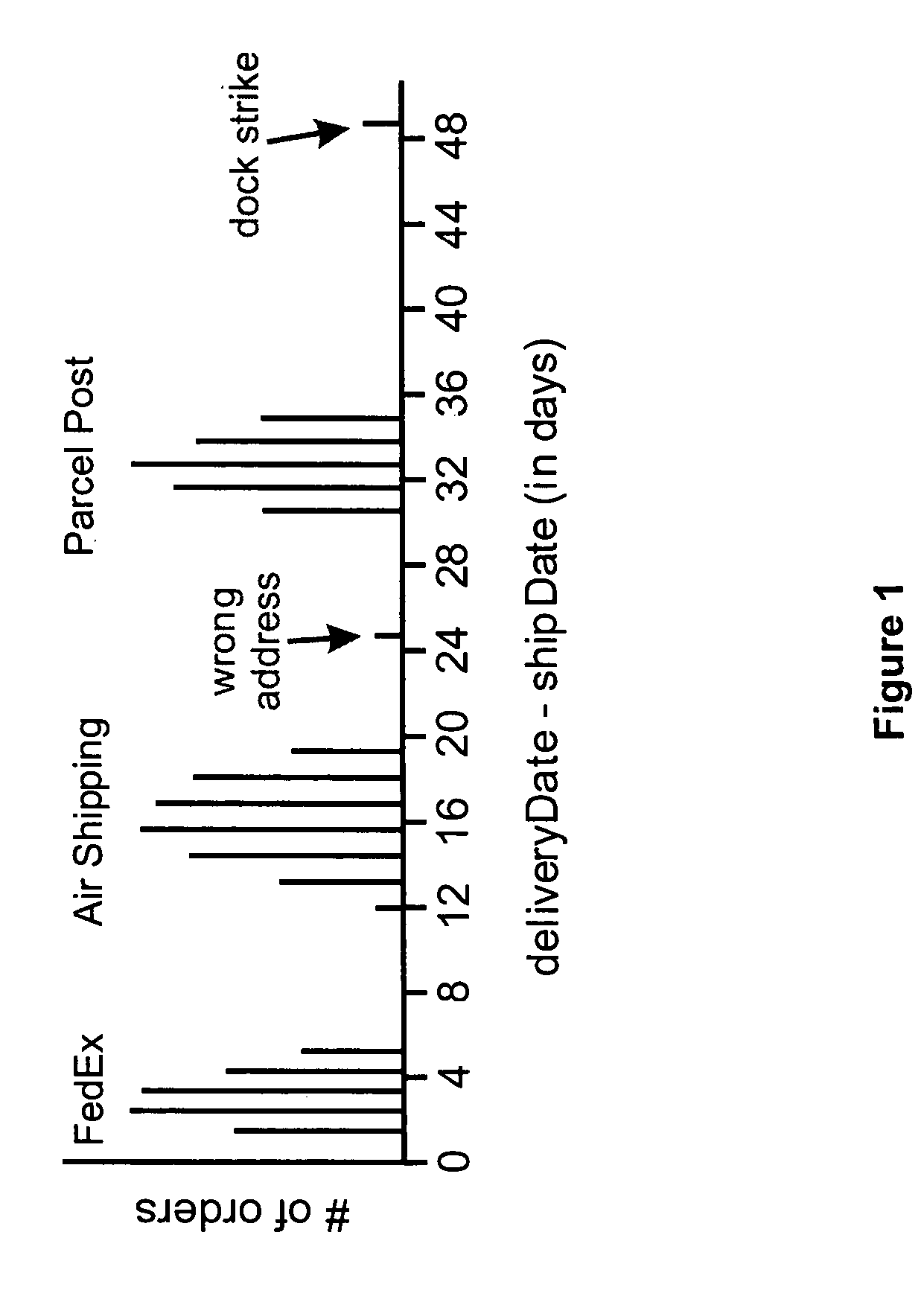
[0042]A casual inspection of the columns orders.shipDate and deliveries.deliveryDate may not reveal any meaningful relationships, but if the following SQL query is executed
with the resulting data points being plotted as a histogram, a plot as in FIG. 1 is obtained. It is seen from FIG. 1 that, except for a small number of outlier points, the data satisfy the pr...
example 2
[0056]Consider the example of the Section 1, with the deliveryDate column located in the orders table, as shown in Table 3 below.
[0058]The orders table is horizontally range-partitioned on deliveryDate across a number of parallel processing nodes. Now, lets consider the following query:
[0059]SELECT COUNT(*)
[0060]FROM orders
[0061]WHERE orders.shipDate=‘2003-07-01’
[0062]Using the information derived from the predicate in (1), the following predicate can be derived:
deliveryDate BETWEEN ‘2003-07-01’+2 DAYS AND ‘2003-07-01’+5 DAYS
the structure of the environmentally friendly knitted fabric provided by the present invention; figure 2 Flow chart of the yarn wrapping machine for environmentally friendly knitted fabrics and storage devices; image 3 Is the parameter map of the yarn covering machine
Login to View More
PUM
Login to View More
Abstract
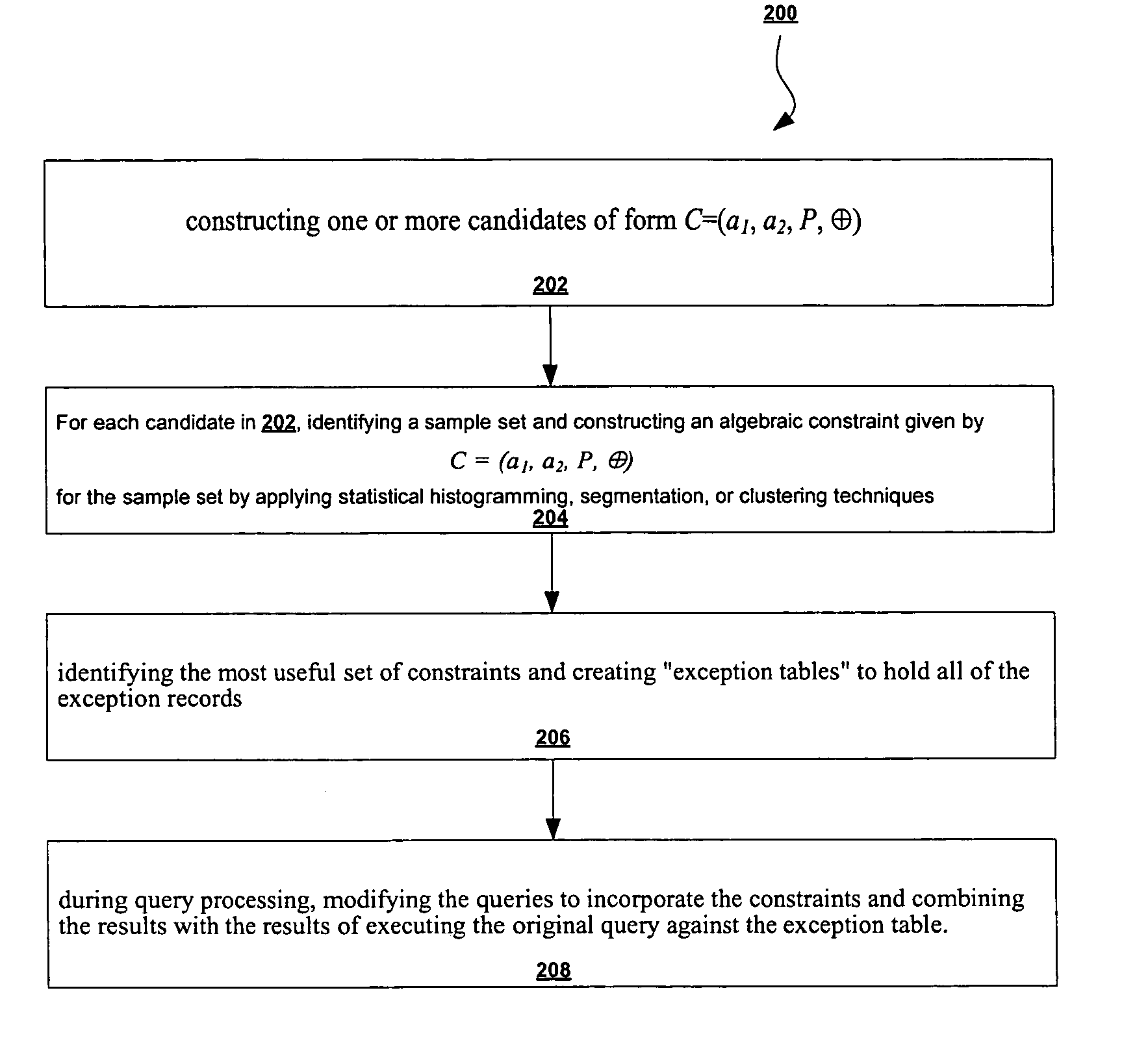
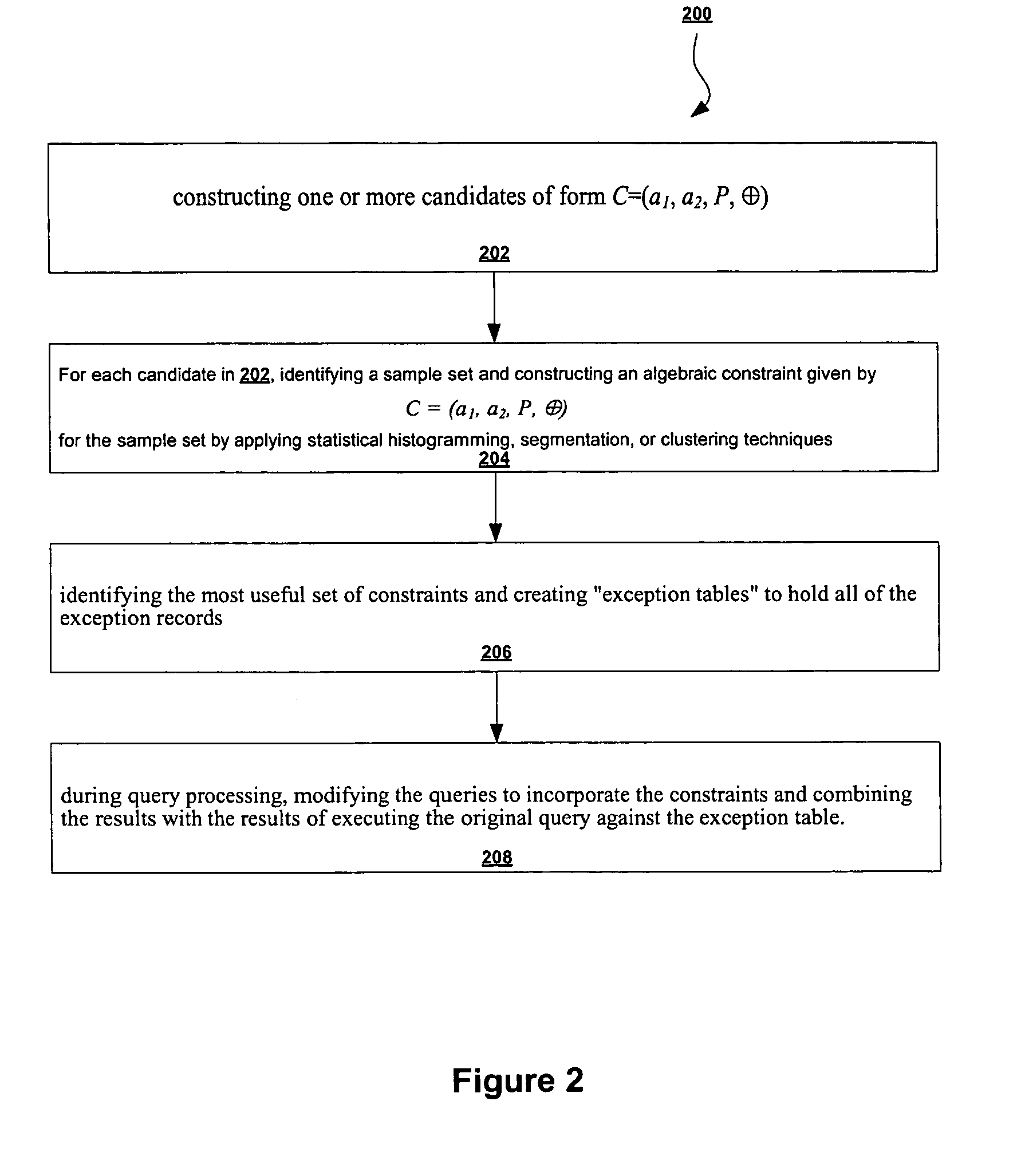
A scheme is used to automatically discover algebraic constraints between pairs of columns in relational data. The constraints may be “fuzzy” in that they hold for most, but not all, of the records, and the columns may be in the same table or different tables. The scheme first identifies candidate sets of column value pairs that are likely to satisfy an algebraic constraint. For each candidate, the scheme constructs algebraic constraints by applying statistical histogramming, segmentation, or clustering techniques to samples of column values. In query-optimization mode, the scheme automatically partitions the data into normal and exception records. During subsequent query processing, queries can be modified to incorporate the constraints; the optimizer uses the constraints to identify new, more efficient access paths. The results are then combined with the results of executing the original query against the (small) set of exception records.
Description
BACKGROUND OF THE INVENTION[0001]1. Field of Invention[0002]The present invention relates generally to the field of databases. More specifically, the present invention is related to an algorithm to automatically identify algebraic constraints between pairs of columns in relational data.[0003]2. Discussion of Prior Art[0004]Commercial DBMS vendors increasingly view autonomic and self-managing technologies as crucial for maintaining the usability and decreasing the ownership costs of their systems. Self-tuning database systems have also been receiving renewed attention from the research community (see, for example, the paper by Weikum et al. entitled, “Self-tuning database technology and information services: from wishful thinking to viable engineering”, and references therein). Query optimizers that actively learn about relationships in the data are an important component of this emerging technology.[0005]Previous work on automatic methods for learning about data relationships can be...
Claims
the structure of the environmentally friendly knitted fabric provided by the present invention; figure 2 Flow chart of the yarn wrapping machine for environmentally friendly knitted fabrics and storage devices; image 3 Is the parameter map of the yarn covering machine
Login to View More
Application Information
Patent Timeline
Application Date:The date an application was filed.
Publication Date:The date a patent or application was officially published.
First Publication Date:The earliest publication date of a patent with the same application number.
Issue Date:Publication date of the patent grant document.
PCT Entry Date:The Entry date of PCT National Phase.
Estimated Expiry Date:The statutory expiry date of a patent right according to the Patent Law, and it is the longest term of protection that the patent right can achieve without the termination of the patent right due to other reasons(Term extension factor has been taken into account ).
Invalid Date:Actual expiry date is based on effective date or publication date of legal transaction data of invalid patent.


 Login to View More
  Login to View More