Generating a subindex with relevant attributes to improve querying

a subindex and attribute technology, applied in the field of information retrieval, can solve the problems of human intuition not being able to identify an optimal ranking algorithm with optimal parameters efficiently, reliably, effectively, and render the search of an optimal set of parameters difficult, so as to facilitate the process of identifying an optimal ranking algorithm and improve the effect of information retrieval ranking algorithm

US7363296B1Inactive Publication Date: 2008-04-22MICROSOFT TECH LICENSING LLC
35 Cites 15 Cited by

Patent Information

Authority / Receiving Office
US · United States
Patent Type
Patents(United States)
Current Assignee / Owner
Publication Date
2008-04-22
Estimated Expiration
Not applicable · inactive patent

Smart Images

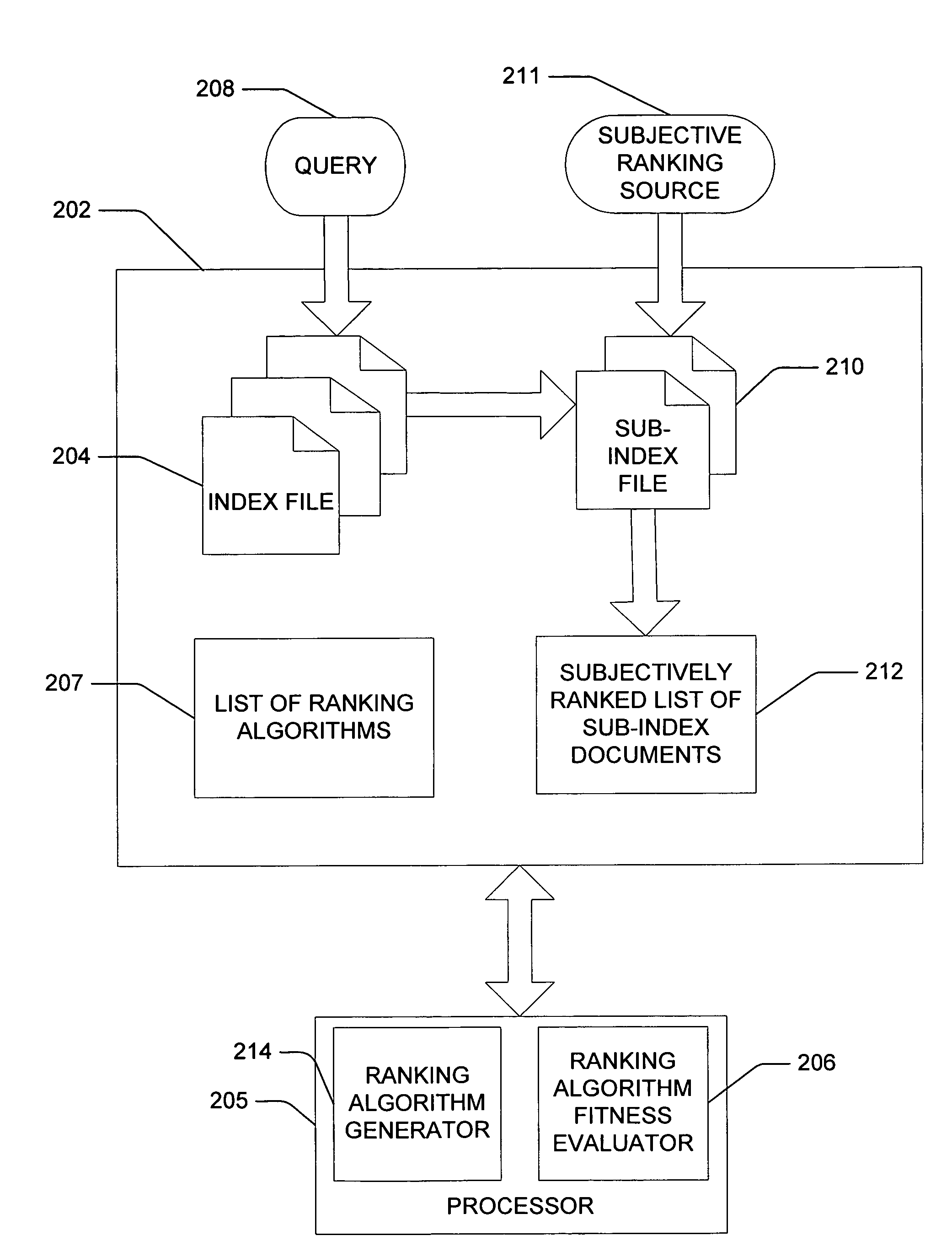
  • Figure 1
    Figure 1
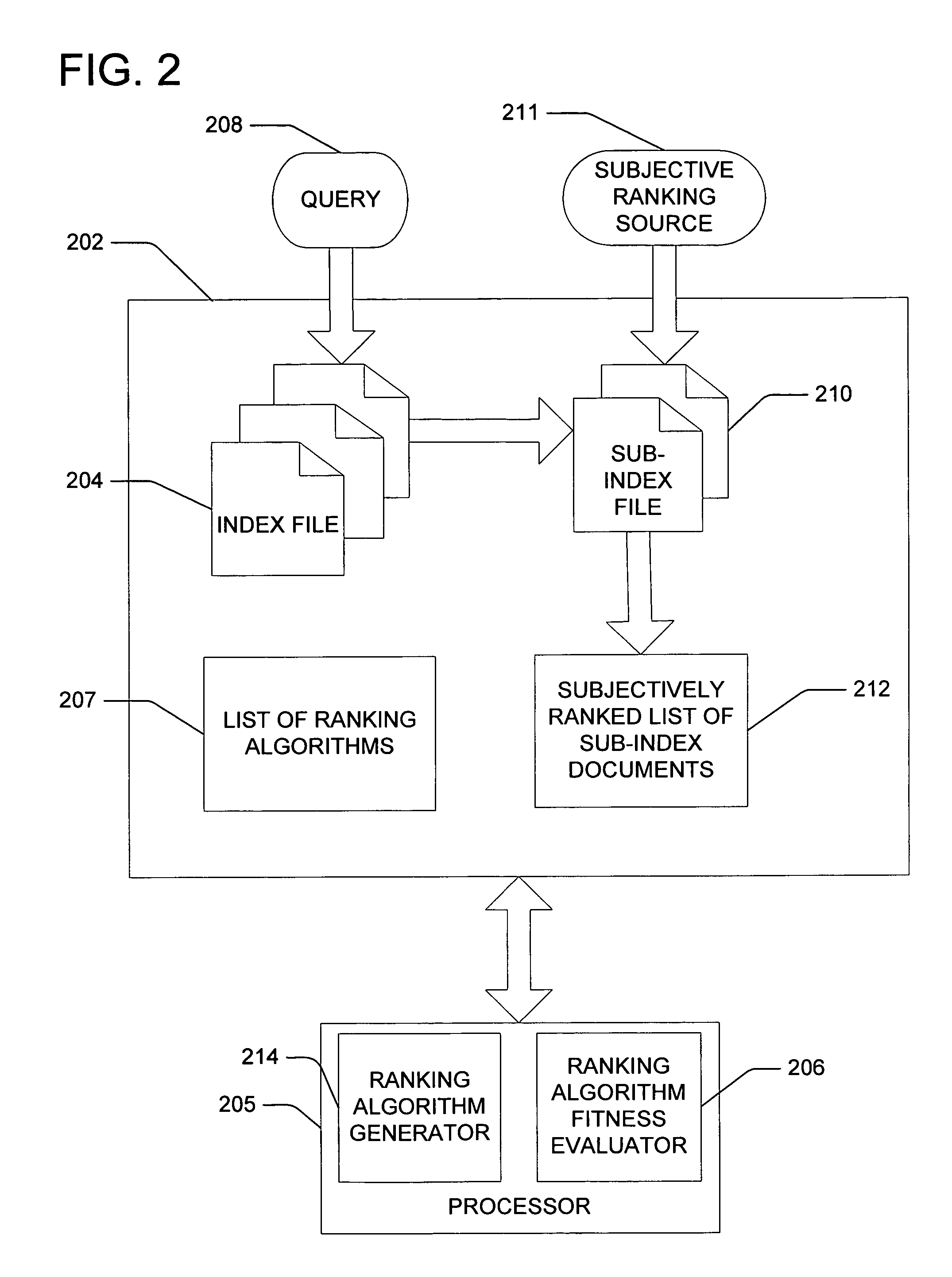
  • Figure 2
    Figure 2
  • Figure 3
    Figure 3
Patent Text Reader

Abstract

Rating information retrieval algorithms. A query is received and submitted to a search engine for execution on an index file. A list of index documents and a plurality of attributes are received from the search engine in response to the submitted query. A portion of the received list of index documents and the received plurality of attributes are stored in a subindex file. The received query is executed on the subindex file to obtain a list of subindex documents. The obtained list of subindex documents is ranked by a particular ranking algorithm using the attributes associated therewith. The list of ranked subindex documents is compared with a list of subjectively ranked documents to generate a score for the particular ranking algorithm. The generated score represents a degree of correlation between the list of ranked subindex documents and the list of subjectively ranked documents.
Need to check novelty before this filing date? Find Prior Art

Description

TECHNICAL FIELD

[0001] Embodiments of the present invention relate to the field of information retrieval. In particular, embodiments of the invention relate to evaluating information retrieval ranking algorithms and improving ranking algorithms for information retrieval.BACKGROUND OF THE INVENTION

[0002] The Internet has vast amounts of information distributed over a multitude of computers, hence providing users with large amounts of information on various topics. This is also true for a number of other communication networks, such as intranets and extranets. Although large amounts of information may be available on a network, finding the desired information can be difficult.

[0003] Search engines have been developed to address the problem of finding desired information on a network. Typically, a user who has an idea of the type of information desired enters one or more search terms to a search engine. The search engine then returns a list of network locations (e.g., uniform resource loca...

Examples

Embodiment Construction

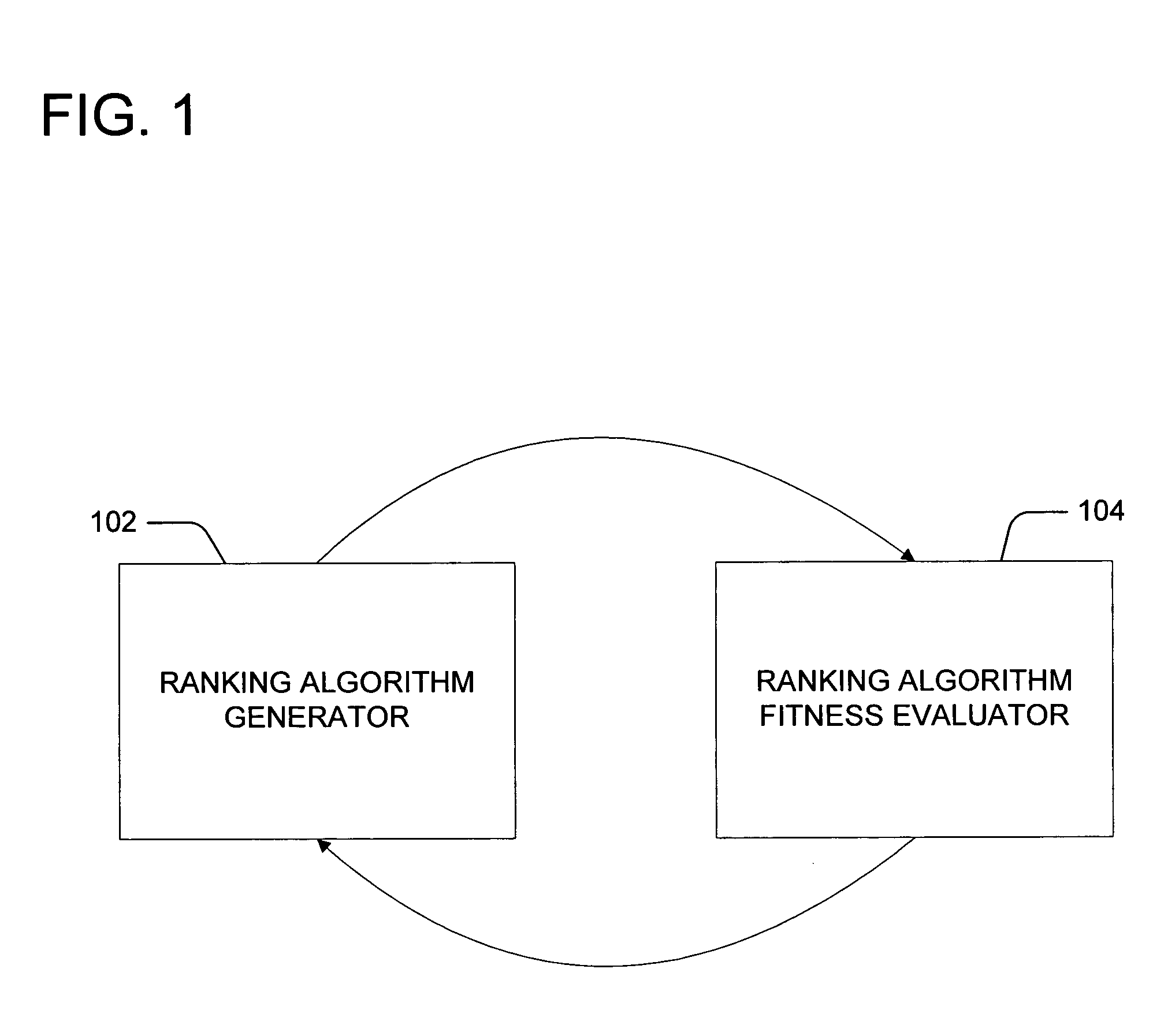
[0026]Referring first to FIG. 1, a block diagram illustrates one example of a suitable framework in which embodiments of the invention may be utilized. A ranking algorithm generator 102 is configured to receive a set of ranking algorithms and to produce a new set of ranking algorithms based on the received set of ranking algorithms. A ranking algorithm fitness evaluator 104 is configured to determine the effectiveness of a given ranking algorithm in producing a relevance ranking that accurately reflects the relative importance of electronic documents with respect to a search query. In one embodiment of the invention, the ranking algorithm generator 102 (or alternatively, a human operator) creates an initial set of ranking algorithms and communicates the created set of ranking algorithms to the ranking algorithm fitness evaluator 104. Ranking algorithm fitness evaluator 104 then evaluates each of the ranking algorithms and identifies the most effective ranking algorithm in the set. R...