[0018]The invention preferably incorporates one or more interface units, including a standard / widescreen interface unit operative to convert the video program in the
input format into an output
signal representative of a standard / widescreen formatted image, and output the signal to an attached
display device. A high-definition television interface unit is operative to convert the video program in the
input format into an output signal representative of an HDTV-formatted image, and output the signal to the
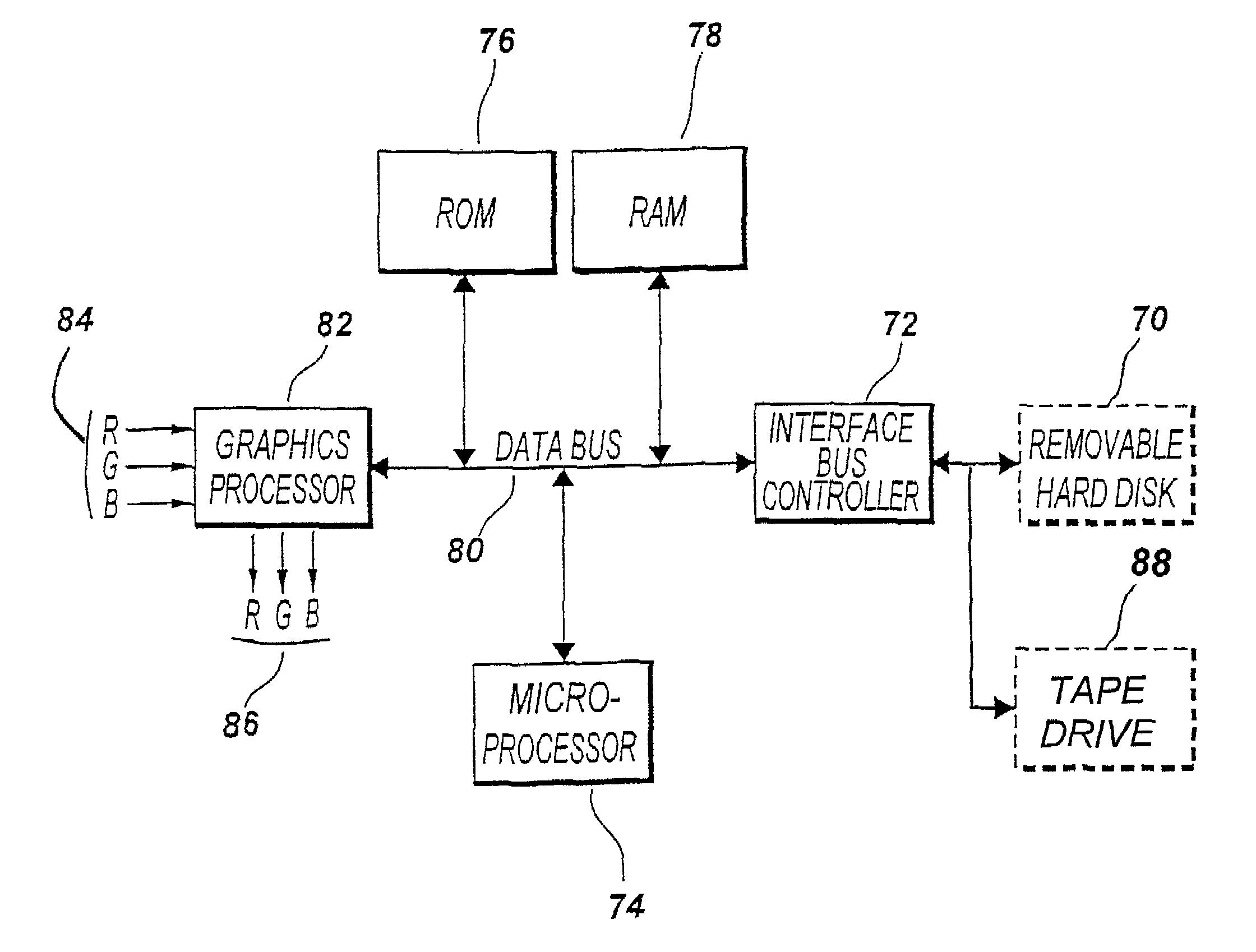
display device. A centralized controller in operative communication with the video program input, the
graphics processor, and an
operator interface, enables commands entered by an operator to cause the
graphics processor to perform one or more of the conversions using the television interfaces. The present invention thus encourages production at relatively low pixel dimensions to make use of lower-cost general-purpose technology and to maintain high signal-to-
noise ratio, and then subsequently expands the
resultant image into a so-called up-converted program. This is in contrast to alternative approaches, which recommend operating at HDTV-type resolution, then down-converting, as necessary, to smaller image formats. This has led to the use of expensive dedicated hardware, the need for which the present invention seeks to eliminate. In addition, the flexible storage and playback facilities allow extensive control of the playback of the program material, enabling frame rate adjustments and alterations, and providing for time-shifting of the start and end points of the program
reproduction in those cases wherein
direct control of the
source material frame rate is not practical, due to
physical separation of the equipment or multiple reception points simultaneously producing outputs at different frame rates from the same source signal playback
data stream. In commercial implementations, the invention readily accepts and processes enhanced information, such as pan / scan information or identification information to
restrict viewing based on regional or geographical marketing plans.
[0019]The method and associated technology provide for maintaining the original
high bandwidth of conventional cameras (up to 15 MHZ, which corresponds to more than 600 TV-lines of resolution-per picture height for 16:9
aspect ratio) and provide optimized compression techniques to fully utilize the available capacity of general storage media, such as the commercially available Panasonic DVCPRO, DVCPRO50, Sony DVCAM, JVC Digital-S, and Sony Betacam SX recorders. The
system preferably employs a consistent compression scheme, utilizing only intra-frame compression (such as Motion-
JPEG-type systems, systems used in DV-format recorders, MPEG2 4:2:2P@ML) throughout the entire production process. This avoids many signal artifacts, ensures high signal-to-
noise ratios, and provides for editing the program material in data-compressed format. This enables the system to preserve the original camera capability of 600+ TV-lines of resolution per picture height, and with 4:2:2
processing provides a
chrominance bandwidth of up to 7.5 MHZ. Utilizing 10-bit
processing results in 65 dB signal-to-
noise performance and improved camera sensitivity (rating of f-11). In contrast, available and proposed systems for HDTV are based on 8-bit
processing, and offer performance of less than 54 dB signal-to-noise ratio and camera sensitivity rating of only f-8.
[0022]The technology of display devices and methodology has progressed as well, offering alternative features such as conversion of interlaced signals to
progressive scan, line doubling, pixel quadrupling, and improved general techniques for
horizontal and vertical pixel interpolation. Availability of these features as part of display devices will simplify the process of implementing multi-format digital production.


 Login to View More
  Login to View More