
Molded foam mouthguard
a technology of mouth guards and foam, applied in the field of dental mouth guards, can solve the problems of deformation and decomposition, headache, muscle spasm, etc., and achieve the effect of being cheap to produ
- Summary
- Abstract
- Description
- Claims
- Application Information
AI Technical Summary
Benefits of technology
Problems solved by technology
Method used
Image

Examples
Embodiment Construction
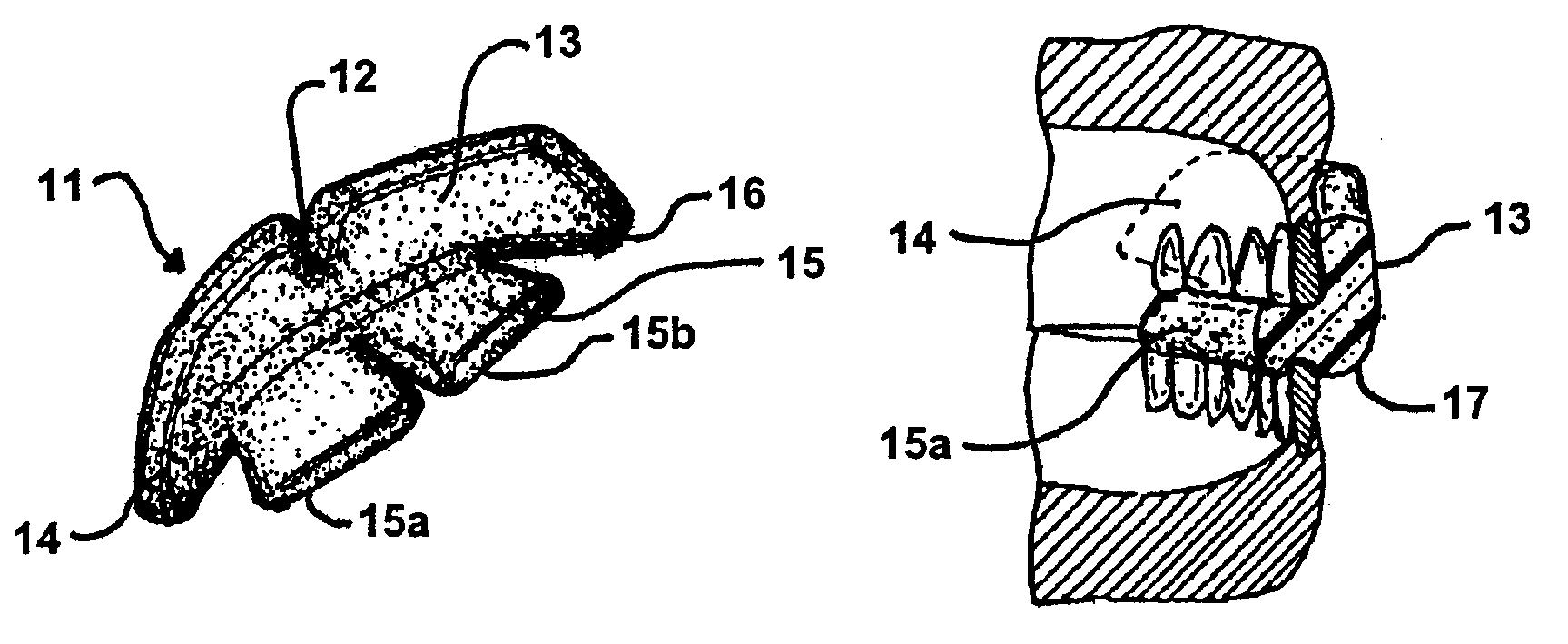
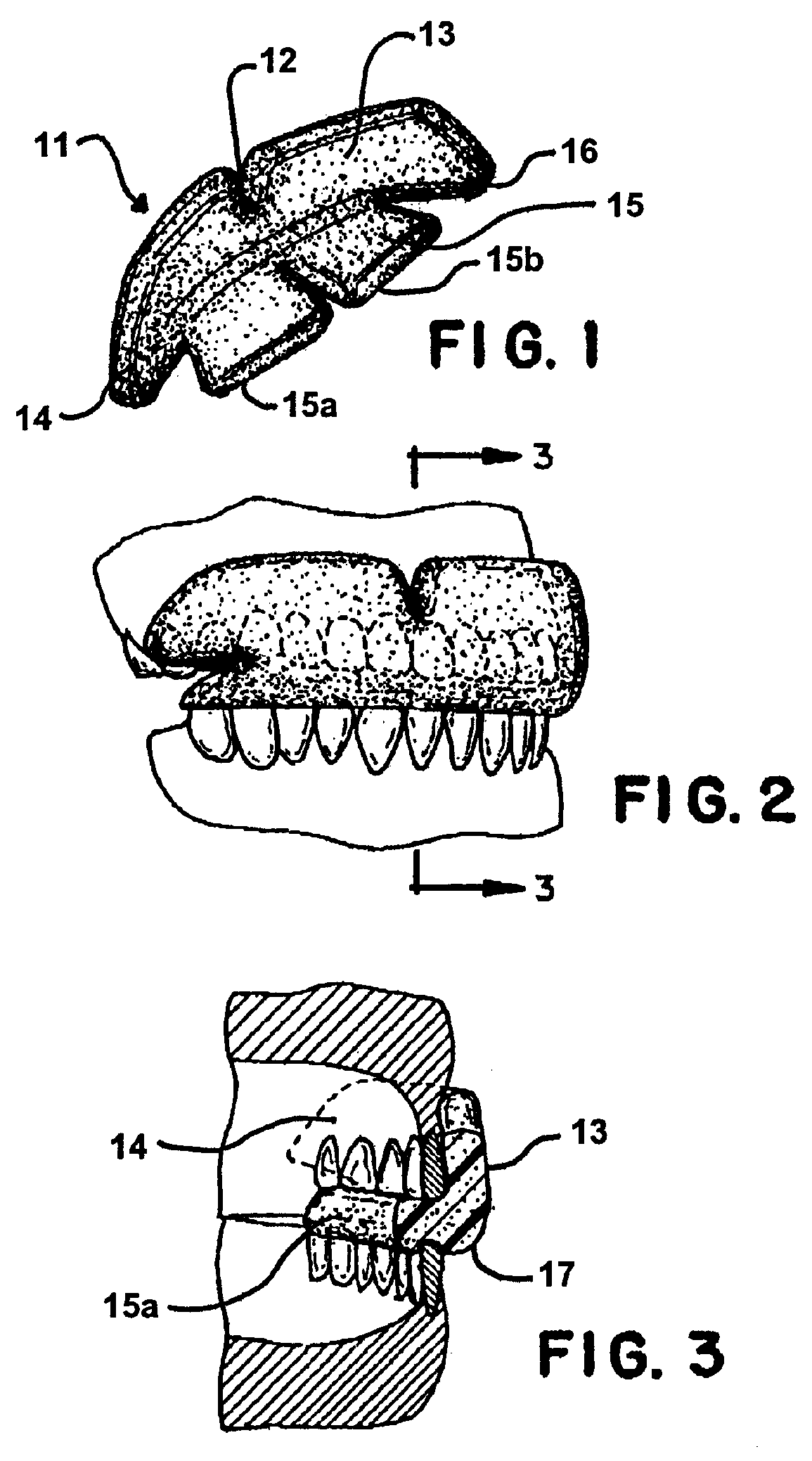
[0011]As shown in FIG. 1, the mouthguard of the invention 11 is molded in one piece preferably composed of polyolefin foam such as the foam material manufactured by the Voltek company under the product name Volara®. It includes two sections, a vertical component 13 and a horizontal component 15. The horizontal component comprises two rearwardly extending tabs 15a and 15b that form a bite platform. The vertical component also has a V-shaped midline notch 12 to accommodate the labial frenum and further includes rearwardly extending wings 14 and 16 that are located adjacent to the side edges of each of the bite platform tabs. The flexibility of the foam material and the construction of the mouthguard as shown in FIG. 1 provides it with the flexibility to conform to the individual anatomical shape of the user's mouth as shown in FIG. 2 and as further described in FIG. 3.
[0012]Referring now to FIG. 3, the vertical component 13 of the mouthguard forms an acute angle with the horizontal co...
PUM
 Login to View More
 Abstract
Description
Claims
Application Information
 Login to View More