[0011]In securing the tissue folds or anchoring to or from these tissue folds or plications, over-compression of the tissue directly underlying the tissue anchors is preferably avoided. Over-compression of the underlying tissue may occur if the anchor compresses the tissue to such a degree that tissue necrosis or cutting of the underlying muscularis or serosal tissue by the anchor occurs. Accordingly, a tissue anchor is preferably configured to maintain or secure a tissue plication yet still allow for adequate blood flow to occur within the tissue underlying the anchor. As such, the tissue anchor is preferably configured to accommodate a range of deflections due to various movements of the tissue due to, e.g., peristalsis, patient movement, weight of the gastrointestinal organ itself, etc., while maintaining or exerting a substantially constant force against the tissue.
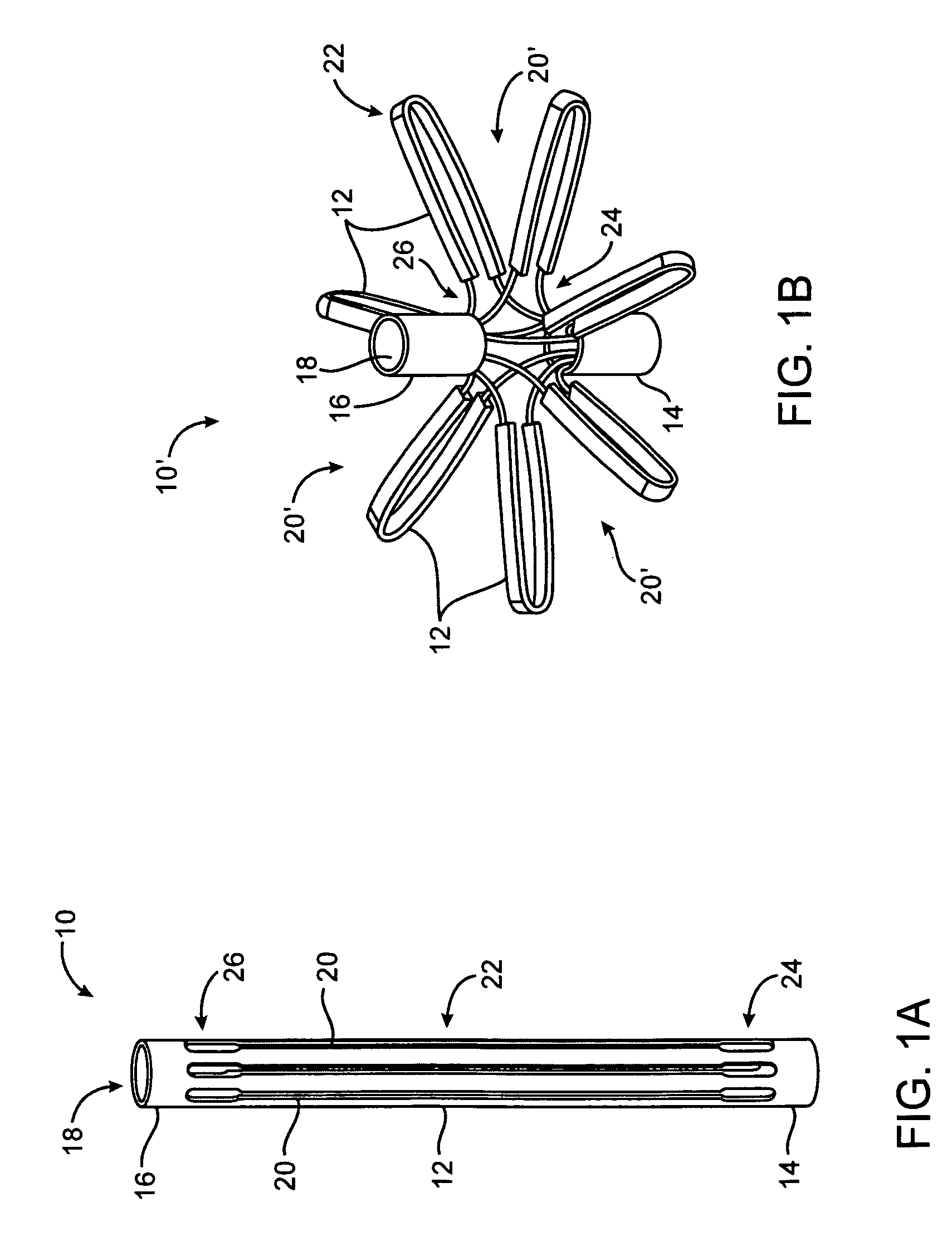
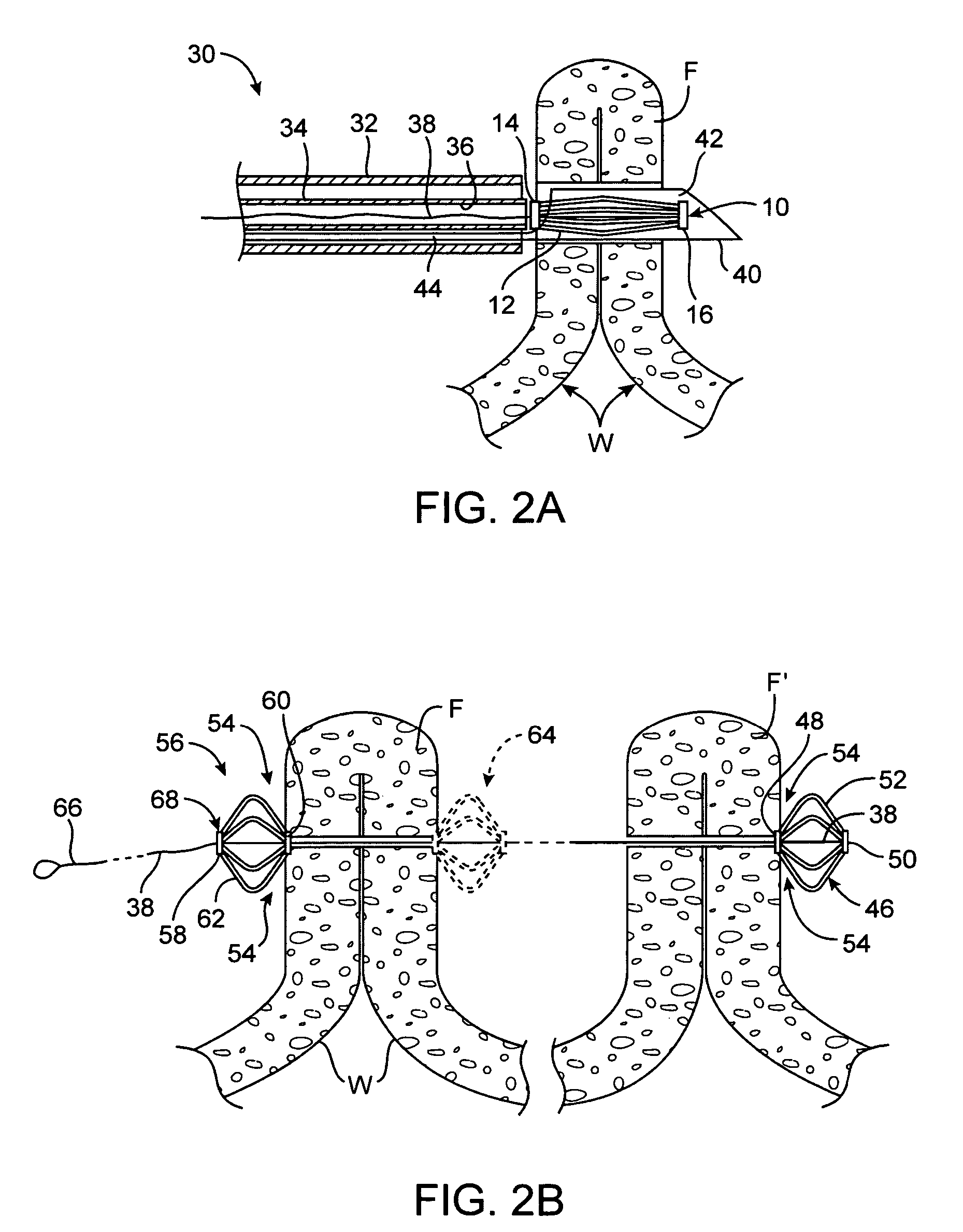
[0012]A particular type of anchor which may be utilized is a reconfigurable “basket”-type anchor generally having a number of configurable struts or legs extending between at least two collars or bushing members. This anchor may have a low-profile delivery configuration and a radially expanded anchoring configuration. When expanded, each arm of the anchor may be separated from one another by a spacing or opening. The spacing is preferably created to minimize the contact area between the anchor body and the underlying tissue surface to allow for greater blood flow in the tissue and to inhibit necrosis of the tissue.
[0016]One method for limiting the loading or pre-load force upon an anchor may involve including a post or stop in the anchor body which limits the proximal deflection of the distal collar and thus prevents over-compression of the anchor against the tissue. Another variation may utilize friction-producing regions within the anchor delivery catheter. As the anchor is tensioned, various regions may produce frictional forces which vary in accordance to the degree of anchor deflection. A change in the detected frictional force may thus be utilized to indicate that anchor has been configured within an optimal range of deflections.
[0018]Yet another variation may include configuring the proximal collar of the anchor to prevent the passage of stop member contained within the anchor. thus, the length of suture extending from the stop member to the attachment point within the anchor may be of a predetermined length such that when the stop member is seated against the proximal collar, the suture length may compress the anchor into a predetermined deflection level. This deflection level may be preset to configure the anchor to any desired configuration, as described above.
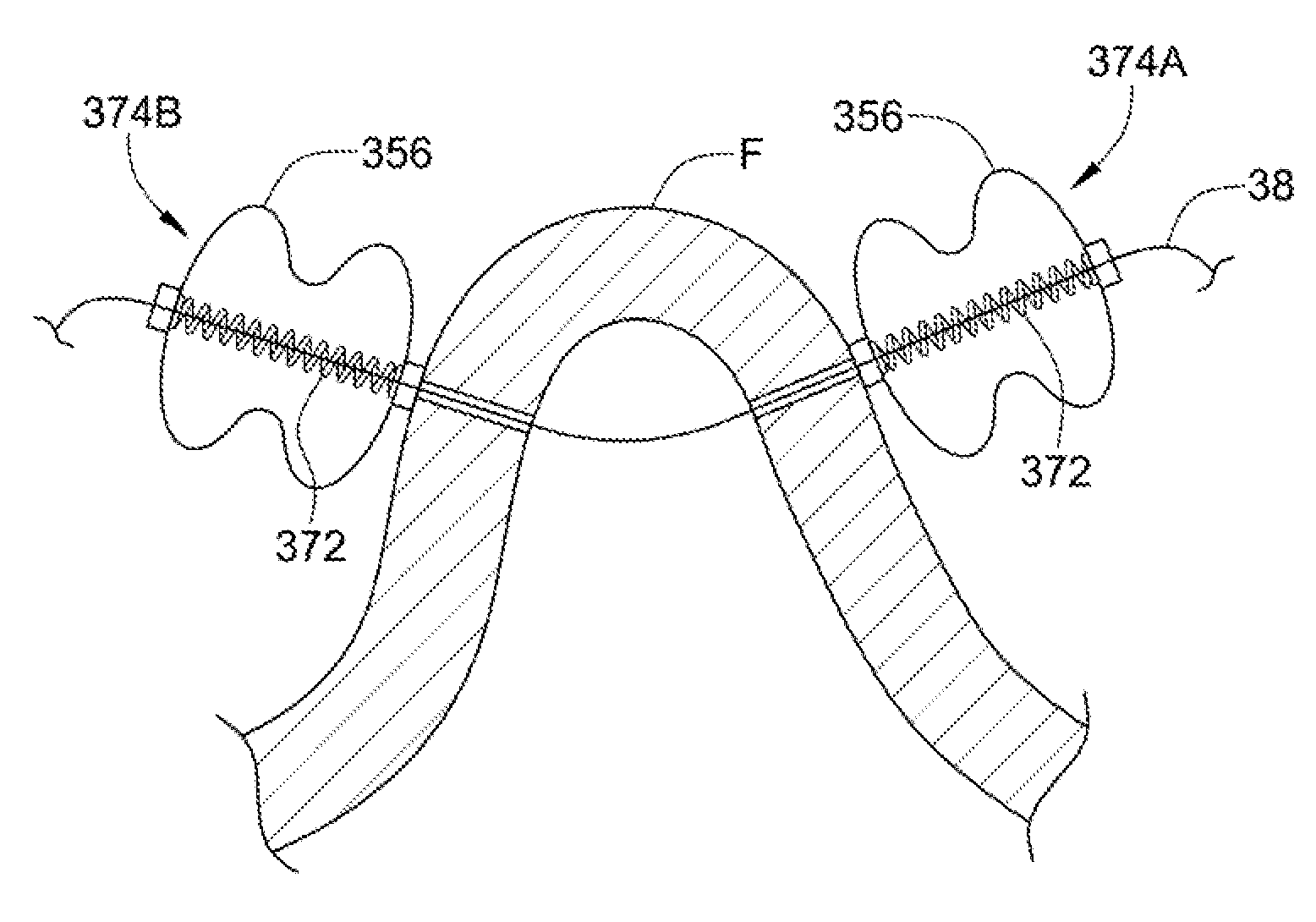
[0022]In another variation, a separate mesh basket and basket anchor may be assembled as a hybrid combination where the basket anchor is placed within the mesh basket such that they are freely floating with respect to one another. Alternatively, one or both collared ends of both baskets, i.e., the basket anchor and mesh basket, may be formed or otherwise adhered to one another. In yet another variation, a mesh basket, alone or in combination with a basket anchor, may be pre-formed to compress into a ringed configuration which inhibits or resists being pulled through a tissue region when deployed and compressed against the tissue surface. In these and other variations, a biasing element such as a spring may also be utilized to connect the collars of the mesh anchor to one another. Use of a spring may facilitate at least the partial expansion of a mesh anchor when deployed or released from the deployment instrument and inhibit the anchors from being pulled through a tissue region.


 Login to View More
  Login to View More