
System and method for providing optimized receiver architectures for combined pilot and data signal tracking
a receiver architecture and integrated technology, applied in the field of global navigation satellite system receiver hardware configuration, can solve the problems of reducing the power consumption of the receiver, using less hardware, etc., and achieve the effects of low signal-to-noise ratio tracking, and efficient hardware complexity reduction
- Summary
- Abstract
- Description
- Claims
- Application Information
AI Technical Summary
Benefits of technology
Problems solved by technology
Method used
Image

Examples
Embodiment Construction
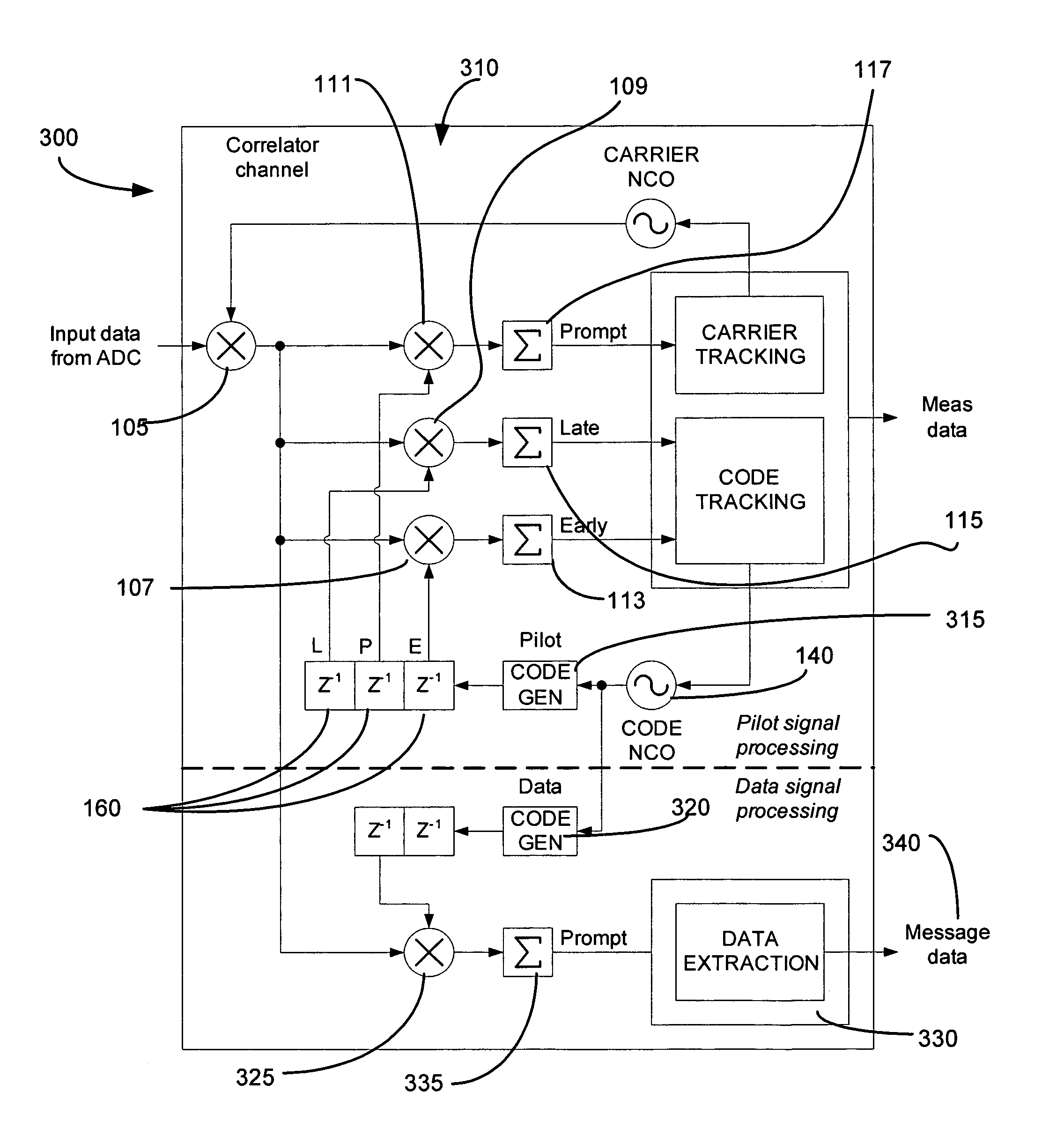
[0018]The present invention provides for a system and method for efficiently reducing the hardware complexity required for enabling the reception of both a pilot signal and a data signal in a GNSS receiver. FIG. 5 shows a generic representation of a system within which the present invention operates. As shown in FIG. 5, a receiver 500 is located at a particular location on the Earth 510 at a given moment, and a plurality of satellites 520 orbit the Earth 510. Each of the satellites 520 is capable of transmitting information to the receiver 500, which can receive a number of the signals, possibly with the help of an assistance mechanism 530.
[0019]The circuitry for a typical receiver according to one embodiment of the present invention is shown in FIG. 6 in a simplified block diagram. The electronic device 1 of FIG. 6 comprises, for example, a positioning receiver 2 as well as communication mechanism 3 such as an antenna. By this communication mechanism 3, the electronic device 1 may,...
PUM
 Login to View More
 Abstract
Description
Claims
Application Information
 Login to View More