
Blue colorant derived from Genipa americana fruit
a technology of genipa americana and blue colorant, which is applied in the field of colorant making methods, can solve the problems of no description of stable colorant, wide range of applications, and disfavored synthetic colorants today
Active Publication Date: 2011-04-19
ECOFLORA
View PDF14 Cites 25 Cited by
- Summary
- Abstract
- Description
- Claims
- Application Information
AI Technical Summary
Benefits of technology
"The present invention provides a method to make a blue colorant as a liquid and as a powder, which can be used in various industries such as textile, pharmaceutical, food, cosmetics, and others. The method involves peeling off a Genipa americana fruit from its skin, obtaining raw liquid juice from the pulp, mixing the raw liquid juice with glycine, and warming up the mixture. The raw liquid juice can be obtained by grinding the Genipa americana fruit pulp and compressing it against a mesh to retain major solids. The mixing of the raw liquid juice with glycine can be done with at least 0.2 grams of glycine per 100 milliliters of raw liquid juice. The resulting mixture can be dehydrated to form a stable colorant powder. The present invention also provides a liquid colorant made of a mix of raw liquid juice and glycine, and a powder colorant made of a dehydrated mix of raw liquid juice, glycine, and starch. The technical effects of the invention include the ability to make a stable blue colorant with a simple process and the versatility to apply it in various industries."
Problems solved by technology
Synthetic colorants tend to be disfavored nowadays because of side effects, e.g., carcinogenic.
However, there is no description of an stable, broad range of applications, blue colorant derived from unprocessed raw components obtained from Genipa americana fruits with a minimum of other added components.
Method used
the structure of the environmentally friendly knitted fabric provided by the present invention; figure 2 Flow chart of the yarn wrapping machine for environmentally friendly knitted fabrics and storage devices; image 3 Is the parameter map of the yarn covering machine
View moreImage
Smart Image Click on the blue labels to locate them in the text.
Smart ImageViewing Examples

Examples
Experimental program
Comparison scheme
Effect test
examples
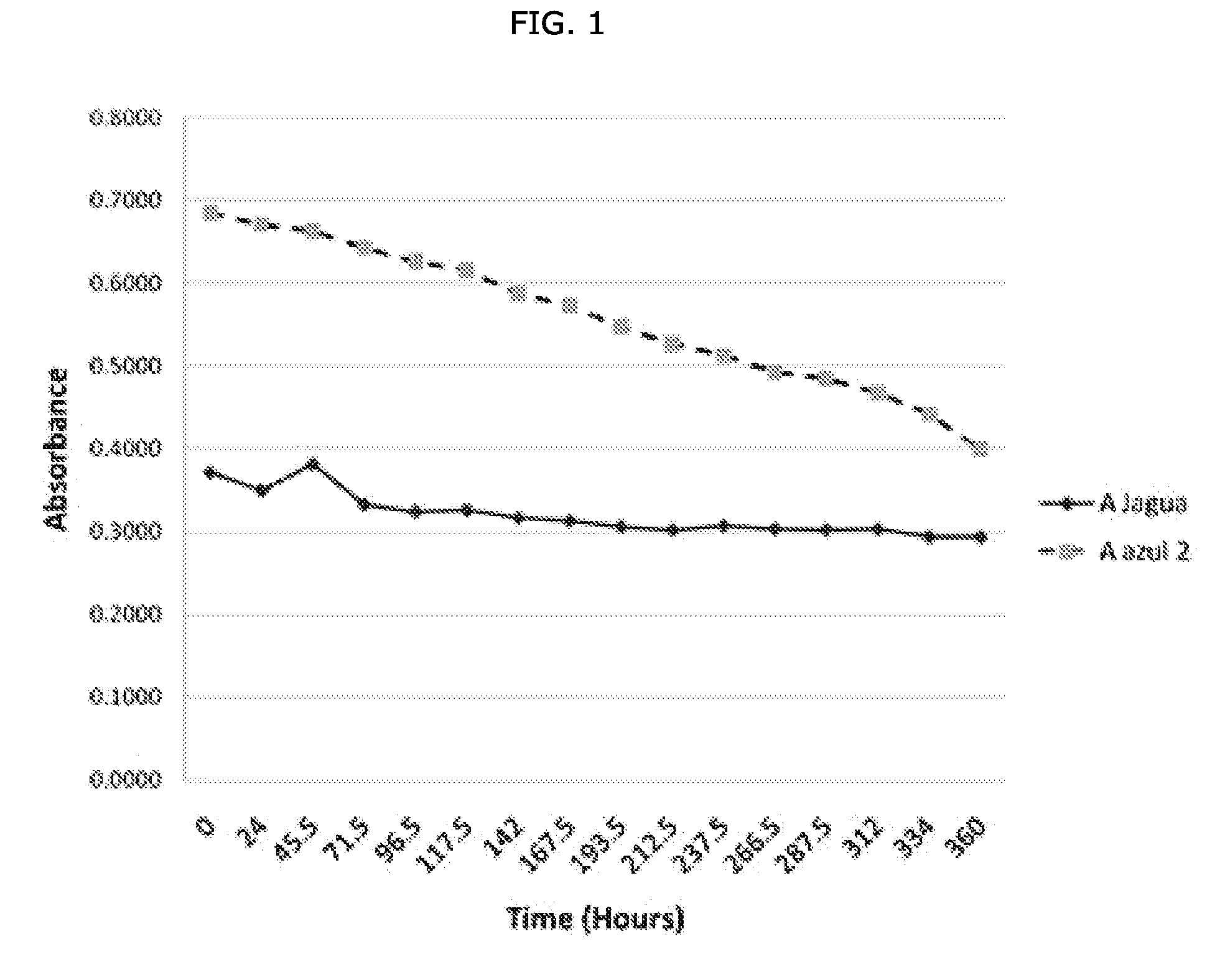
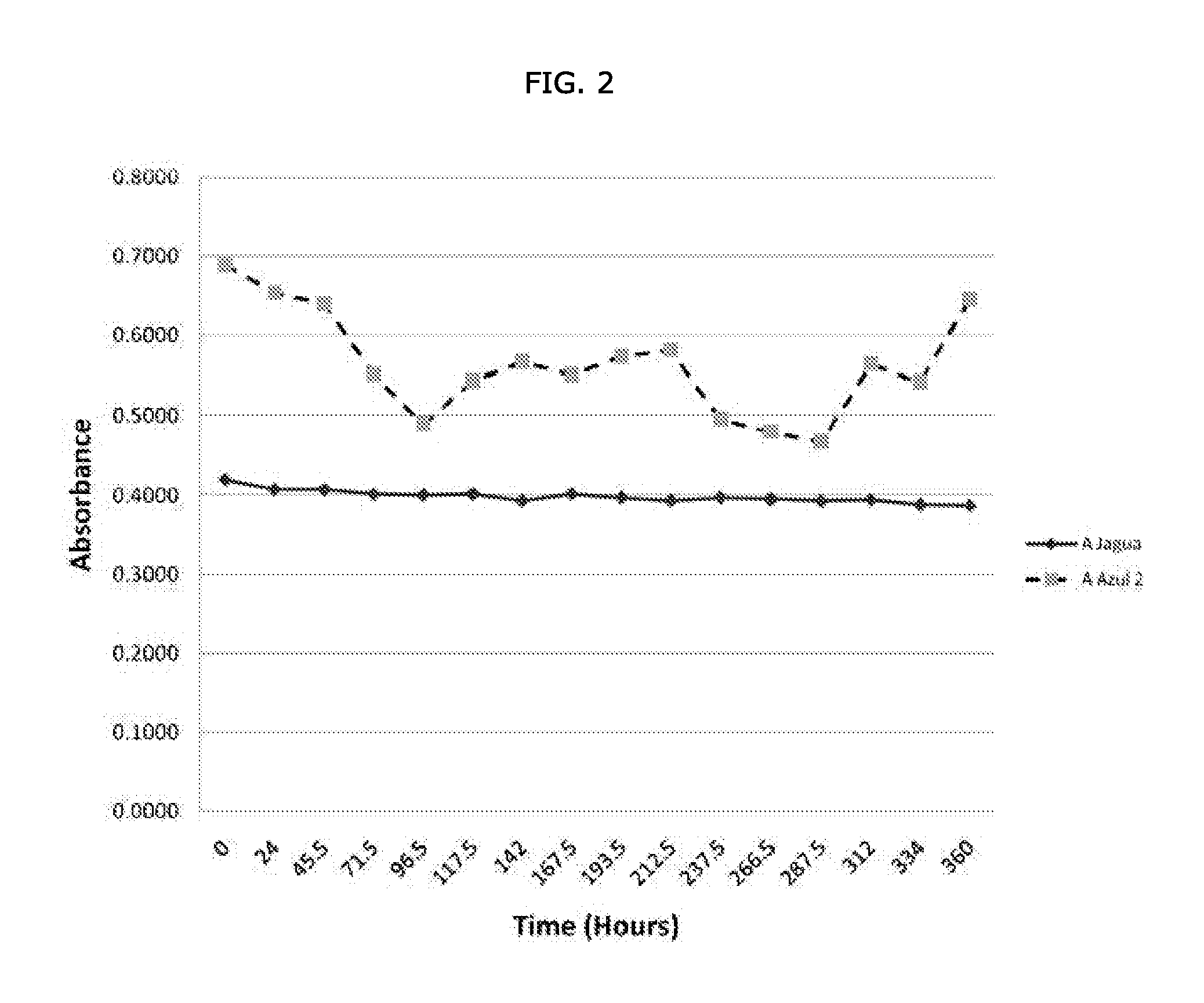
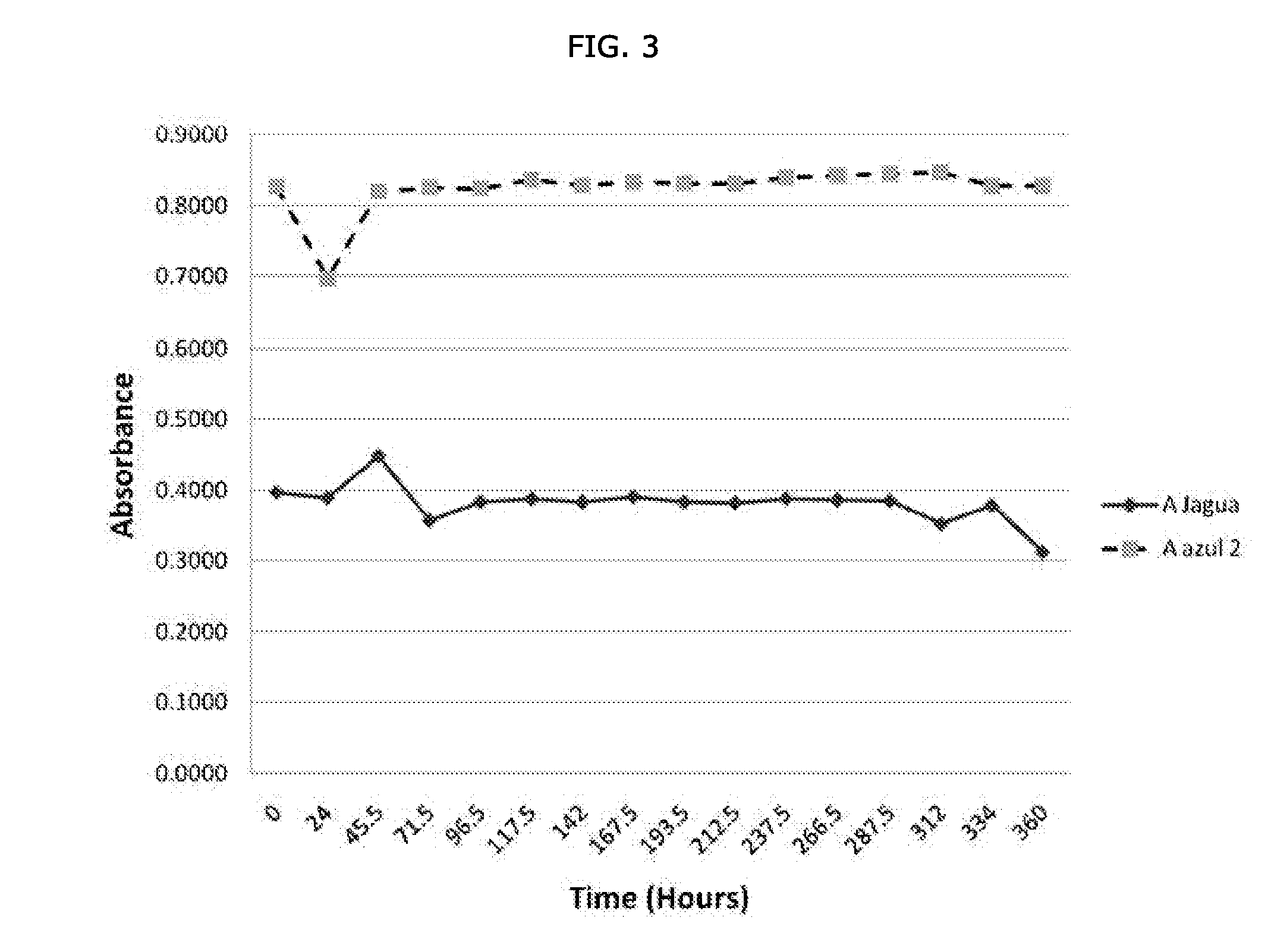
[0095]The liquid colorant of the present invention, which for the purpose of the test was called Jagua (AJagua), was tested for stability in a concentration of 0.01 grams / 40 ml and compared with synthetic colorant Blue No.2 (Azul 2) (0.0003 grams / 40 ml). Both tested compounds were maintained for 15 days under the following conditions:[0096]6° C. (Centigrade) at pH 3, pH 5, pH 7, pH 9, and pH 7.17[0097]20° C. (Centigrade) at pH 3, pH 5, pH 7, pH 9, and pH 7.17[0098]50° C. (Centigrade) at pH 3, pH 5, pH 7, pH 9, and pH 7.17
[0099]Results of said testing can be observed in the graphics of FIGS. 1 to 15.
the structure of the environmentally friendly knitted fabric provided by the present invention; figure 2 Flow chart of the yarn wrapping machine for environmentally friendly knitted fabrics and storage devices; image 3 Is the parameter map of the yarn covering machine
Login to View More PUM
 Login to View More
 Abstract
The present invention provides a method to make a blue colorant as a liquid and as a powder, wherein the blue colorant is derived from unprocessed raw juice obtained from Genipa americana fruit pulp, and wherein said raw juice is mixed with glycine (liquid) or with glycine plus starch (powder). Except for an additional step of warming up the juice-glycine mix, and in the case of the powder further dehydration of the juice-glycine-starch remix, no further steps are required to make a temperature and PH stable blue colorant which may be applied in textile, pharmaceutical, food, cosmetics, and other industries.
Description
FIELD OF THE INVENTION[0001]The present invention relates to a method to make a colorant using raw liquid juice obtained from Genipa americana fruit pulp.DESCRIPTION OF PRIOR ART[0002]Synthetic colorants tend to be disfavored nowadays because of side effects, e.g., carcinogenic. Food, cosmetic and textile industries are tending to use natural or organic colorants.[0003]Safe colorants derived from extracted components from plants have been described. In JP Patent Publications No. 52053932A2 and No. 52053934A2, H. Okuyama et al. describes a blue-violet colorant made of an spontaneous reaction of compounds bearing primary amino groups and genipin or analogs (extracted from Gardenia jasminoides) after treatment with glucosidase. Similarly, K. Kunimasa, et al. in U.S. Pat. No. 4,878,921, describes a blue colorant made of taurine that reacts with genipin, wherein the genipin have been extracted from Gardenia jasminoides by the hydrolysis of iridoid glycoside geniposide under action of glu...
Claims
the structure of the environmentally friendly knitted fabric provided by the present invention; figure 2 Flow chart of the yarn wrapping machine for environmentally friendly knitted fabrics and storage devices; image 3 Is the parameter map of the yarn covering machine
Login to View More Application Information
Patent Timeline
 Login to View More
 Patent Type & AuthorityPatents(United States)
IPC IPC(8): A61K36/00
CPCC09B61/00
InventorECHEVERRY, LUIS FERNANDOZAPATA, SANDRA PATRICIATORRES, LUIS FERNANDO
OwnerECOFLORA