
Efficiency optimization and damage detection of electrolysis cells
a technology of efficiency optimization and damage detection, applied in the direction of electrochemical machining apparatus, electrolysis components, material analysis by electric/magnetic means, etc., can solve the problem of cell identification with lower current efficiency, and achieve the effect of improving overall electrolysis efficiency and low current efficiency
- Summary
- Abstract
- Description
- Claims
- Application Information
AI Technical Summary
Benefits of technology
Problems solved by technology
Method used
Image

Examples
Embodiment Construction
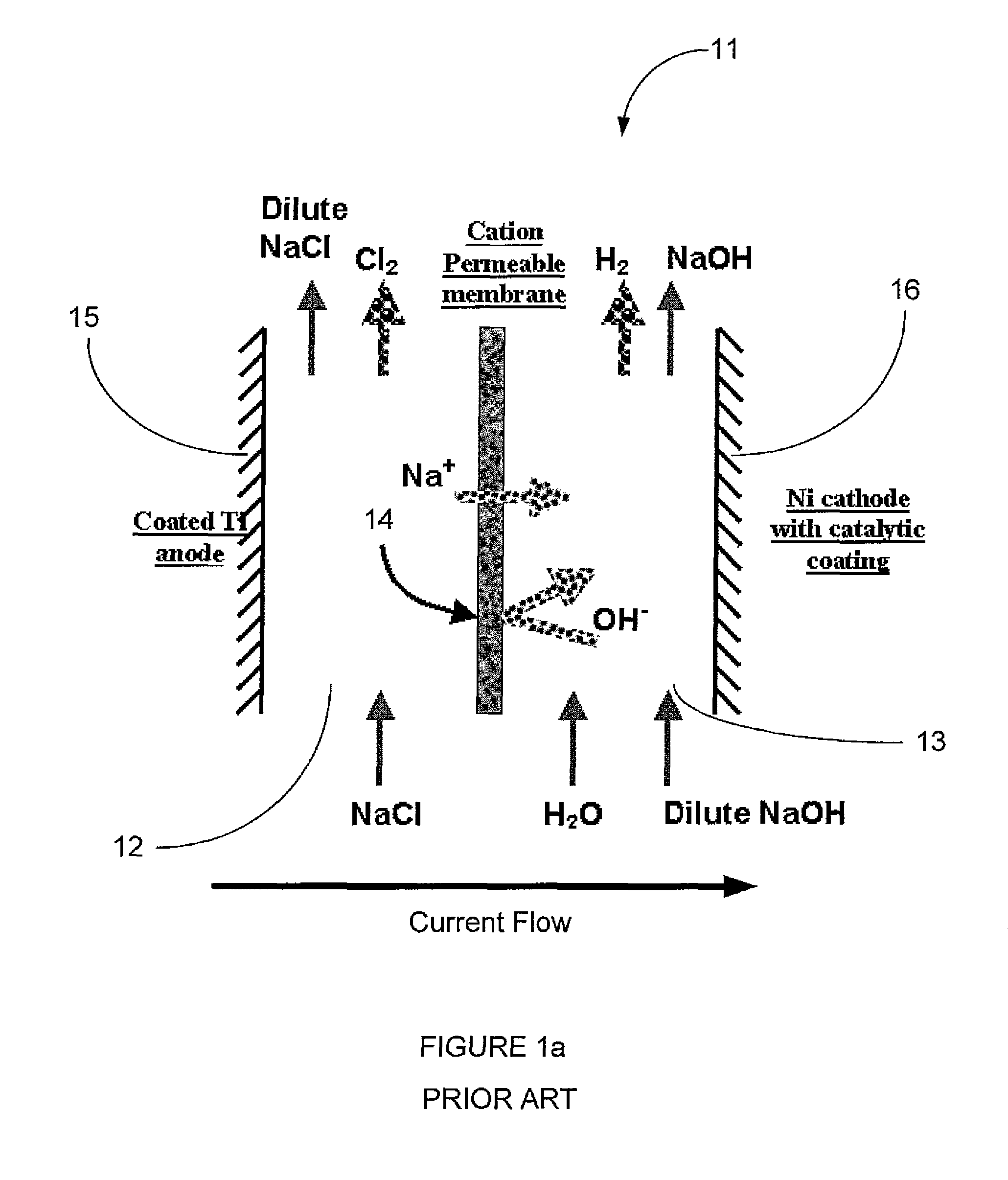
[0025]FIG. 1a is a schematic representation of a typical membrane cell 11 used in the Chlor-alkali industry. It is composed of two compartments, an anode compartment 12 and a cathode compartment 13, separated by a membrane 14. The anode compartment 12 is filled-up with a saturated brine solution (NaCl), while a dilute caustic soda passes through the cathode compartment 13.
[0026]In Chlor-alkali production plants, Chlorine is generated at the coated anode 15 (usually with Titanium). The combination of Hydroxide ions with migrated Sodium ions across the selective membrane 14 generates caustic soda (NaOH) and Hydrogen gas. The cathode 16 is usually made of Nickel with a catalytic coating to reduce the over-potential for H2 evolution. The complete Chlor-Alkali process is described by the following equation:
2NaCl+2H2O→Cl2+H2+2NaOH (1)
[0027]The efficiency of membrane-type Chlor-Alkali cell (kw / h per unit of caustic produced) is a complex resultant of the interaction of a number of aspects...
PUM
| Property | Measurement | Unit |
|---|---|---|
| current density | aaaaa | aaaaa |
| current density | aaaaa | aaaaa |
| current density | aaaaa | aaaaa |
Abstract
Description
Claims
Application Information
 Login to View More