Check patentability & draft patents in minutes with Patsnap Eureka AI!

Phase synchronization device and phase synchronization method

a phase synchronization and phase synchronization technology, applied in phase-modulated carrier systems, digital transmission, pulse automatic control, etc., can solve the problems of high bit error rate, difficulty in simultaneously sending the clock required for demodulation and data, etc., and achieve low cost and power saving

Active Publication Date: 2012-02-28
NEC CORP
View PDF16 Cites 4 Cited by
  • Summary
  • Abstract
  • Description
  • Claims
  • Application Information

AI Technical Summary

Benefits of technology

This approach enables power saving and cost reduction while maintaining accurate phase synchronization for demodulation, reducing the need for complex analog circuits and high-resolution A / D converters, thus improving the efficiency of wireless communication systems.

Problems solved by technology

However, in the case of a wireless communication, there exists only one physical transmission line, so that it is difficult to simultaneously send the clock required for demodulation and data.
The lower the synchronization accuracy is, the higher the bit error rate becomes.

Method used

the structure of the environmentally friendly knitted fabric provided by the present invention; figure 2 Flow chart of the yarn wrapping machine for environmentally friendly knitted fabrics and storage devices; image 3 Is the parameter map of the yarn covering machine
View more

Image

Smart Image Click on the blue labels to locate them in the text.
Viewing Examples
Smart Image
  • Phase synchronization device and phase synchronization method
  • Phase synchronization device and phase synchronization method
  • Phase synchronization device and phase synchronization method

Examples

Experimental program
Comparison scheme
Effect test

first exemplary embodiment

Explanation of Operation

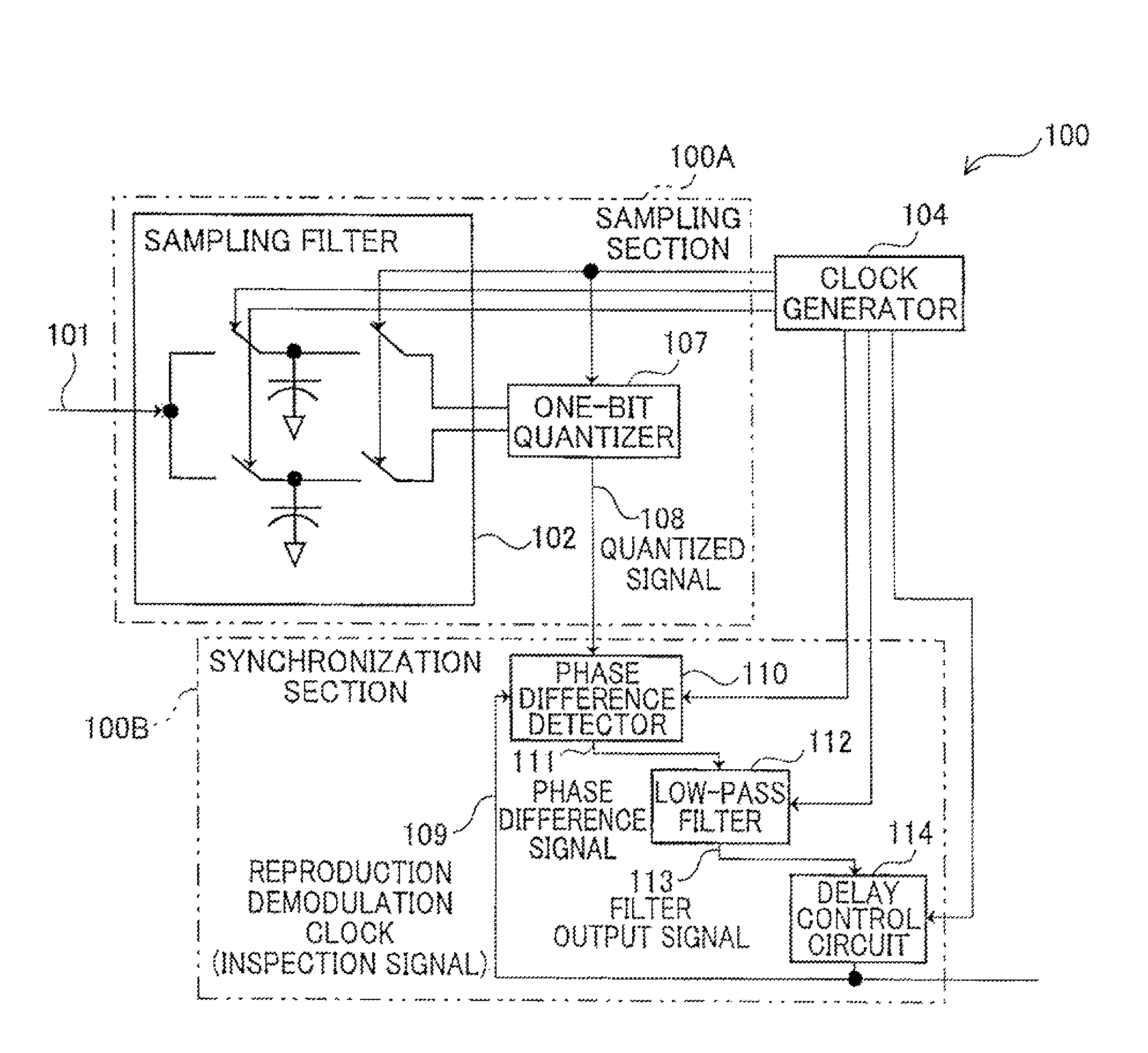
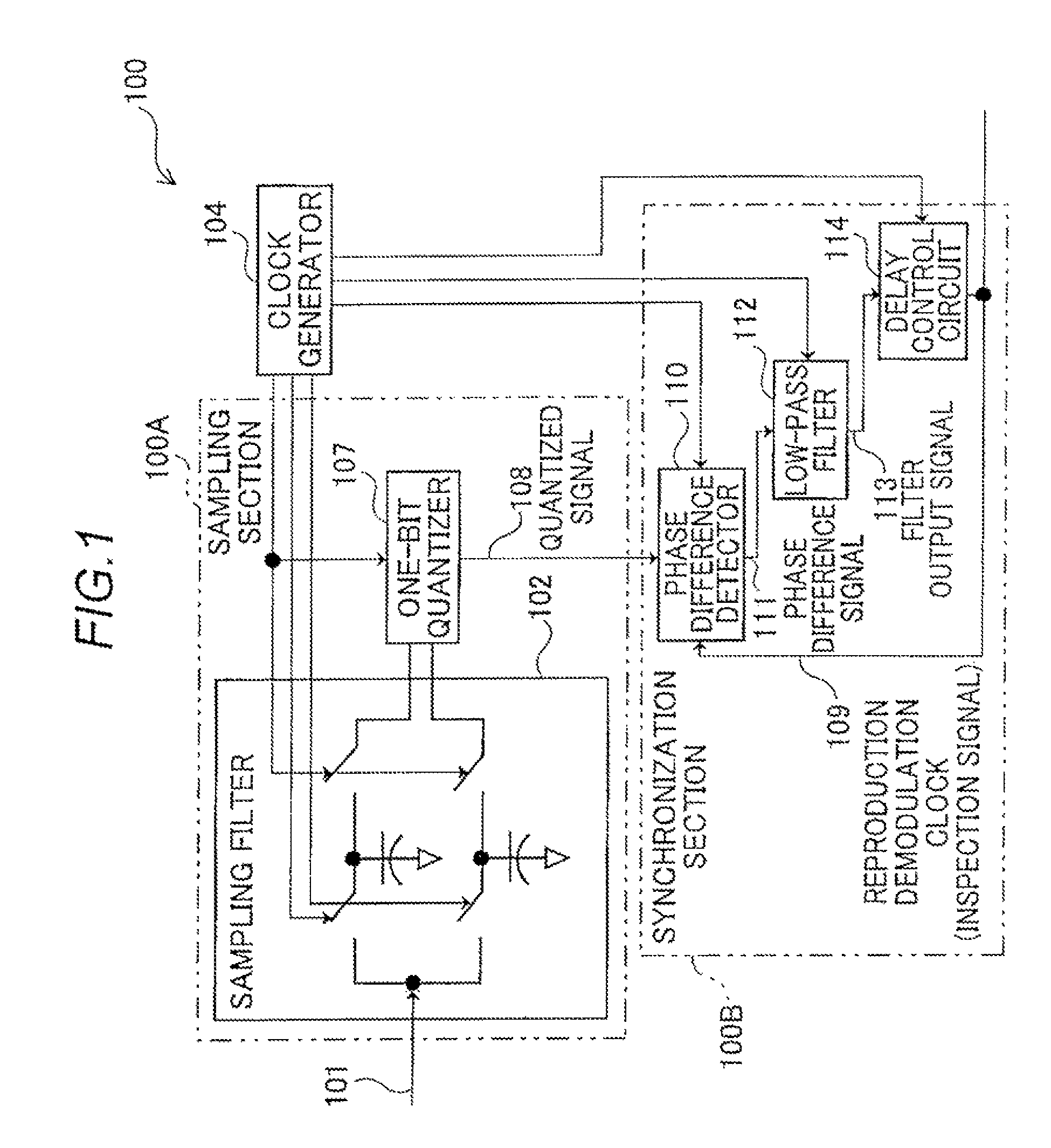
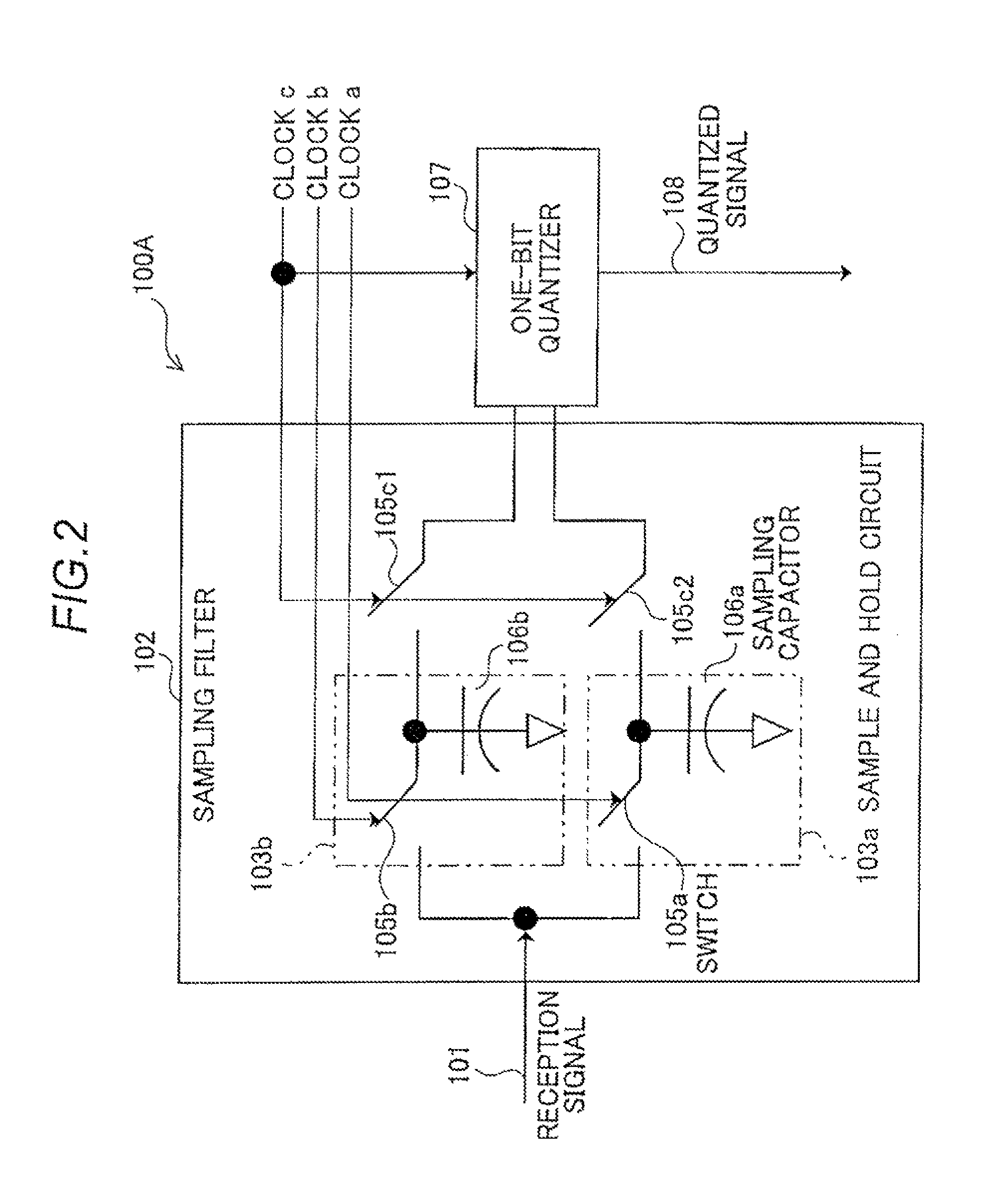
[0049]Operation of the phase synchronization device 100 having the configuration described above will be described with reference to a flowchart illustrated in FIG. 3. The reception signal 101 of a frequency 11 input to the sampling filter 102 is sampled by the sample and hold circuits 103a and 103b according to the clocks “a” and “b” each having a frequency fs0 and the sampled values are held by the sample and hold circuits 103a and 103b. As a result, the reception signal 101 is converted from a continuous-time signal into a discrete-time signal (step S1).

[0050]FIG. 4 illustrates an example of the sampling performed by the sampling filter 102. As illustrated in FIG. 4, the reception signal 101 is converted into discrete signals of A1 to A4 and A9 to A12 according to the clock “a” and discrete signals of B5 to B8 and B13 to B16 according to the clock “b”. The values of A1 to A4 are held in the sampling capacitor 106a as an analog addition value (A1+A2+A3+A4),...

second exemplary embodiment

Explanation of Operation

[0080]Operation of the phase synchronization device 200 having the configuration described above will be described. The operation of the synchronization section 100B according to the present exemplary embodiment is the same as that of the first exemplary embodiment, and the description thereof will be omitted. In the following, a part of the operation of the sampling section 200A different from that of the sampling section 100A of the first exemplary embodiment will mainly be described.

[0081]The multi-phase generator 215 divides the phase of the clock “a” input from the clock generator 104 to generate clocks a1 to a4 of four phases and outputs the generated clocks to the phase compensator 216. The phase compensator 216 adjusts the correlation skews of the clocks a1 to a4 and sequentially inputs the resultant clocks to the sample and hold circuit 203a. More concretely, as illustrated in FIG. 10, the clock a1 is input to the switch 105a1 of the sample and hold ...

the structure of the environmentally friendly knitted fabric provided by the present invention; figure 2 Flow chart of the yarn wrapping machine for environmentally friendly knitted fabrics and storage devices; image 3 Is the parameter map of the yarn covering machine
Login to View More

PUM

No PUM Login to View More

Abstract

A sampling section (100A) includes a sampling filter (102) that converts a continuous-time signal into a discrete-time signal and applies filtering of low-pass characteristics and a one-bit quantizer (107) that outputs a quantized signal representing a time-dependent change in the discrete-time signal. A synchronization section (100B) includes a phase difference detector (110) that calculates the phase difference between an inspection signal and the quantized signal and a delay control circuit (114) that feeds back the inspection signal to the phase difference detector at the timing set in consideration of a delay amount corresponding to the phase difference. When the phase difference between the inspection signal and the current quantized signal shows the same phase, the phase of the inspection signal is detected as a reference phase.

Description

[0001]This application is the National Phase of PCT / JP2009 / 051406, filed Jan. 29, 2009, which is based upon and claims the benefit of priority from prior Japanese Patent Application No. 2008-023779 (filed Feb. 4, 2008), the entire contents of which are incorporated herein by reference.TECHNICAL FIELD[0002]The present invention relates to a technique for demodulating a phase-modulated reception signal.BACKGROUND ART[0003]Now, as represented by the field of terrestrial broadcast, data communication is rapidly being shifted from analog modulation to digital modulation. The digital modulation is roughly divided into three according to a data value to be transmitted: ASK (Amplitude Shift Keying) that controls the amplitude of a carrier wave; FSK; and (Frequency Shift Keying) that controls the frequency of a carrier wave; and PSK (Phase Shift Keying) that controls the phase of a carrier wave. In the above three digital modulations, overlapping between data of “0” and data of “1” in the ph...

Claims

the structure of the environmentally friendly knitted fabric provided by the present invention; figure 2 Flow chart of the yarn wrapping machine for environmentally friendly knitted fabrics and storage devices; image 3 Is the parameter map of the yarn covering machine
Login to View More

Application Information

Patent Timeline
no application Login to View More
Patent Type & Authority Patents(United States)
IPC IPC(8): H03L7/00H03D3/18
CPCH04L27/0014H04L27/227H04L2027/0053H04L2027/0067H04L7/0337
Inventor ISHIZAKI, HARUYA
Owner NEC CORP
Features
  • R&D
  • Intellectual Property
  • Life Sciences
  • Materials
  • Tech Scout
Why Patsnap Eureka
  • Unparalleled Data Quality
  • Higher Quality Content
  • 60% Fewer Hallucinations
Social media
Patsnap Eureka Blog
Learn More