Cup component of an orthopaedic joint prosthesis

a technology of orthopaedic joints and components, applied in the field of orthopaedic joint prosthesis components, can solve the problems of inability to use fixation techniques, quality or quantity of bone tissue, etc., and achieve the effect of minimising the size of the flang

US8409294B2Active Publication Date: 2013-04-02DEPUY (IRELAND) LTD
66 Cites 3 Cited by

Patent Information

Authority / Receiving Office
US · United States
Patent Type
Patents(United States)
Current Assignee / Owner
Publication Date
2013-04-02

Smart Images

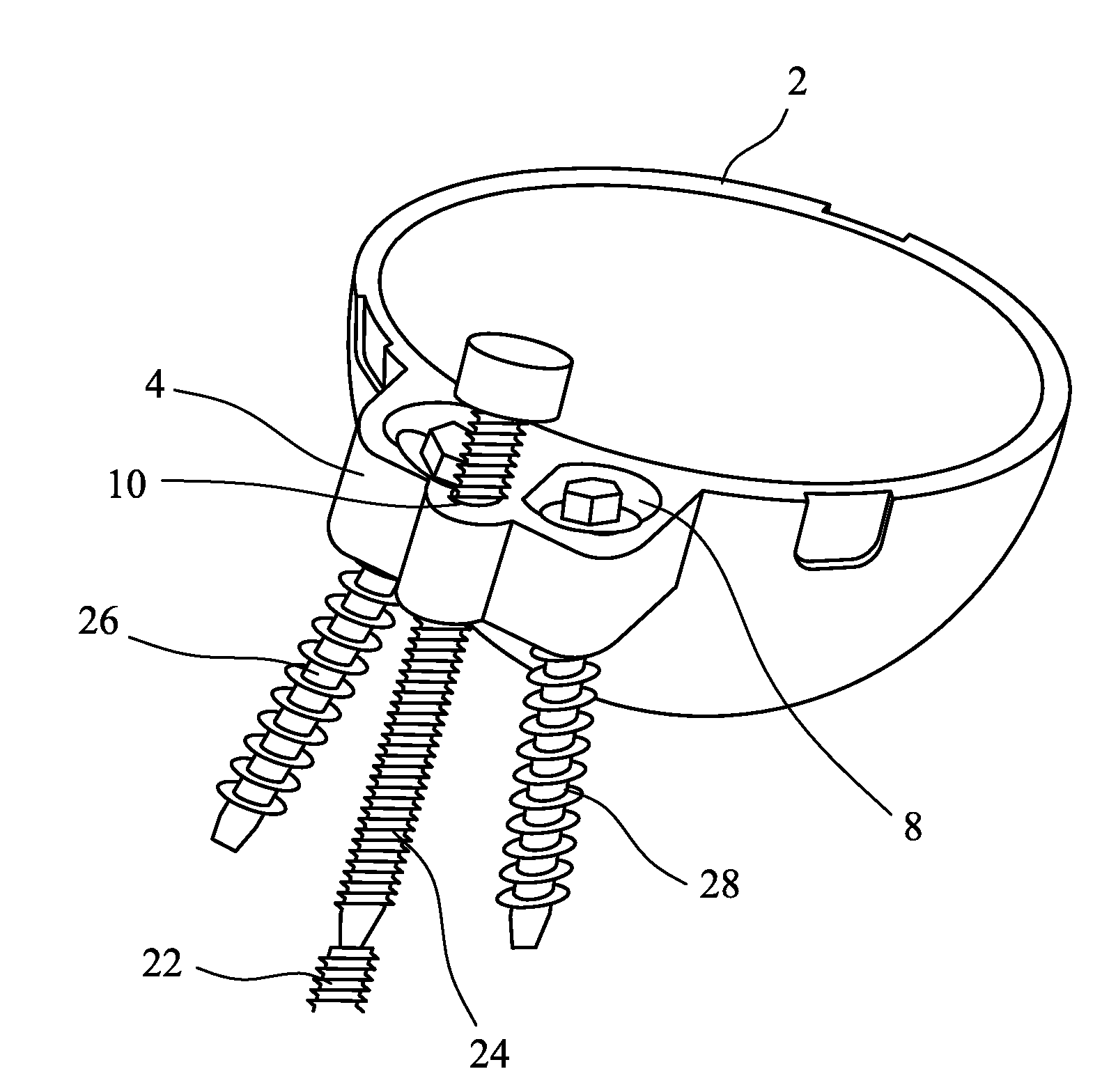
  • Figure 1
    Figure 1
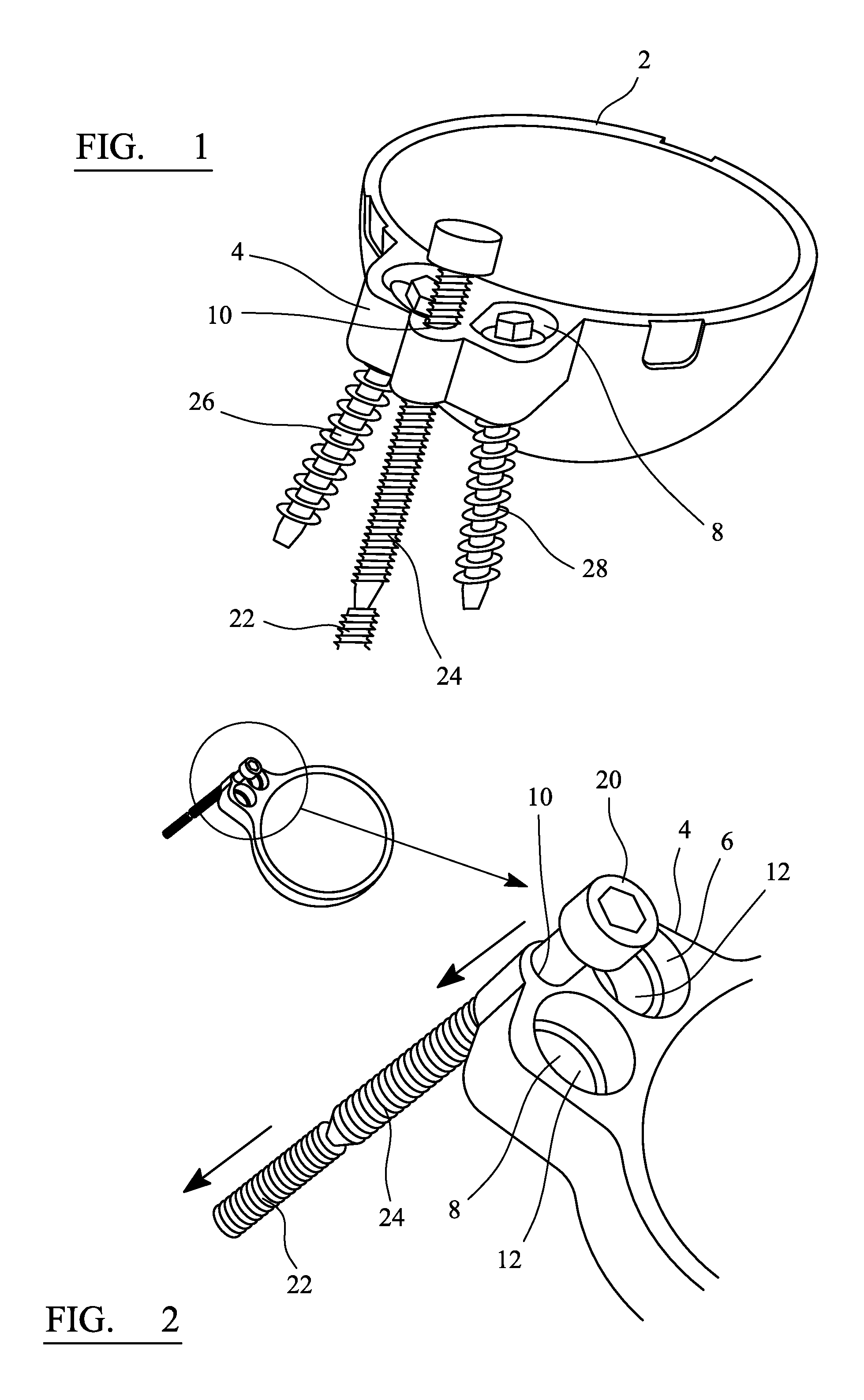
  • Figure 2
    Figure 2
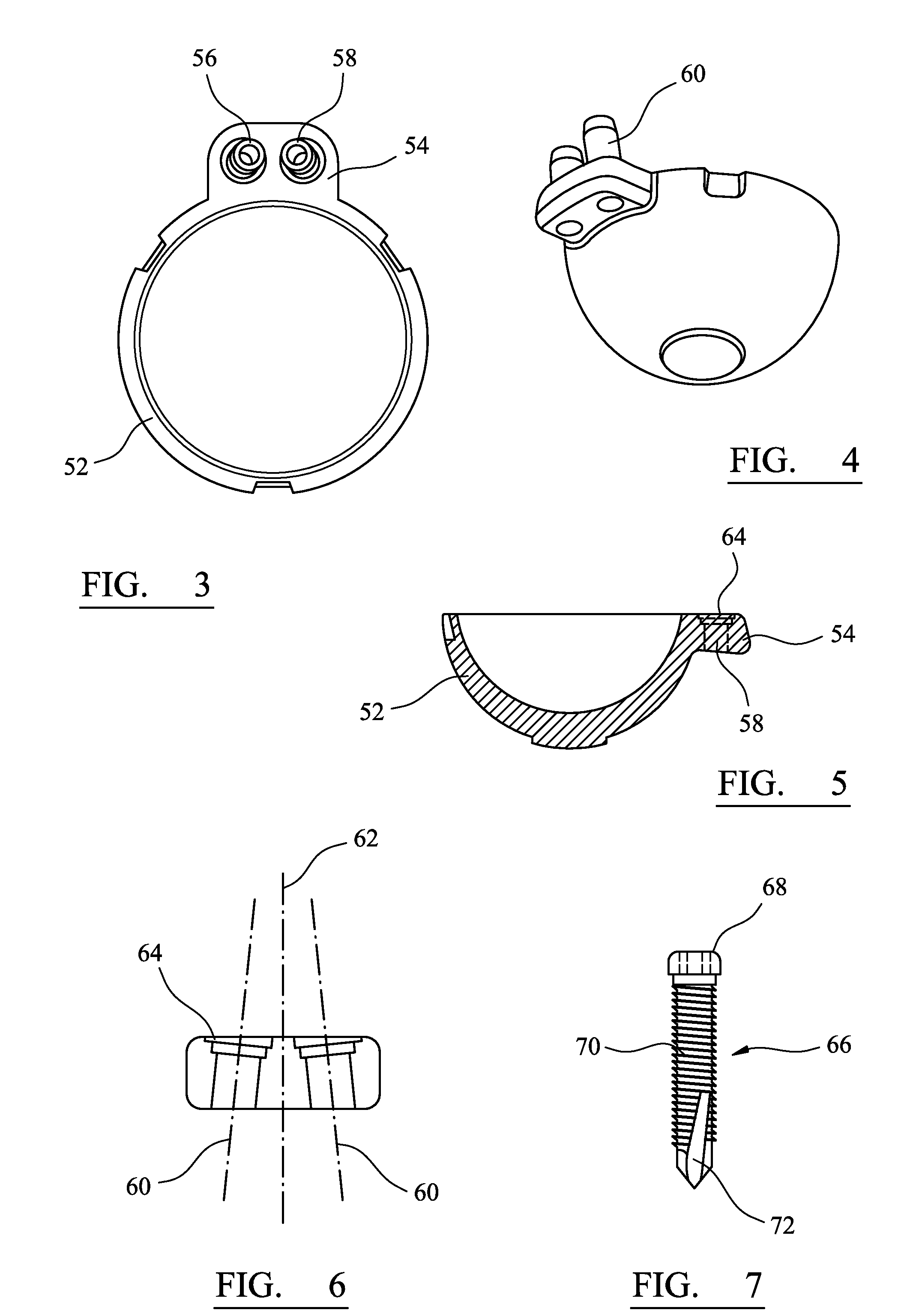
  • Figure 3
    Figure 3
Patent Text Reader

Abstract

A cup component of an orthopaedic joint prosthesis comprises a hollow shell wherein the head part of a mating component of the joint can be received. The shell has a flange at its open face extending around at least part of its periphery with at least two major threaded bores extending through the flange. The flange also provides at least one minor threaded bore, wherein the diameter of the minor bore is less than that of the major bores and the pitch of the thread in the minor bore is less than that of the thread in the major bores. The cup component includes at least two fixation screws whose shanks have approximately equal diameters, each of which is threaded on its external surface (i) to engage the thread a respective one of the bores in the shell flange, and (ii) to threadingly engage the bone, and a temporary screw having a self-drilling tip for forming a bore in a bone, and a diameter and a thread which are suitable for threadingly engaging the thread in the minor bore.
Need to check novelty before this filing date? Find Prior Art

Description

CROSS REFERENCE TO RELATED APPLICATION

[0001] This application is a National Stage 35 U.S.C. 371 of International Patent Application PCT / EP2009 / 001588, filed Feb. 26, 2009.BACKGROUND OF THE INVENTION

[0002] This invention relates to a cup component of an orthopaedic joint prosthesis.

[0003] Orthopaedic joint prostheses for replacement of joints such as the hip and shoulder joints generally comprise a cup component and a mating component which has a convex head which can be received in the cup and can articulate relative to the cup. For example a hip joint prosthesis can comprise a femoral component having a stem part which can be implanted in the intramedullary canal of the femur and a head part on a neck which is inclined to the axis defined by the intramedullary canal. The joint prosthesis includes an acetabular component which comprises a metal shell which is fixed within the patient's acetabulum and a bearing part, frequently formed from a polymeric material such as ultrahigh molecula...

Examples

Embodiment Construction

[0057]Referring to the drawings, FIGS. 1 and 2 show the shell 2 of an acetabular cup component of a hip joint prosthesis. The shell has an outwardly extending flange 4 at its open face. The flange has three bores formed in it. First and second bores 6, 8 have a larger diameter than a third bore 10. The third bore is located between the first and second bores, displaced outwardly from the first and second bores.

[0058]As shown in FIG. 2, each of the first and second bores 6, 8 has a bearing surface 12 which is defined by part of a sphere. The first and second bores can receive bushings which have an external surface which is defined by part of a sphere. The bushings can be articulated within their respective bores by virtue of the mating spherical surfaces on the bushings and the bores. These features are also incorporated in the embodiment which is shown in FIGS. 8 to 12 and are described below in relation to that embodiment.

[0059]The bushings have a threaded bore which extends throu...