
Composition and method for reducing hydrate agglomeration
a technology of hydrate agglomeration and composition, applied in the direction of gaseous fuels, sealing/packing, borehole/well accessories, etc., can solve the problems of hydrate plugs, pipeline damage, safety hazards of field workers, extended length, etc., to prevent hydrate plugs and not negatively affect the overboard water quality
- Summary
- Abstract
- Description
- Claims
- Application Information
AI Technical Summary
Benefits of technology
Problems solved by technology
Method used
Image

Examples
example 1
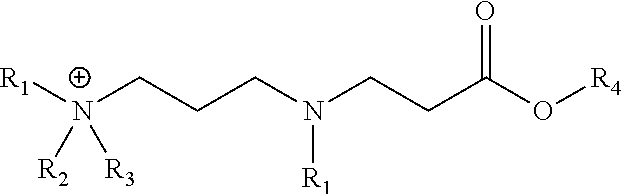
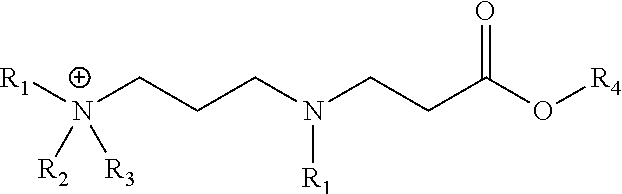
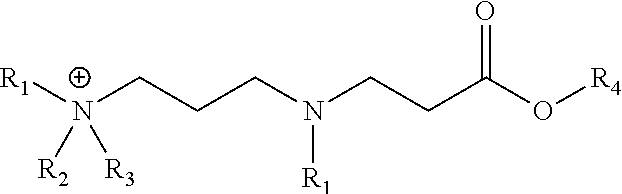
[0055]This example illustrates an embodiment of the composition of invention. A representative synthetic procedure for 2-ethylhexyl 3-(3-(dimethylamino)propylamino) propanoate is described.
[0056]
[0057]To a 500-mL, 3-neck round bottom flask was added 50.0 g (0.49 . mol) 3-(dimethylamino)-1-propylamine and a magnetic stirbar. The flask was fitted with a thermocouple, reflux condenser, and addition funnel containing 90.2 g (0.49 mol) 2-ethylhexylacrylate. The acrylate was added to the stirring amine in three equal volume shots. Once the addition was complete, the reaction mixture was heated to 100° C. for 5 hours. The final product was a light yellow liquid at ambient temperature. Complete conversion is apparent by the disappearance of the diamine starting material by TLC (1 / 5CHCl3 / MeOH with 0.5% v / v NH4OH).
example 2
[0058]This example illustrates an embodiment of the composition of invention. A representative synthetic procedure for N-(3-(butyl(3-(2-ethylhexyloxy)-3-oxopropyl)amino)propyl)-N,N-dimethylbutan-1-aminium chloride is described.
[0059]
[0060]To a 220 mL volume capacity sealed tube was added 25.0 g (87.3 mmol) 2-ethylhexyl 3-(3-(dimethylamino)propylamino)propanoate, 16.2 g (174.6 mmol) 1-chlorobutane, 8.27 g 2-propanol, and a magnetic stir bar. The tube was sealed tightly and heated in a silicone oil bath for 21 hours at 130° C. Complete conversion was apparent by the disappearance of the diamine starting material by TLC (1 / 5CHCl3 / MeOH with 0.5% v / v NH4OH).
example 3
[0061]This example illustrates an embodiment of the composition of invention. A representative synthetic procedure for 2-ethylhexyl 3-(3-(dibutylamino)propylamino)propanoate is described.
[0062]
[0063]To a 500-mL, 3-neck round bottom flask was added 50.0 g (0.27 . mol) 3-(dibutylamino)-1-propylamine and a magnetic stirbar. The flask was fitted with a thermocouple, reflux condenser, and addition funnel containing 49.4 g (0.27 mol) 2-ethylhexylacrylate. The acrylate was added to the stirring amine in three equal volume shots. Once the addition was complete, the reaction mixture was heated to 100° C. for 5 hours. The final product was a light yellow liquid at ambient temperature. Complete conversion is apparent by the disappearance of the diamine starting material by TLC (1 / 5CHCl3 / MeOH with 0.5% v / v NH4OH).
Example 4
[0064]This example illustrates an embodiment of the composition of invention. A representative synthetic procedure for N-butyl-N-(3-(3-(2-ethylhexyloxy)-3-oxopropylamino)propy...
PUM
| Property | Measurement | Unit |
|---|---|---|
| thickness | aaaaa | aaaaa |
| inner diameter | aaaaa | aaaaa |
| inner diameter | aaaaa | aaaaa |
Abstract
Description
Claims
Application Information
 Login to View More