Developing a collective operation for execution in a parallel computer

a technology of parallel computer and collective operation, applied in the field of data processing, can solve the problems of difficult to construct a computer with a single fast processor and a large number of slow processors with the same throughput, and certain theoretical limits to the potential speed of serial processors

Inactive Publication Date: 2015-01-20
INT BUSINESS MASCH CORP
View PDF10 Cites 0 Cited by
  • Summary
  • Abstract
  • Description
  • Claims
  • Application Information

AI Technical Summary

Benefits of technology

The solution enables the development of collective operations that efficiently utilize hardware components, resulting in faster execution, lower power consumption, and reduced resource intensity, thereby improving overall performance and efficiency in parallel computing.

Problems solved by technology

Since that time, computer systems have evolved into extremely complicated devices.
It is far more difficult to construct a computer with a single fast processor than one with many slow processors with the same throughput.
There are also certain theoretical limits to the potential speed of serial processors.
After that point adding more processors does not yield any more throughput but only increases the overhead and cost.
Shared memory processing needs additional locking for the data and imposes the overhead of additional processor and bus cycles and also serializes some portion of the algorithm.
Message passing processing uses high-speed data communications networks and message buffers, but this communication adds transfer overhead on the data communications networks as well as additional memory need for message buffers and latency in the data communications among nodes.
Although a tree network typically is inefficient in point to point communication, a tree network does provide high bandwidth and low latency for certain collective operations, message passing operations where all compute nodes participate simultaneously, such as, for example, an allgather operation.

Method used

the structure of the environmentally friendly knitted fabric provided by the present invention; figure 2 Flow chart of the yarn wrapping machine for environmentally friendly knitted fabrics and storage devices; image 3 Is the parameter map of the yarn covering machine
View more

Image

Smart Image Click on the blue labels to locate them in the text.
Viewing Examples
Smart Image
  • Developing a collective operation for execution in a parallel computer
  • Developing a collective operation for execution in a parallel computer
  • Developing a collective operation for execution in a parallel computer

Examples

Experimental program
Comparison scheme
Effect test

Embodiment Construction

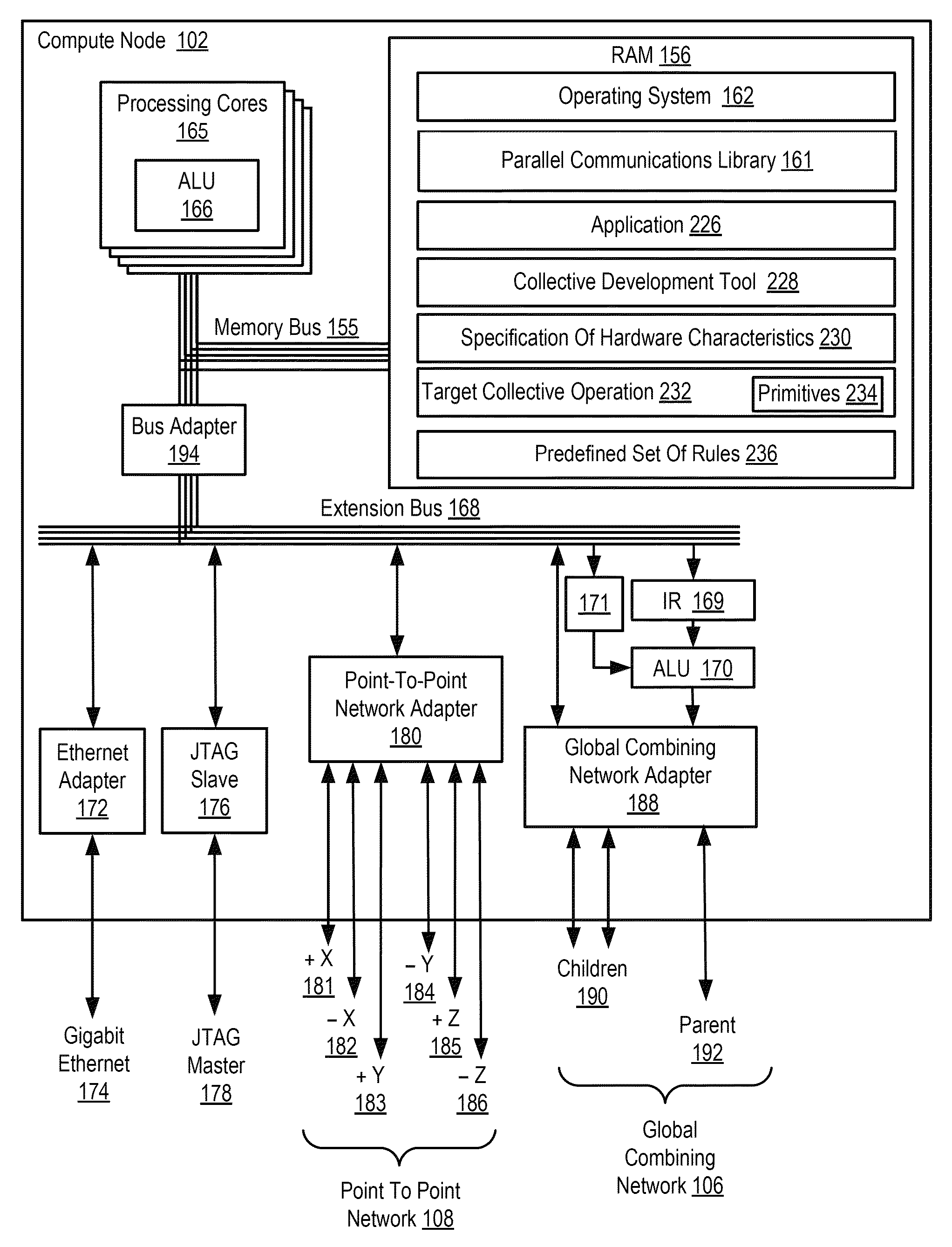
[0023]Exemplary methods, apparatus, and products for developing a collective operation for execution in a parallel computer in accordance with the present invention are described with reference to the accompanying drawings, beginning with FIG. 1. FIG. 1 illustrates an exemplary system for which a collective operation may be developed according to embodiments of the present invention. The system of FIG. 1 includes a parallel computer (100), non-volatile memory for the computer in the form of a data storage device (118), an output device for the computer in the form of a printer (120), and an input / output device for the computer in the form of a computer terminal (122).

[0024]The parallel computer (100) in the example of FIG. 1 includes a plurality of compute nodes (102). The compute nodes (102) are coupled for data communications by several independent data communications networks including a high speed Ethernet network (174), a Joint Test Action Group (‘JTAG’) network (104), a global...

the structure of the environmentally friendly knitted fabric provided by the present invention; figure 2 Flow chart of the yarn wrapping machine for environmentally friendly knitted fabrics and storage devices; image 3 Is the parameter map of the yarn covering machine
Login to View More

PUM

No PUM Login to View More

Abstract

Developing a collective operation for execution in a parallel computer that includes compute nodes coupled for data communications, including: receiving, by a collective development tool, a specification of a target collective operation to develop; receiving, by the collective development tool, a specification of computer hardware characteristics of the parallel computer within which the target collective operation will be executed; selecting, by the collective development tool automatically without user interaction, iteratively for each stage of the target collective operation, a collective primitive in dependence upon the specification of computer hardware characteristics and a predefined set of rules specifying selection criteria of collective primitives based on computer hardware characteristics; and generating, by the collective development tool, the target collective operation in dependence upon the selected collective primitives.

Description

BACKGROUND OF THE INVENTION[0001]1. Field of the Invention[0002]The field of the invention is data processing, or, more specifically, methods, apparatus, and products for developing a collective operation for execution in a parallel computer.[0003]2. Description of Related Art[0004]The development of the EDVAC computer system of 1948 is often cited as the beginning of the computer era. Since that time, computer systems have evolved into extremely complicated devices. Today's computers are much more sophisticated than early systems such as the EDVAC. Computer systems typically include a combination of hardware and software components, application programs, operating systems, processors, buses, memory, input / output devices, and so on. As advances in semiconductor processing and computer architecture push the performance of the computer higher and higher, more sophisticated computer software has evolved to take advantage of the higher performance of the hardware, resulting in computer ...

Claims

the structure of the environmentally friendly knitted fabric provided by the present invention; figure 2 Flow chart of the yarn wrapping machine for environmentally friendly knitted fabrics and storage devices; image 3 Is the parameter map of the yarn covering machine
Login to View More

Application Information

Patent Timeline
no application Login to View More
Patent Type & AuthorityPatents(United States)
IPC IPC(8): G06F9/44
CPCG06F8/45G06F9/44
InventorARCHER, CHARLES J.CAREY, JAMES E.SANDERS, PHILIP J.SMITH, BRIAN E.
OwnerINT BUSINESS MASCH CORP