
Programmable logic device
a logic device and programmable logic technology, applied in the direction of instruments, computation using denominational number representation, pulse technique, etc., can solve the problems of increasing power consumption, affecting the stability of the system, so as to facilitate dynamic reconfiguration and short startup time
- Summary
- Abstract
- Description
- Claims
- Application Information
AI Technical Summary
Benefits of technology
Problems solved by technology
Method used
Image

Examples
embodiment 1
[Embodiment 1]
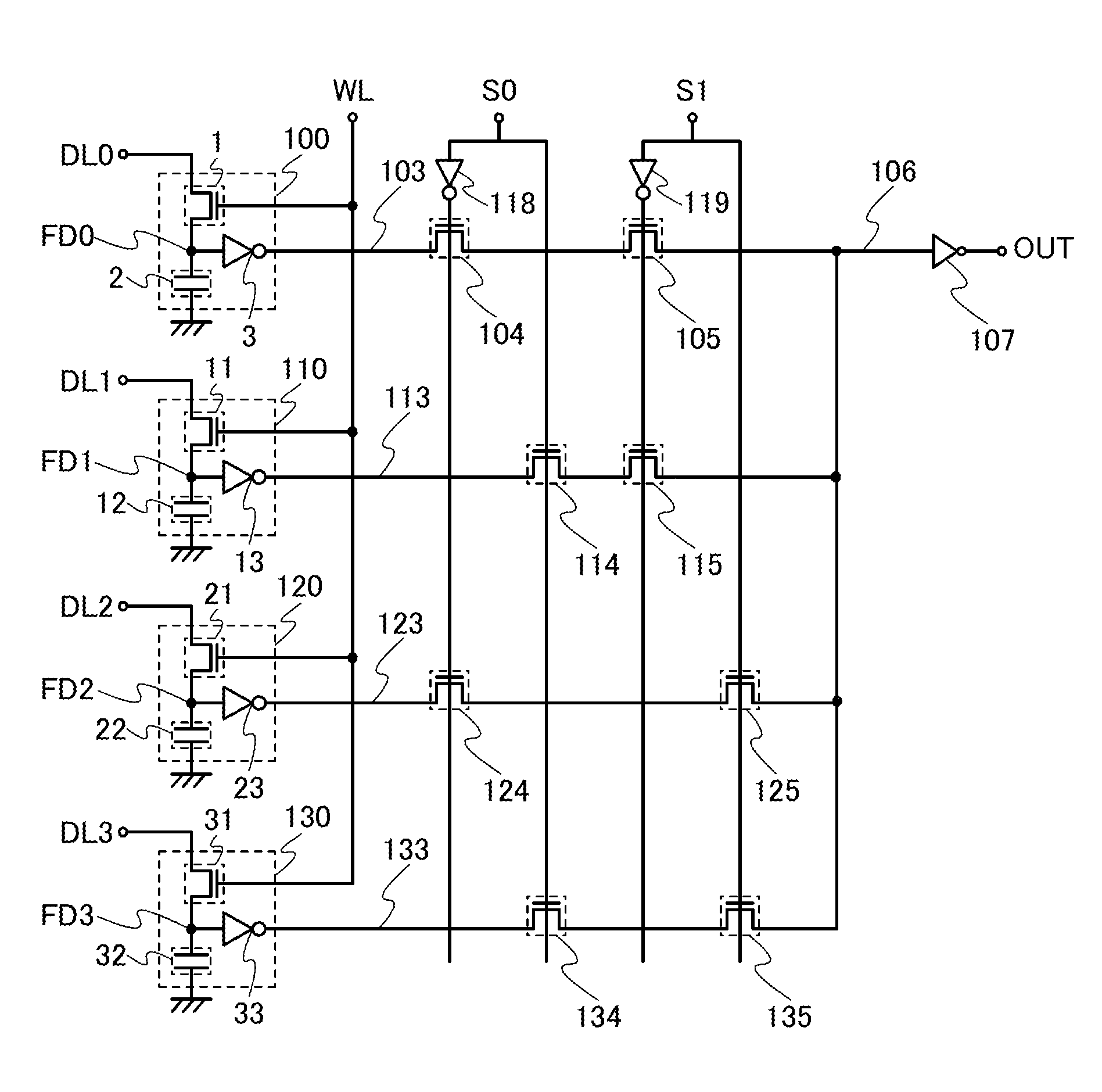
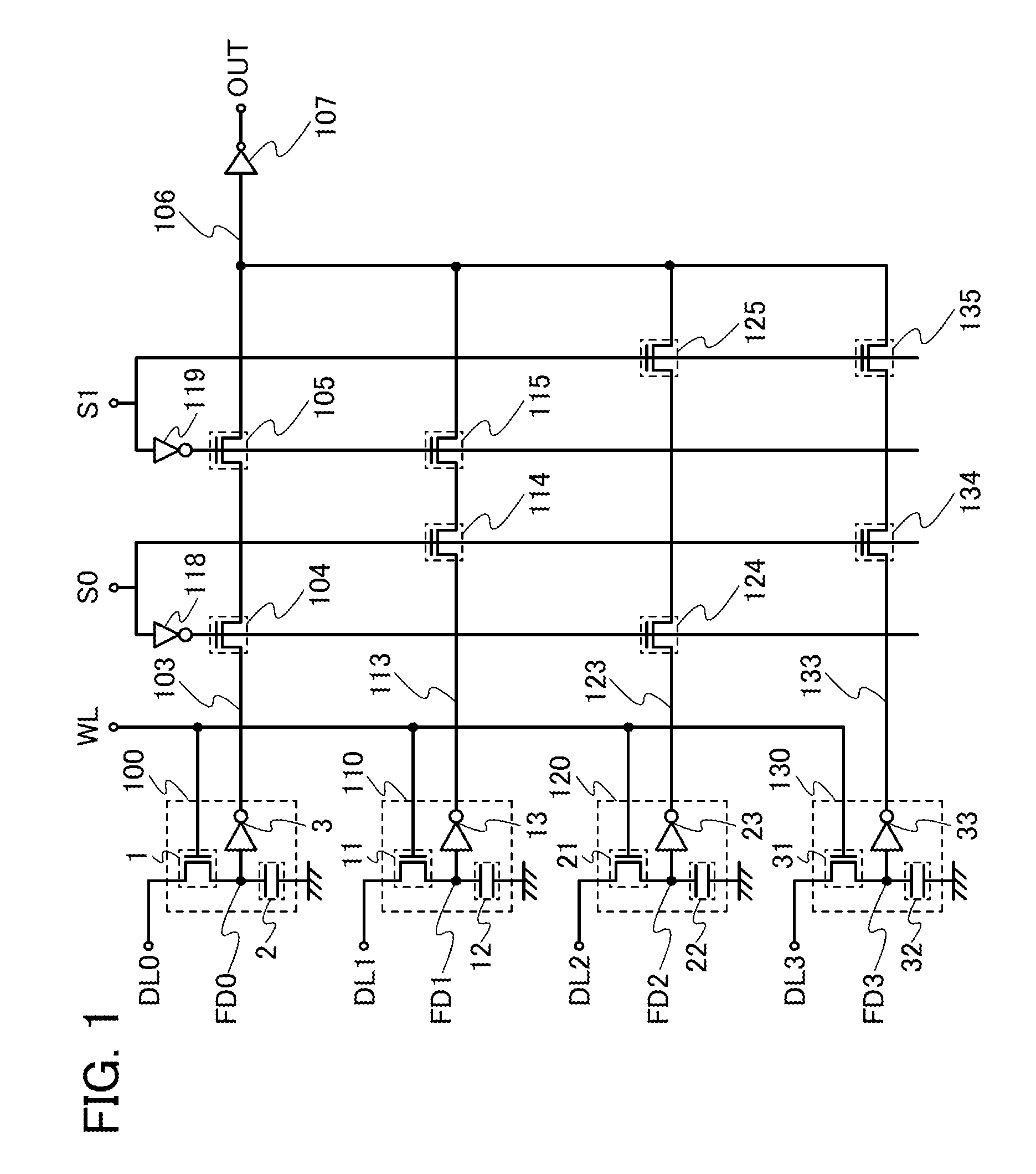
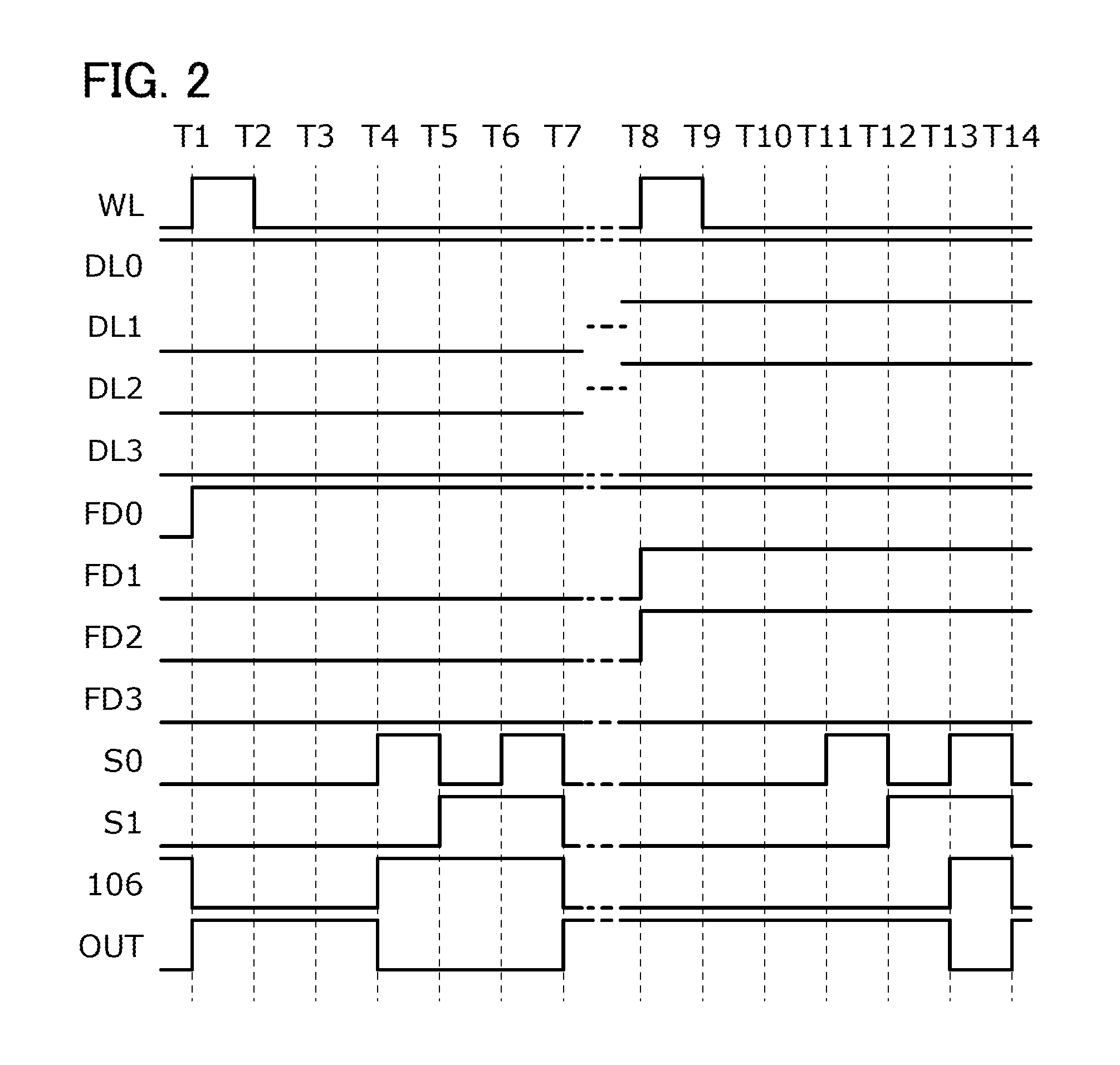
[0054]In this embodiment, a PLD according to one embodiment of the present invention will be described with reference to FIG. 1 and FIG. 2.
(Structure)
[0055]FIG. 1 illustrates the structure of a multiplexer in an LE of a PLD. The multiplexer includes memory elements 100, 110, 120, and 130, transistors 104, 105, 114, 115, 124, 125, 134, and 135, and inverters 107, 118, and 119. The transistors 104, 105, 114, 115, 124, 125, 134, and 135 function as switches. These transistors, input terminals, and the inverters 118 and 119 form selectors. In FIG. 1, a 1-bit selector including the input terminal to which a signal S0 is input, the inverter 118, and the transistors 104, 114, 124, and 134, and a 1-bit selector including the input terminal to which a signal 51 is input, the inverter 119, and the transistors 105, 115, 125, and 135 are provided.
[0056]In FIG. 1, each of the memory elements 100, 110, 120, and 130 includes one transistor, one inverter, and one storage capacitor. Th...
embodiment 2
[Embodiment 2]
[0081]Next, a PLD including a memory element having a structure different from that in Embodiment 1 according to one embodiment of the present invention will be described with reference to FIG. 3 and FIG. 4.
(Structure)
[0082]FIG. 3 illustrates the structure of a multiplexer in an LE of a PLD, which is different from the structure in FIG. 1. The multiplexer includes memory elements 200, 201, 210, 211, 220 (not shown), 221 (not shown), 230, and 231, transistors 204, 205, 214, 215, 224 (not shown), 225 (not shown), 234, and 235, and inverters 207, 218, and 219. The transistors 204, 205, 214, 215, 224, 225, 234, and 235 function as switches. These transistors, input terminals, and the inverters 218 and 219 form selectors. In FIG. 3, a 1-bit selector including the input terminal to which a signal S0 is input, the inverter 218, and the transistors 204, 214, 224, and 234, and a 1-bit selector including the input terminal to which a signal S1is input, the inverter 219, and the ...
embodiment 3
[Embodiment 3]
[0118]Next, a PLD including a memory element having a structure different from those in Embodiments 1 and 2 according to one embodiment of the present invention will be described with reference to FIG. 5 and FIG. 6. That is, this embodiment is different from Embodiments 1 and 2 in that a dynamic memory element including a capacitor and a reading control line is used instead of a static memory element including an inverter (CMOS circuit).
(Structure)
[0119]FIG. 5 illustrates the structure of a multiplexer in an LE of a PLD. The multiplexer includes memory elements 340, 350, 360, and 370, transistors 304, 305, 314, 315, 324, 325, 334, and 335, a latch circuit 306, a transistor 307, inverters 308, 318, and 319, and a transistor 309. The transistors 304, 305, 314, 315, 324, 325, 334, and 335 function as switches. These transistors, input terminals, and the inverters 318 and 319 form selectors. In FIG. 5, a 1-bit selector including the input terminal to which a signal S0 is i...
PUM
 Login to View More
 Abstract
Description
Claims
Application Information
 Login to View More