
Reconfigurable storage device
a storage device and reconfigurable technology, applied in the direction of memory adressing/allocation/relocation, instruments, input/output to record carriers, etc., can solve the problems of increasing engineering costs, inability to match the assumption of one storage device with the assumption of another device, and inability to sustain traditional customization approaches
- Summary
- Abstract
- Description
- Claims
- Application Information
AI Technical Summary
Benefits of technology
Problems solved by technology
Method used
Image

Examples
example 1
[0050)
[0051]
vol1logical100GBthickbyteread | write 4KB10ms1h99.9%notification50:504KB1K1h99.9%notification
[0052]In the above example, the user may be interested in 100 GB device which is byte-addressable. In addition, the 4 KB page read latency must be smaller than 10 ms and the 4 KB write latency must be smaller than 10 ms as well. Finally, the IOPS of device must be at least 1K.
example 2
[0053)
[0054]
vol2logical200GBsecure_erase write 4KB50ms
example 3
[0055)
[0056]
vol1read1ms5%
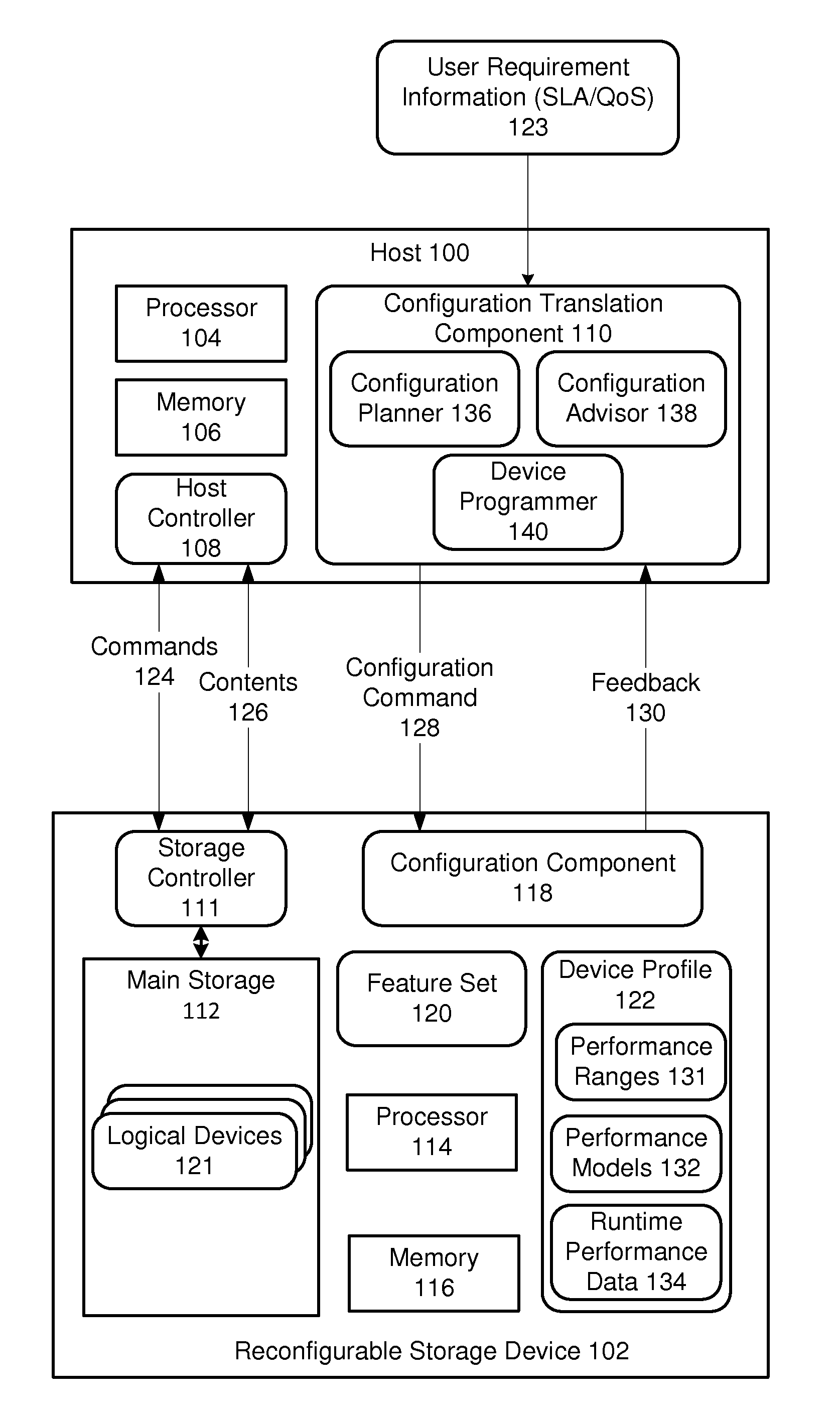
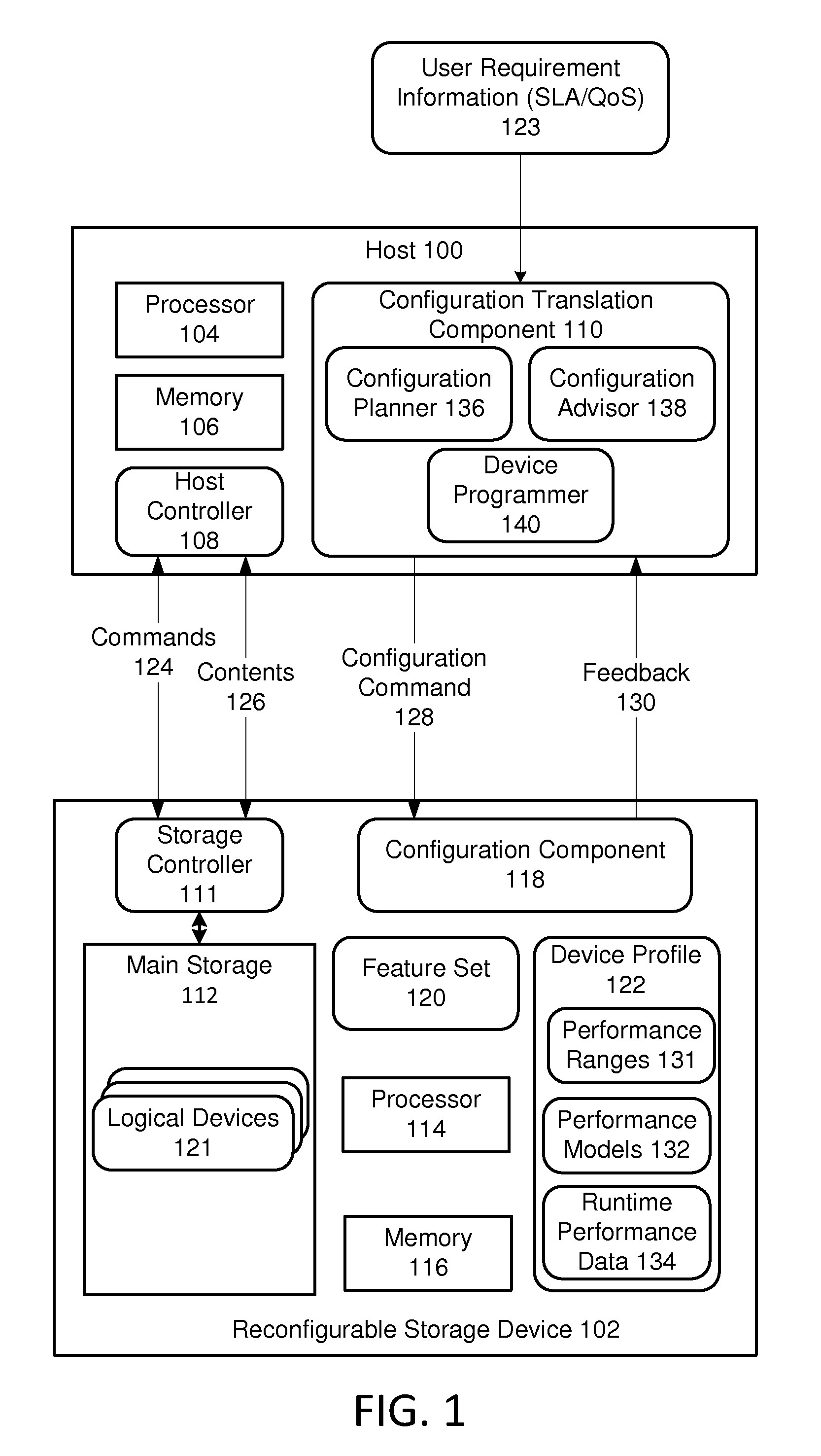
[0057]The reconfigurable storage device 102 may further include a plurality of operational features, referred to here as a feature set 120. In one embodiment, the feature set 120 may include hardware operation (e.g., clock frequency, over-provisioning ratio), command scheduling policy (e.g., read over write, random access over sequential access, small request over big request, scheduling algorithm, read over GC), logical device characteristics (e.g., capacity, queue length, timeout control, protection), mapping policy of logical address onto physical address (e.g., page mapping, block mapping, hybrid mapping), background job execution policy (e.g., garbage collection algorithm, period and frequency of garbage collection, background TRIM, background compaction), and so on, which are not exhaustive.
[0058]Once the configuration translation component 110 receives the user requirement information 123, the configuration translation component 110 may automatically ...
PUM
 Login to View More
 Abstract
Description
Claims
Application Information
 Login to View More