

Method and controller for managing memory device
a memory device and controller technology, applied in the field of controlling flash memory, can solve the problems of complicated operation of some types of mlc flash memory, increased related cost, and important control of flash memory in portable memory devices, so as to save time and human resources, save initialization time of memory devices, and improve efficiency
- Summary
- Abstract
- Description
- Claims
- Application Information
AI Technical Summary
Benefits of technology
Problems solved by technology
Method used
Image



Examples
Embodiment Construction
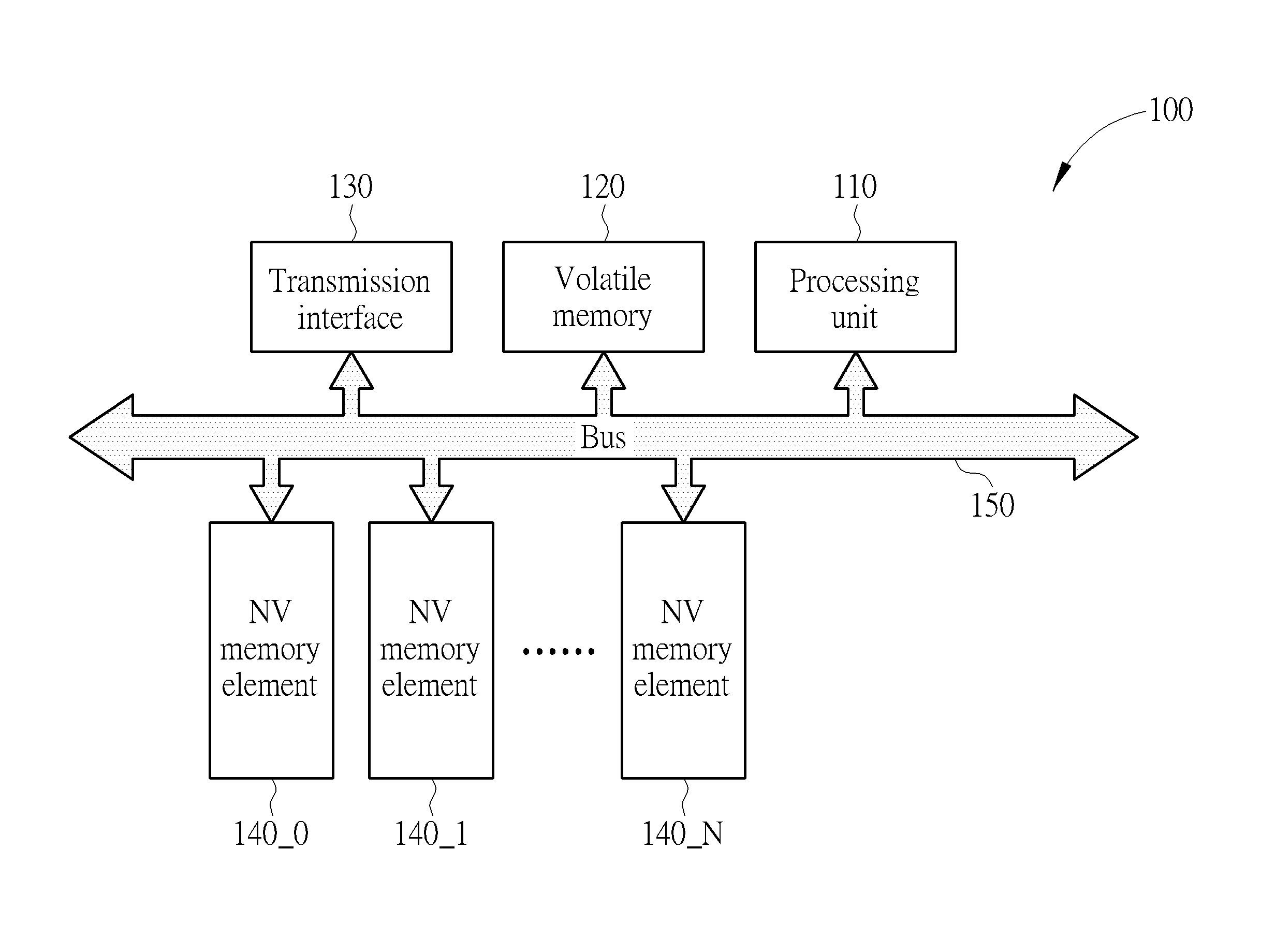
[0019]FIG. 1 is a diagram illustrating a memory device 100 according to a first embodiment of the present invention. The memory device 100 comprises: a processing unit 110, a volatile memory 120, a transmission interface 130, a plurality of non-volatile (NV) memory elements 140_0, 140_1, . . . , 140_N (wherein N is a positive integer), such as (N+1) flash chips, and a bus 150. Typically, after the transmission interface 130 is coupled to a host (not shown in FIG. 1), the host may utilize the transmission interface 130 to access the memory device 100. The host may represent a personal computer (PC), such as a laptop computer or a desktop computer.
[0020]The processing unit 110 may refer to a program code (not shown in the figure) embedded in the processing unit 110 or received from outside the processing unit 110, to manage the memory device 100. The program code may be a hardware code embedded in the processing unit 110, and more particularly, a read-only memory code (ROM code). In a...
PUM
 Login to View More
 Abstract
Description
Claims
Application Information
 Login to View More