
Architectural ceramic prepared from industrial solid waste through dry method and process for preparing architectural ceramic
A technology for building ceramics and solid waste residues, which is applied in the production, application, and clay products of ceramic materials, etc., can solve the problems of poor product function, low efficiency, and difficult control of the production process, so as to reduce the cost of slurry degumming and reduce Firing shrinkage, the effect of ensuring performance
Patent Information
- Authority / Receiving Office
- CN · China
- Patent Type
- Patents(China)
- Current Assignee / Owner
- Publication Date
- 2015-03-04
Smart Images
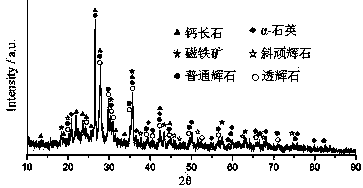
Figure 1 
Figure 2 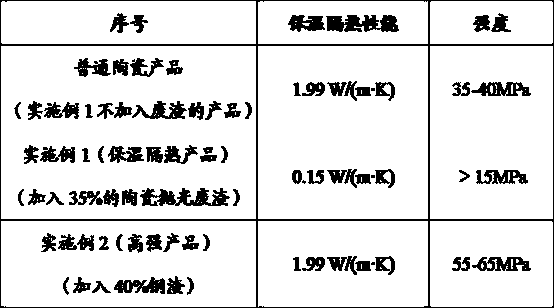
Figure 3
Abstract
Description
technical field
[0001] The invention belongs to the field of preparation of architectural ceramic products, and in particular relates to a formula and method for preparing functional architectural ceramics by using industrial solid waste dry method. Background technique
[0002] At present, the effective and reasonable utilization of solid waste has always been a problem that our government and related industries attach great importance to. With the acceleration of industrialization and urbanization, the consumption of resources in my country's industrial field will further increase, and the environmental problems caused by resource exploitation and utilization and the problem of resource supply security caused by excessive reliance on resource imports will become increasingly prominent. It will face more severe resource and environmental constraints. my country's urbanization requires more than 16 billion tons of non-metallic mineral resources every year. Making full use of...
Examples
Embodiment 1
[0051] In terms of mass percentage, 35% of ceramic polishing waste is pretreated, dried and passed through a 100-mesh sieve. Mix 63% ceramic raw materials and 3% hydroxymethyl cellulose together, and wet ball mill until the slurry particle size is 250 mesh sieve and 0.8~1.2%; the composition of ceramic raw materials is 20% kaolin, 10% Yili Stone, 5% bentonite, 5% talc, 60% potassium albite feldspar. The ball-milled slurry is sieved to remove iron; the slurry is spray-dried. The spray-dried powder and ceramic polishing waste enter the mixer for dry mixing, and pass through a 20-mesh sieve after mixing. The sieved powder is conveyed to the press for molding, the pressed bricks enter the drying kiln for drying, and the dried bricks enter the roller kiln for firing at 1200 °C. The bulk density of the fired product is less than 900kg / m 3 , the compressive strength is greater than 15MPa, it has the function of light heat preservation and heat insulation, the thermal conductivity ...
Embodiment 2
[0053] In terms of mass percentage, 40% steel slag is pretreated and passed through a 100-mesh sieve after drying. Mix 59% ceramic raw materials and 1% sodium silicate together, and wet ball mill until the slurry particle size is 250 mesh sieve and 0.8~1.2%; the composition of ceramic raw materials is 22% Bailaiyang soil, 14% red Laiyang soil, 13% high density soil, 16% Mengyin feldspar, 28% Laiwu feldspar and 7% talc. The ball-milled slurry is sieved to remove iron; the slurry is spray-dried. The spray-dried powder and ceramic polishing waste are sent to a powder mill for dry mixing, and then passed through a 20-mesh sieve after mixing. The sieved powder is conveyed to the press for molding, the pressed bricks enter the drying kiln for drying, and the dried bricks enter the roller kiln for firing at 1185 °C. The main crystal phase of the fired product is quartz, anorthite and diopside. The product has high strength and wear resistance, and the flexural strength can reach 55...
Embodiment 3
[0055] In terms of mass percentage, 20% of ceramic polishing waste slag, 20% of steel slag, and 10% of aluminum slag are pretreated, and passed through a 100-mesh sieve after drying. Mix 48% of ceramic raw materials and 2% gum arabic together, and wet ball mill until the slurry particle size is 0.8~1.2% of the 250 mesh sieve; wherein the ceramic raw materials are composed of 18% pyrophyllite, 20 % kaolin, 43% potassium feldspar, 4% nepheline, 10% Guangdong white clay, 5% talc. The ball-milled slurry is sieved to remove iron; the slurry is spray-dried. The spray-dried powder is dry-mixed with ceramic polishing waste slag and steel slag, and is pulverized and mixed by a pulverizer, and passed through a 20-mesh sieve after mixing. The sieved powder is conveyed to the press for molding, the pressed bricks enter the drying kiln for drying, and the dried bricks enter the roller kiln for firing at 1220 °C.