
Rapid protein analysis and detection device based on whole microfluidic chip closing system
A microfluidic chip and rapid analysis technology, applied to the analysis of materials, instruments, etc., can solve the problems of complex operation and poor accuracy, and achieve the effects of high sensitivity, high detection, and reduced instrument volume
Patent Information
- Authority / Receiving Office
- CN · China
- Current Assignee / Owner
- Publication Date
- 2015-03-18
Smart Images
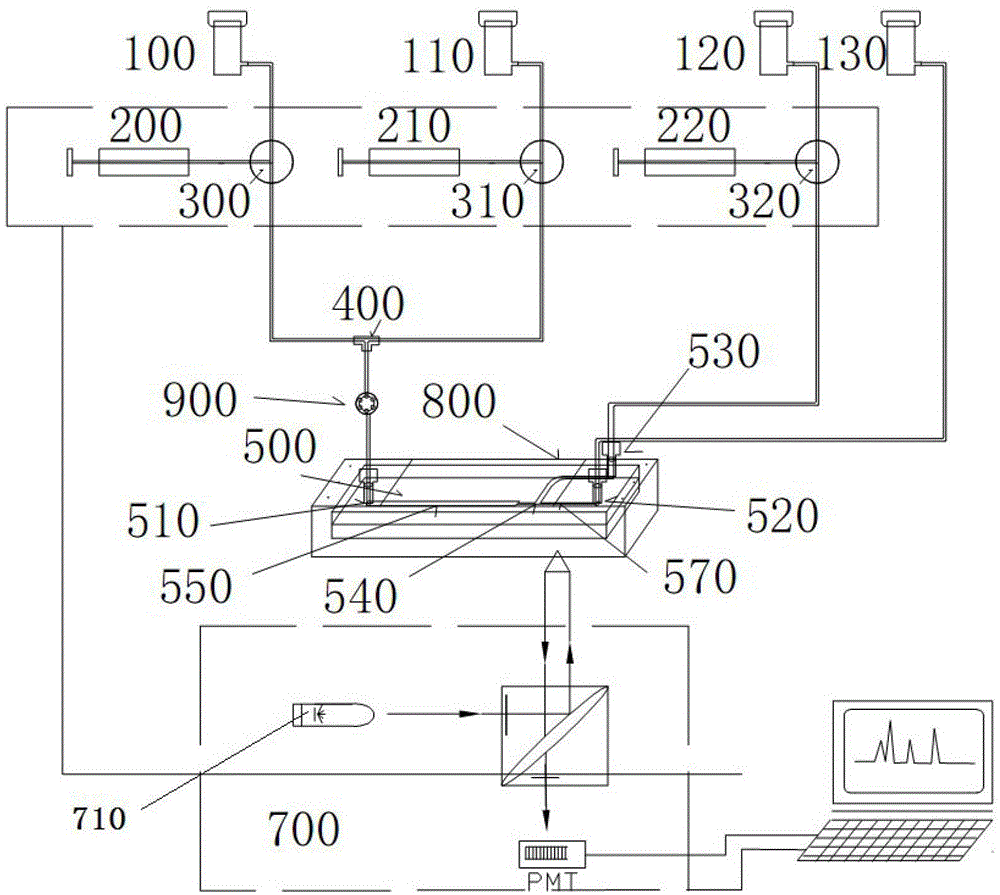
Figure 1 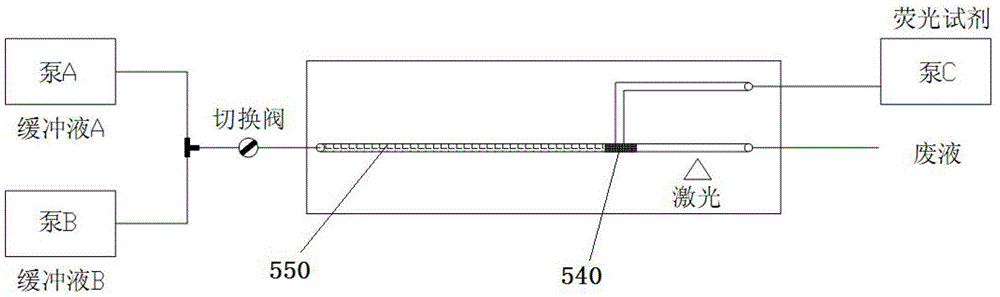
Figure 2 
Figure 3
Abstract
Description
technical field
[0001] The invention relates to a protein detection device, and in particular provides a rapid protein analysis and detection device based on a microfluidic chip. Background technique
[0002] Micro Total Analysis Systems (μ-TAS) is a new interdisciplinary field, the ultimate goal of which is to maximize the transfer of analytical laboratory functions to portable analytical instruments through the miniaturization and integration of chemical equipment. In the equipment (such as various types of chips), the "miniaturization" of the analysis equipment is realized. Its characteristic is that it can realize the sampling, dilution, addition of reagents, enrichment, extraction, mixing, reaction, separation, detection, etc. of the target analyte. Integration of steps.
[0003] There are trace amounts of protein in body fluid, which is one of the important indicators to reveal the health of the human body, and is very important for evaluating its health status. Curr...
Examples
Embodiment 1
[0026] Such as figure 1 Build a rapid protein analysis and detection device based on a microfluidic chip, which integrates a microfluidic control system, a sample injection system, a microfluidic chip system, a micro laser-induced fluorescence detection system and a data acquisition system. The size of the entire instrument is 30cm×15cm× 50cm.
[0027] Such as figure 2 As shown, a microfluidic chip for protein enrichment-elution-on-line fluorescent labeling-detection was constructed. The enrichment column is an albumin antibody column, the particles filled in the antibody column are Agilent fillers with albumin antibody immobilized, the fluorescent labeling reagent is 2% Nano Orange, and 0.5M NaHCO is used 3 As a derivatization buffer solution. Buffer A and buffer B are commercially available loading and elution solutions from Agilent. The excitation / emission wavelengths for laser-induced fluorescence detection are 473 / 570nm.
[0028] The specific operation process is as...
Embodiment 2
[0034] A rapid protein analysis and detection device based on a microfluidic chip was constructed for quantitative analysis of patient urine samples.
[0035] Take 0.01mg / mL, 0.03mg / mL, 0.05mg / mL, 0.07mg / mL, 0.1mg / mL as standard samples for analysis, calculate the detected peak area, and make a standard curve (such as Figure 4 shown), the concentration (x)-peak area (y) linear relationship is y=57.454x-0.5632, R 2 =0.9625.
[0036] Take the patient's urine sample and centrifuge at 3000g for 5min at 4°C, filter it with a 0.22um filter membrane, precipitate with an equal volume of acetone, and then centrifuge at 12000g for 5min at 4°C, remove the supernatant, and redissolve the precipitate in 1mL buffer A (Agilent), diluted 500 times, for analysis (eg Figure 5 shown). The peak area is 0.6518. According to the linear relationship of concentration (x)-peak area (y) y=57.454x-0.5632, the calculated concentration is 0.2115mg / mL, and the concentration of albumin in the urine sam...