
Compounds for the treatment of metabolic disorders
a metabolic disorder and compound technology, applied in the field of compound for the treatment of metabolic disorders, can solve the problems of diabetes mellitus, major morbidity and mortality, debilitating complications, etc., and achieve the effect of reducing the risk of cardiovascular diseas
Patent Information
- Authority / Receiving Office
- US · United States
- Current Assignee / Owner
- Publication Date
- 2006-11-02
- Estimated Expiration
- Not applicable · inactive patent
Smart Images
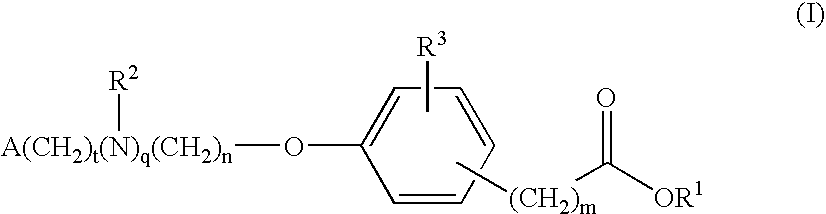
Figure 1 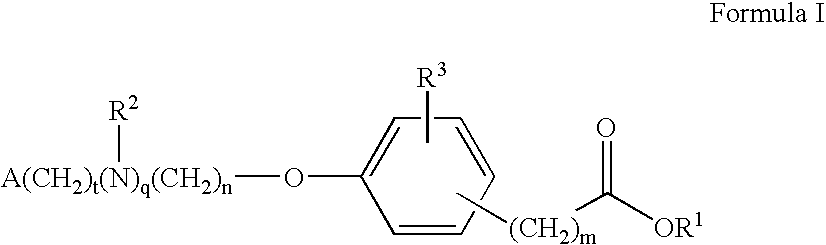
Figure 2 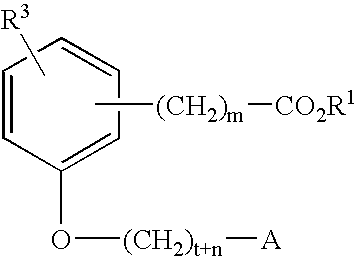
Figure 3
Abstract
Description
BACKGROUND OF THE INVENTION
[0001] Diabetes mellitus is a major cause of morbidity and mortality. Chronically elevated blood glucose leads to debilitating complications: nephropathy, often necessitating dialysis or renal transplant; peripheral neuropathy; retinopathy leading to blindness; ulceration of the legs and feet, leading to amputation; fatty liver disease, sometimes progressing to cirrhosis; and vulnerability to coronary artery disease and myocardial infarction.
[0002] There are two primary types of diabetes. Type I, or insulin-dependent diabetes mellitus (IDDM) is due to autoimmune destruction of insulin-producing beta cells in the pancreatic islets. The onset of this disease is usually in childhood or adolescence. Treatment consists primarily of multiple daily injections of insulin, combined with frequent testing of blood glucose levels to guide adjustment of insulin doses, because excess insulin can cause hypoglycemia and consequent impairment of brain and other functions...
Examples
synthesis examples
CHEMICAL SYNTHESIS EXAMPLES
Example 1
[0233]
3-(2,6-Dimethylbenzyloxy)phenylacetic acid
Step A: Preparation of Ethyl 3-hydroxyphenylacetate
[0234] To a stirred solution of 3-Hydroxyphenylacetic acid (10 g, 65.7 mmol) and 1,3-dicyclohexylcarbodiimide (DCC, 16.27 g, 78.8 mmol) in DMF (30 ml) was added pyridine (2.5 ml) followed by absolute ethanol (15 ml, 255.5 mmol). The reaction mixture was stirred at room temperature for 16 hours, filtered, concentrated and purified by flash chromatography on a silica gel column (hex: ethyl acetate 2:1) to give the title compound.
[0235]1H NMR (270 MHz, CDCl3): 1.2 (t, 3H); 3.5 (s, 2H); 4.1 (q, 2H); 6.6-7.2 (m, 4H).
Step B: Preparation of Ethyl 3-(2,6-dimethylbenzyloxy)phenylacetate
[0236] A solution of 2,6-Dimethylbenzyl alcohol (5.25 g, 38.6 mmol) and diisopropyl azodicarboxylate (DIAD, 8.49 g, 42 mmol) in THF (30 ml) and DMF (13 ml) was added drop wise to a solution of Ethyl 3-hydroxyphenylacetate (Step A, 6.66 g, 37 mmol) and triphenylphosphine (1...
example 2
[0240]
3-(2,6-Dimethylbenzyloxy)benzoic acid
Step A: Preparation of Ethyl 3-(2,6-dimethylbenzyloxy)benzoate
[0241] To a stirred solution of Ethyl 3-hydroxybenzoate (12.21 g, 73.47 mmol) and triphenylphosphine (21.01 g, 80.13 mmol) in dry THF (100 ml) was added dropwise a solution of 2,6-Dimethylbenzyl alcohol (10 g, 73.5 mmol) and diisopropyl azodicarboxylate (16.19 g, 80.13 mmol) in dry THF (35 ml) and dry DMF (15 ml) at ambient temperature. After three hours of stirring at room temperature, the reaction mixture was diluted with diethyl ether and washed twice with water and brine. The combined organic layer was dried over Na2SO4, filtered, concentrated and purified by flash chromatography using ethyl acetate:hexane (1:3) as elutent.
[0242]1H NMR (270 MHz, CDCl3): 1.4 (t, 3H); 2.4 (s, 6H); 4.4 (q, 2H); 5.1 (s, 2H); 7.1 (m, 2H); 7.2 (m, 2H); 7.4 (t, 1H); 7.9 (m, 2H).
Step B: Preparation of 3-(2,6-Dimethylbenzyloxy)benzoic acid
[0243] 1N NaOH (86 ml) was added to a stirred solution of ...
example 3
3-(2,6-Dimethylbenzyloxy)benzoic acid
Step A: Mitsunobu Coupling—Ethyl 3-(2,6-dimethylbenzyloxy)benzoate
[0245]
TABLE 1hydroxyCpdesterTPPTHFbenzyl-OHDIADTHFproductMW166.17262.29136.19202.21284.35Mass15.025.812.319.9Vol4019.440Mol0.0900.0980.0900.098D1.027
Theoretical yield 25.7 g;
actual yield 19.85 g;
fractional yield 0.773.
Mass = g;
vol = mL
[0246] A solution of ethyl 3-hydroxybenzoate and triphenylphosphine in anhydrous THF was cooled in an ice bath to 5° C. under nitrogen. In a separate flask, a solution of 2,6-dimethylbenzyl alcohol and DIAD in anhydrous THF was prepared and transferred via cannula to first flask. The addition was very exothermic with a rise from 5° C. to 18° C. within the first 2 minutes of the addition (several mLs). The addition was completed over 22 min with a maximum temperature of 24° C. After 30 min of stirring, a precipitate formed and the ice bath was removed. Tlc (hexanes:ether 1:1, UV) after 2.5 h showed a trace of starting material remained.
[0247] A...