
Method of regenerating zeolite catalyst for aromatization of acetylene by plasma treatment
Patent Information
- Authority / Receiving Office
- US · United States
- Current Assignee / Owner
- Publication Date
- 2019-08-29
Smart Images
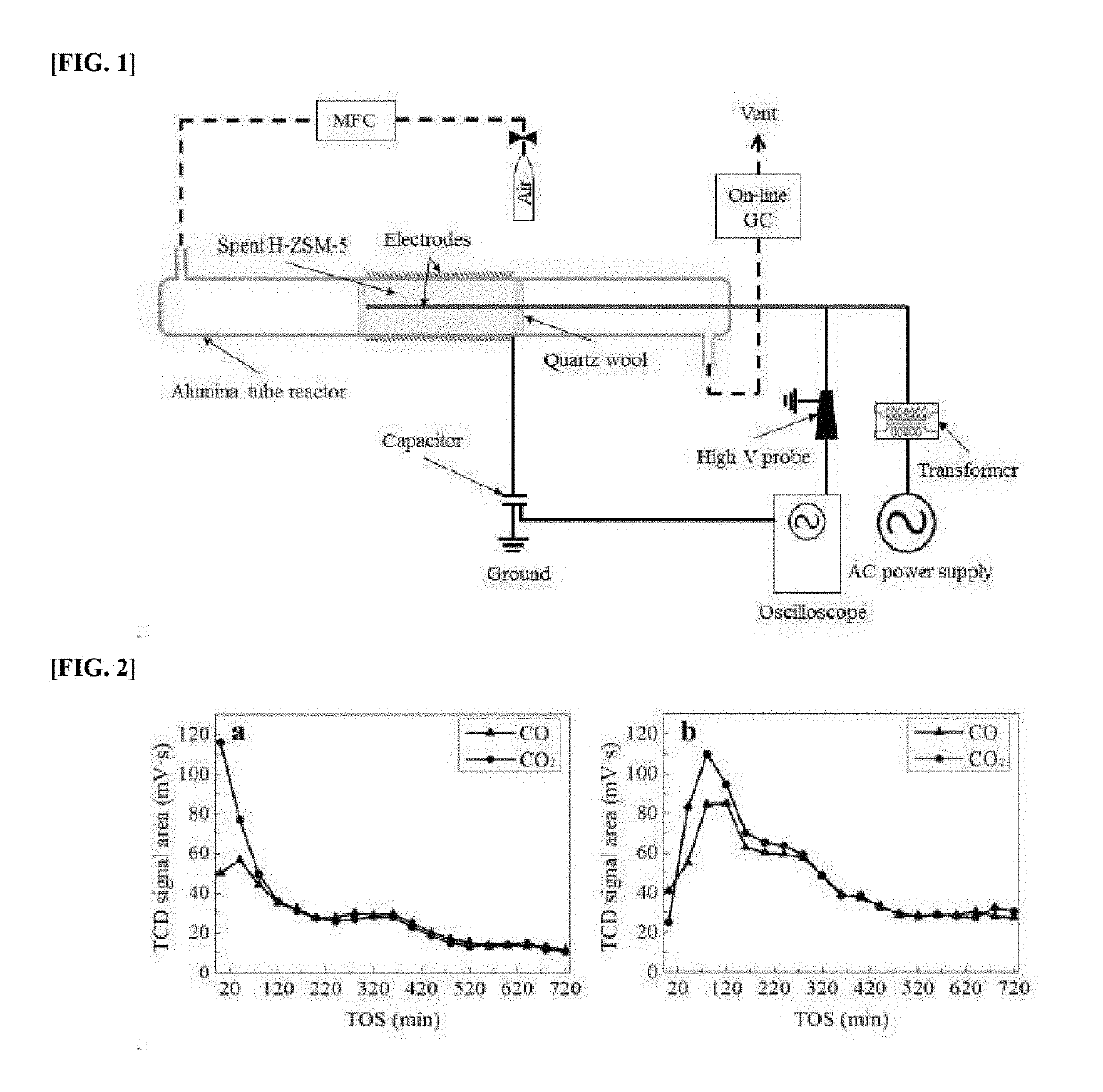
Figure 1 
Figure 2 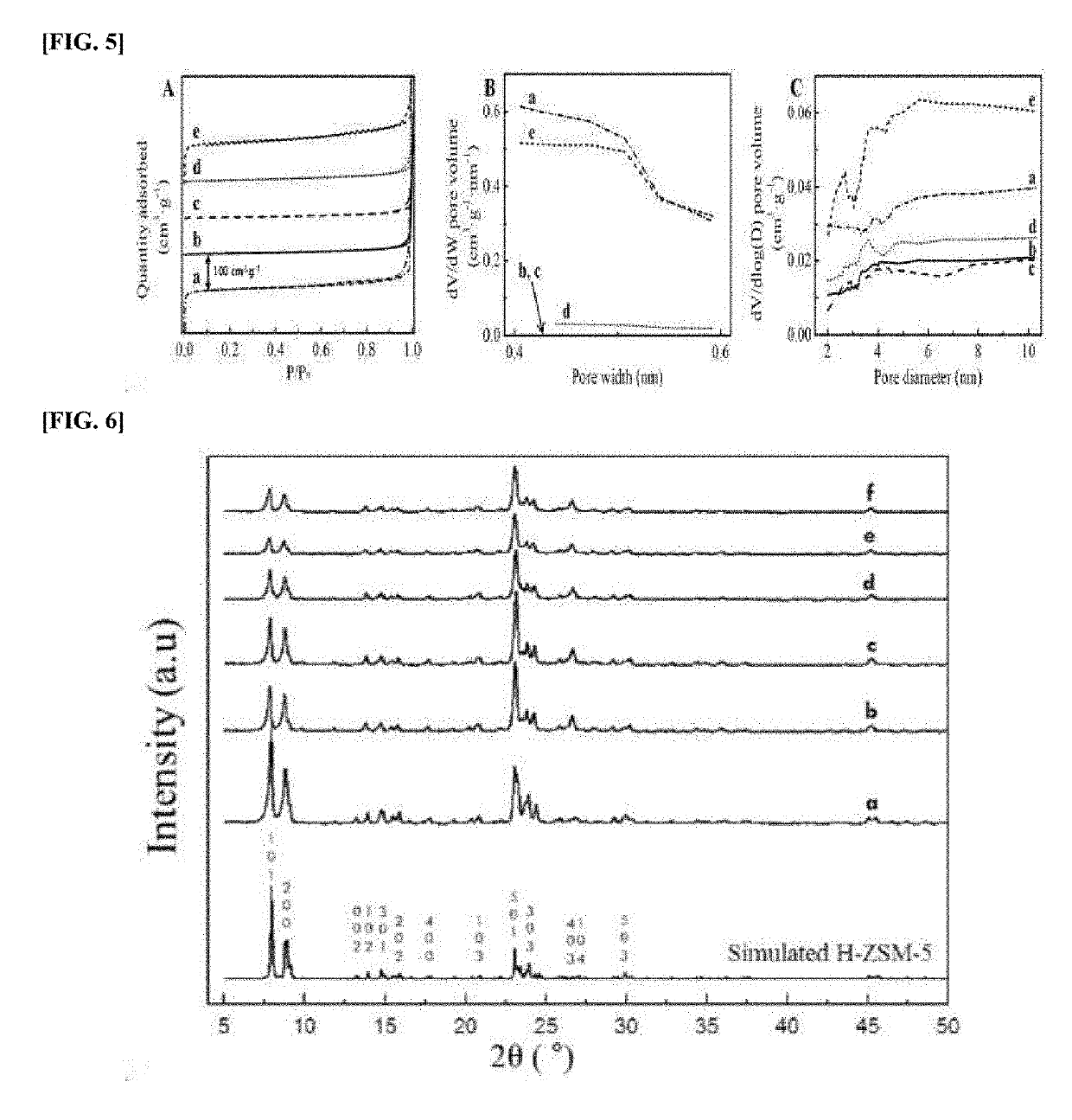
Figure 3
Abstract
Description
TECHNICAL FIELD
[0001] The present invention relates to a method of preparing an aromatic compound from acetylene, which includes synthesizing an aromatic compound from an acetylene-containing reactant gas in the presence of a zeolite catalyst for the aromatization of acetylene, and subjecting the zeolite catalyst deactivated by the coke formed in the aromatization of acetylene, to plasma treatment at ambient temperature and pressure so as to selectively remove the external cokes and partial internal coke, thereby regenerating the zeolite catalyst; a method of regenerating the zeolite catalyst used in the aromatization of acetylene by plasma treatment; and a regenerated zeolite catalyst for the aromatization of acetylene, prepared thereof.BACKGROUND ART
[0002] Conventionally, aromatic compounds have been prepared from petroleum-derived materials and even now are obtained as such. The aromatic chemical industry has been established using petroleum-derived materials as raw materials. Spec...
Examples
example 1
on and Characterization Analysis of the Catalyst for the Aromatization of Acetylene
[0065]Commercialized conventional zeolite H-ZSM-5 (Zeolyst international Inc., USA) with Si / Al ratio of 15 was purchased for the catalyst in the aromatization of acetylene. Transmission electron microscopy (TEM) images of fresh H-ZSM-5, spent H-ZSM-5, and regenerated H-ZSM-5 were taken on the JEM-2100F field emission transmission electron microscope (FE-TEM, USA) under working voltage of 200 kV. X-ray diffraction (XRD) analysis was performed in the θ / 2θ configuration using a Rigaku D / Max-2500V / PC diffractometer (Japan) with a Cu Kα radiation (40 kV, 200 mA, =0.154 nm) from 5° to 50°. Argon physisorption measurements were conducted at 87 K with an ASAP 2020 analyzer (Micromeritics, Inc., USA). Before the measurements, the samples were degassed at 623 K for 12 hours under vacuum condition. Fourier transform infrared spectroscopy (FT-IR) analysis were performed by using Nicolet iS50 (Thermo Fisher Scient...
example 2
tion Reactor and Activity Test
[0067]The aromatization of acetylene was performed in a lab-made 2-channel micro fixed-bed reactor system. Each channel was constructed with 540 mm length and 10 mm inner diameter quartz tube. A spacer for loading catalysts was placed in the middle of quartz tube. The zeolite catalysts were loaded in the middle of the reactor and the zeolite catalysts were diluted (20 wt %) with ball-type alumina (α-Al2O3, ø=1 mm). The aromatization was performed at 650° C. and atmospheric pressure. The composition of feed was C2H2:H2:N2=1:2:7 with gas hourly space velocity (GHSV) of 20,000 mL·gcat−1·h−1.
[0068]On-line Gas Chromatography (6500GC Young Lin Instrument Co., Korea) was used to analyze the products from the reaction. The on-line GC employs Porapak-Q columns and a Molecular Sieve 5A connected with a thermal conductivity detector (TCD), and a Gas-pro column connected with a flame ionization detector (FID). H2, N2, and CH4 in the products were detected by using ...
example 3
a Bed for Regeneration
[0069]A DBD plasma regeneration was performed at atmospheric pressure with aeration and near room temperature. The schematic diagram for this device was illustrated in FIG. 1. GHSV was 1500 mL·mL·gcat−1·h−1 with feed of air and time for the regeneration was 720 min. FIG. 1 shows the lab-made DBD plasma system. An alumina tube of 6 mm internal diameter and 2 mm thickness was used as a dielectric barrier for the plasma bed. A 3 mm diameter stainless steel rod was used as a high voltage electrode, and a steel wire was used as a ground electrode. The 150 mm length discharge zone was covered with the ground electrode. The discharge gap between inner surface of the alumina tube and the high voltage electrode was 1.5 mm, and the spent H-ZSM-5 catalyst was densely packed in this region for the regeneration. A sinusoidal AC power supply (0 V to 220 V, 60 Hz to 1,000 Hz) was connected to a transformer (0-20 kV, 1,000 Hz), and this electrical system continuously applied h...